
Reviewed · DELFT TOURS
Delft – Step/scootertour in and around the city
Delft has more to offer than its postcard center, and this non-electric scooter tour makes that clear quickly. Starting near Oude Delft 113, you ride beyond the usual canals and blue-and-white ceramics to modern building projects, Mill de Roos, Agnetapark, and a quiet courtyard founded in 1707.
I like the route’s mix of city stories and lesser-seen neighborhoods, and I like the small group size, capped at 10 people. Guides Frans and Kevin are named in the tour feedback, and the route leaves room for questions and some guide-led improvisation. The main catch is simple: these are pedal-powered steps, not electric scooters, so you need to ride a bike and be ready for some physical effort.
Key points at a glance
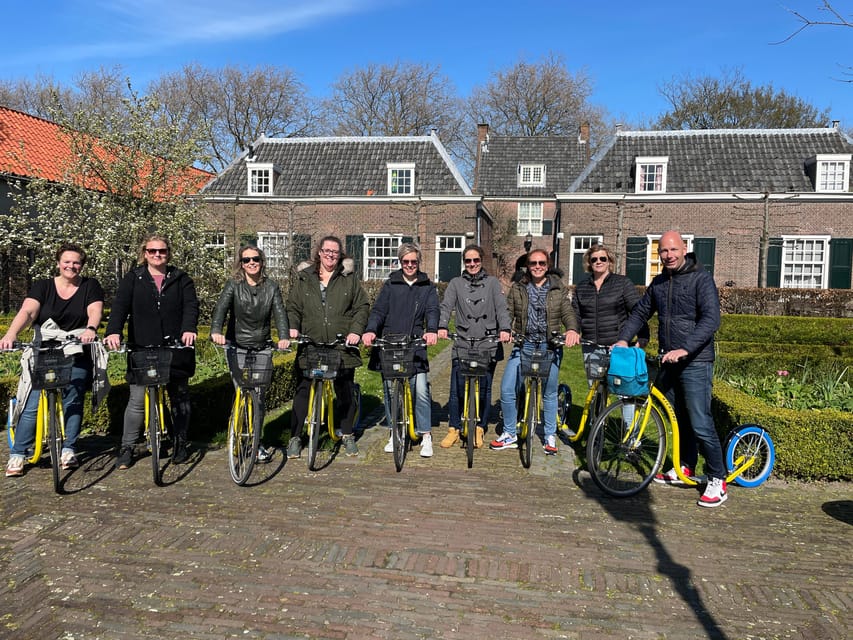
- Non-electric steps change the pace: You ride a traditional scooter, with short sections of scooting between guided stops.
- Agnetapark tells a social story: This garden village reflects the forward-thinking ideas of Jacques van Marken and his wife.
- Hofje van Pauw is a quiet pause: The 1707 courtyard gives you a glimpse of Delft away from its main squares.
- The route mixes old and new Delft: Modern architecture, Mill de Roos, historic streets, and the city center all appear in 90 minutes.
- Frans and Kevin guide the ride: The tour is available in English or Dutch, with a maximum of 10 participants.
- The price is reasonable for a guided introduction: At $32 per person, you pay for the scooter, the guide, and access to places you may not find on a standard walk.
Why this route gives you a fuller Delft
A walking tour can show you Delft’s grand churches, canals, and market square. This ride adds the city around them. You pass from newer construction to a working windmill, from a planned garden village to an enclosed courtyard, then return through the old center.
That change of setting is the main value. You are not spending the whole 90 minutes admiring the same type of canal house. Instead, the guide uses several stops to explain how Delft grew, how people lived, and how the city continues to change.
The tour is also short enough to fit into a busy day. At 1.5 hours, it works well near the start of a visit, when you want an overview before exploring on foot. It also suits anyone who has already seen the Markt and Old Church but wants more than the standard central sights.
The group limit of 10 matters here. A compact group is easier to keep together on city streets, and you should have a better chance to ask about the stories behind each stop. The route includes about 15 minutes at each listed location, with riding between them, so this is a guided sampler rather than a long, leisurely stop at every sight.
A few more Delft trips worth a look
- Delft: Canal Cruise with Guided Commentary
★ 4.4 · 990 reviews - Royal Delft: Delftblue Factory and Museum
★ 4.6 · 588 reviews - Delft: Entrance Ticket for the Old and New Churches
★ 4.4 · 229 reviews
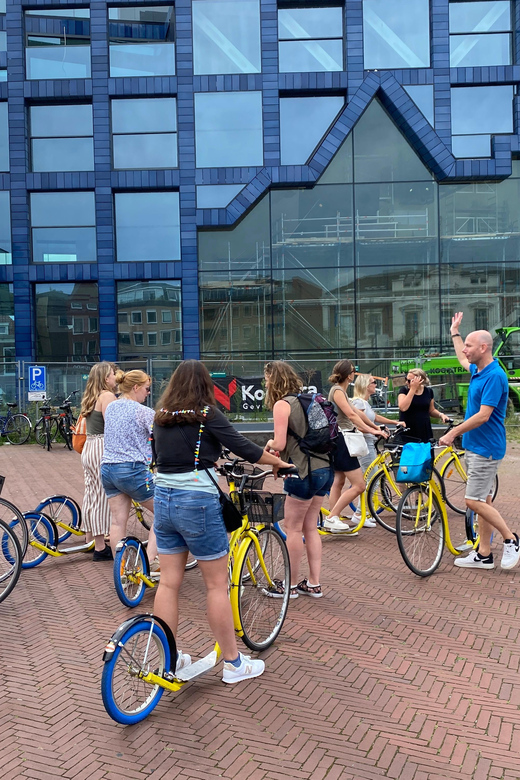
Starting at De Delf and meeting the city’s newer side
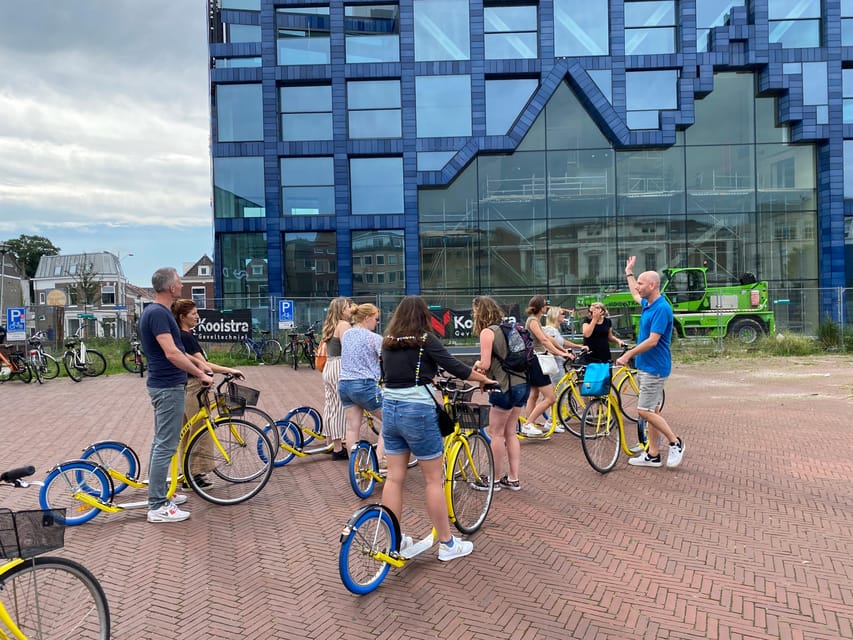
The tour begins at restaurant De Delf, at Oude Delft 113. From there, the first direction is toward modern Delft rather than straight into the most photographed old streets.
That is a smart opening. Delft is often treated as a perfectly preserved old town, but it is also a working Dutch city with new construction and changing transport patterns. Because the train now runs beneath the city, space has opened for modern building projects. The guide uses this part of the route to point out newer architecture and explain how it fits into Delft today.
For you, the practical benefit is contrast. The first section helps you see Delft as a living place, not a museum set. Modern architecture may not be the main reason you booked a historic-city tour, but it gives the rest of the route more meaning.
You should expect short stretches of riding followed by a stop and explanation. One of the most useful comments about the tour is that the riding sections are fairly brief. That is good if you want plenty of narration, but it also means the scooter is a way to connect the stops, not the main activity.
Mill de Roos and Delft’s working past
The route continues to Mill de Roos, a windmill that is still in use. This is one of the tour’s most distinctive stops because it connects Delft’s urban streets with an older form of work and production.
A working mill has more to say than a decorative one. The guide can place it in the story of the town, and you get a reminder that windmills were practical tools, not just symbols placed on souvenirs. The stop also adds variety after the modern architecture section.
The information provided does not promise an interior visit, so think of Mill de Roos as a photo stop and a guided explanation. If your priority is climbing a windmill or seeing its machinery up close, you should not book this tour expecting that. The value here is seeing the mill as one part of Delft’s wider story.
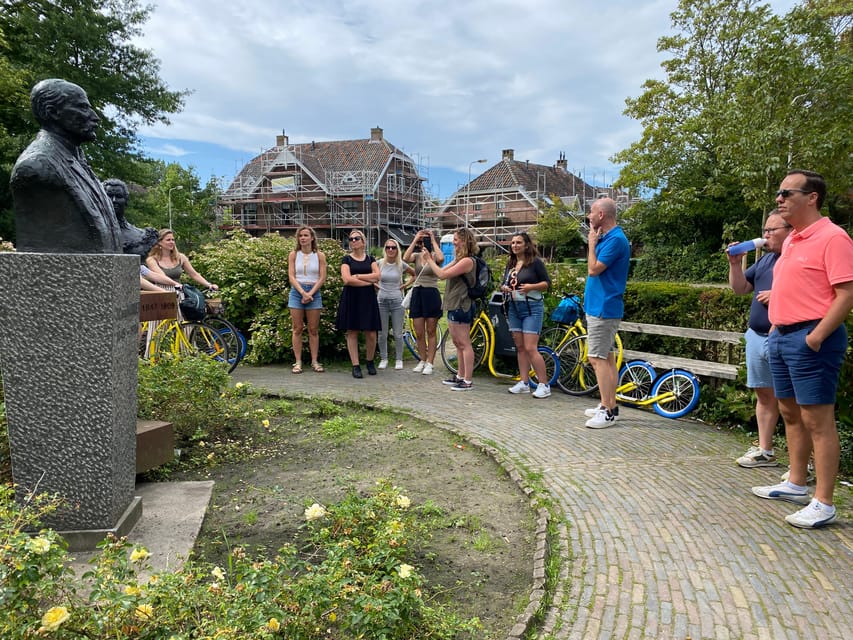
Agnetapark, Jacques van Marken’s social experiment
Agnetapark is likely the most thought-provoking stop. This quiet garden village was linked to Jacques van Marken, a businessman and social reformer whose ideas were far ahead of their time.
The park was designed as a better place for workers to live, with a strong sense of community and attention to daily well-being. The tour presents Agnetapark as a kind of social paradise created around those ideals. You get more than a pretty neighborhood. You get a look at how one couple imagined a better relationship between work, housing, and community life.
This is exactly the sort of stop that benefits from a guide. You can walk or ride past attractive homes and gardens on your own, but you may not understand why the area matters. The 15-minute guided pause gives the setting a clear purpose.
Agnetapark also offers a welcome change of mood. After city streets and modern construction, the area is described as quiet and peaceful. If you enjoy urban design, social history, or unusual local stories, this may be the strongest part of the route.
Same country, a completely different kind of day:
- Delft: Vermeer Centrum Delft Museum Entry Ticket
★ 4.6 · 189 reviews - Delft: City Center Walking Tour
★ 4.7 · 88 reviews - Delft: Craft Beer Tasting in Medieval Brewery with Snacks
★ 4.4 · 67 reviews - Delft: Dive into the Golden Age on a Private Walking Tour
★ 4.6 · 16 reviews
Hofje van Pauw, a courtyard from 1707
Next comes Hofje van Pauw, an enclosed courtyard founded in 1707. In Delft, the word hofje refers to a small residential courtyard, often built through private charity. These places can be easy to miss because they sit behind modest entrances rather than on the main route through town.
The courtyard is presented as an idyllic stop, and the guide tells you about the woman who founded it. That personal detail matters. Instead of seeing the hofje as a general example of old Delft, you hear about the person whose money and intentions shaped this specific place.
This is a good reason to take a guided route rather than simply follow a map. Delft’s main sights are easy to locate, but small courtyards often depend on local knowledge and context. The visit is still a photo stop, not a long historical lecture, so keep your expectations in proportion.
You should also respect the character of a courtyard like this. It is not an entertainment venue. The appeal comes from its calm setting, intimate scale, and connection to the city’s charitable past.
The Eastern Gate and Delft’s old edges
The Eastern Gate is another photo stop on the route. It adds a look at Delft’s defensive and civic past, helping you understand the old limits of the city.
The stop is brief, about 15 minutes, and its value comes from the way it fits into the route. You have already seen a newer district, a working mill, a planned neighborhood, and a charitable courtyard. The Eastern Gate brings you back to the older city and its former boundaries.
You should not expect an extended museum-style presentation at each location. The tour moves at a steady pace, with a short explanation at each stop. That format works well if you want variety and a broad sense of place. It is less suitable if you prefer to spend 30 minutes at one monument with detailed architectural analysis.
Returning through the Markt and the Old Church
The route returns through Delft’s old streets and the Markt. This is the part most first-time visitors expect from Delft: a handsome central square framed by the New Church and the town hall.
The Markt is not a throwaway final stop. It gives you the main visual anchor of the city after you have seen its outer neighborhoods. The New Church and town hall belong on any first visit, and seeing them after the quieter stops helps you read the center with fresh eyes.
The Old Church follows, famous for its leaning tower. Its tilt is one of Delft’s most recognizable features, and the stop gives the tour a strong finish before you return to Oude Delft 113.
The route does not appear to include admission to either church. You should think of these as exterior viewing and guided photo stops. If you want to explore the interiors, plan a separate visit after the scooter tour.
Returning through the old streets also gives you a useful orientation. You may spot cafés and places to eat along the way, and one guide reportedly adjusted the return route to point out food options for the evening. That kind of local suggestion can be more useful than another rehearsed fact, especially if this is your first few hours in Delft.
What riding a traditional step is really like
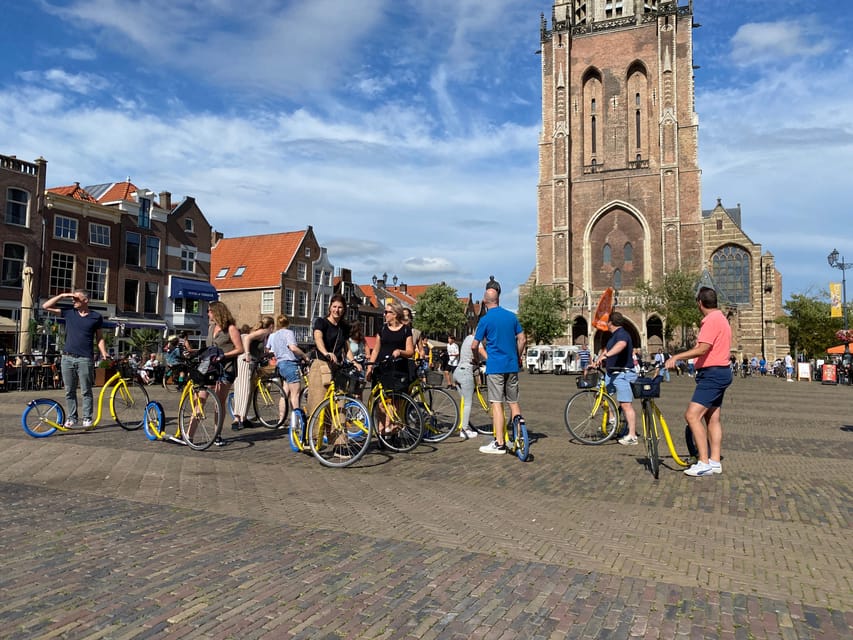
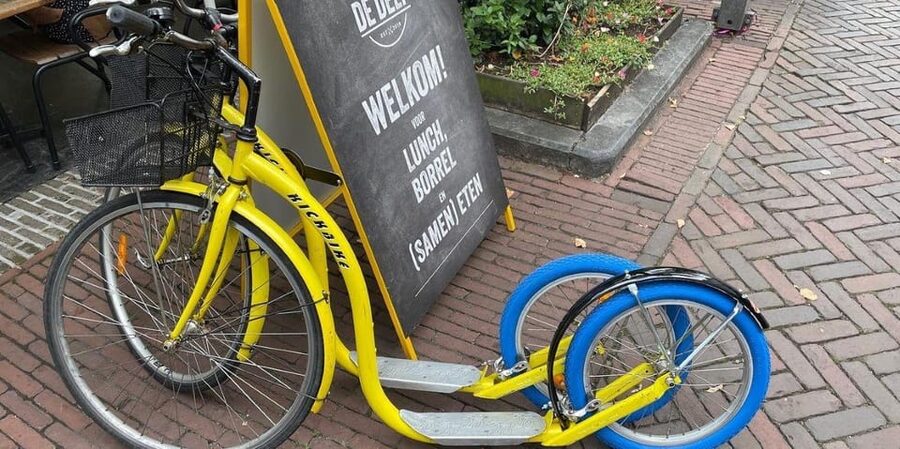
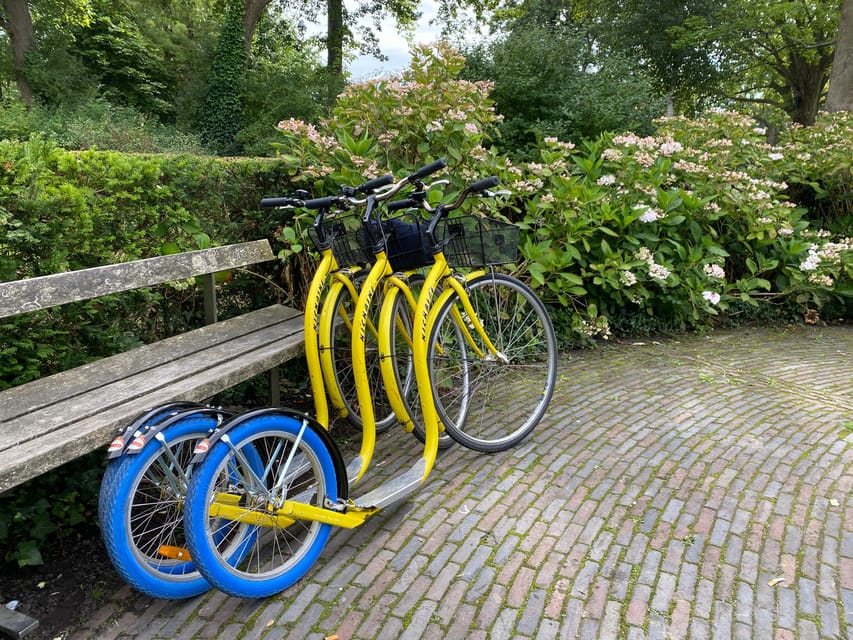
The Dutch word for scooter is step, and the tour uses the non-electric kind. The photographs are worth checking before booking because this is not a motor-assisted ride.
You need to be comfortable riding a bicycle. The tour is not suitable for children under 16, wheelchair users, or people with visual impairments, and the physical setup makes sense of those restrictions. You need balance, control, and enough energy to push along city streets.
The ride itself is not described as nonstop. The route includes small sections of scooting between stops, with guided talks at Agnetapark, Hofje van Pauw, the Eastern Gate, Markt, and the Old Church. Still, one useful warning is that a non-electric step can take some getting used to. In warm weather, the effort may feel greater, especially if you are not accustomed to this type of scooter.
I would wear comfortable clothes and shoes, and I would avoid booking this as a passive sightseeing ride. You are participating in the movement of the tour. That is part of its charm, but also the main physical consideration.
The guides and the small-group feel
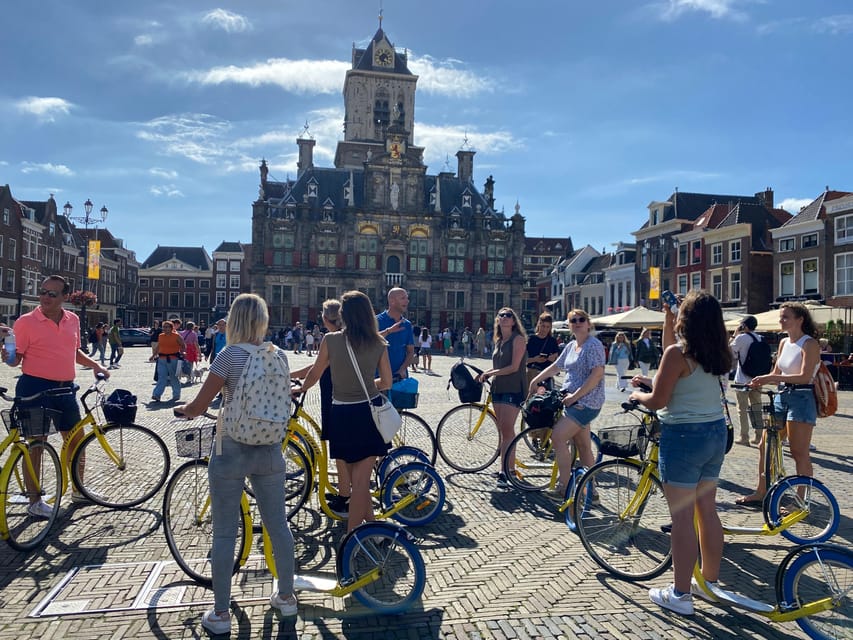
The tour is offered in English and Dutch. Guides Frans and Kevin are specifically associated with the experience, and the feedback points to a lively style with plenty of stories.
That matters because the route depends on explanation. Agnetapark and Hofje van Pauw are not simply famous monuments with large signs. Their meaning comes from the people and ideas connected with them. A guide who welcomes questions can turn a quick stop into something memorable.
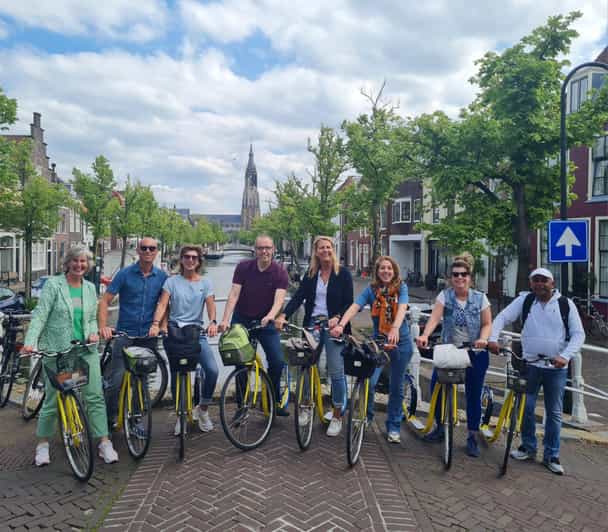
The small group, limited to 10, should help. You are not being moved through Delft in a large convoy, and the guide can respond to the group’s interests. The format also allows for some flexibility on the return route, such as pointing out eating places.
The tour’s average score is 4.8 from nine ratings, with repeated praise for the route, the guides, and the chance to see areas outside the standard center. That pattern is useful, but the lower ratings also point to the main limitation: the non-electric step is less effortless than some people expect, and hot weather can make the ride less comfortable.
Is $32 a fair price for 90 minutes?
At $32 per person, the tour is priced as a modest guided activity rather than a full-day excursion. The fee includes the traditional scooter and guiding services. A drink at the end was also included for at least one booking, though you should confirm the current arrangement when you reserve.
The value is strongest if you want a quick orientation and access to a route you might not create yourself. A self-guided walk can cover the Markt, New Church, Old Church, and town hall easily enough. It is harder to combine those sights with Agnetapark, Mill de Roos, and Hofje van Pauw in a tidy 90-minute outing.
The price is less compelling if you only want the central monuments or dislike physical activities. In that case, a regular walking tour may suit you better. You are paying partly for the unusual way of moving through Delft and partly for the guide’s local stories.
The tour allows cancellation up to 24 hours before departure for a full refund, and you can reserve now and pay later. Those terms make it easier to fit into a changing Netherlands itinerary.
Who should book this Delft tour?
I would recommend it to you if you want:
- A short introduction to Delft before exploring on foot
- A route beyond the usual tourist center
- Local stories about Agnetapark and Hofje van Pauw
- A small group rather than a large city tour
- A light physical activity with frequent stops
- English or Dutch guiding
- A different view of Delft’s mix of old, modern, civic, and social history
I would skip it if you cannot ride a bicycle, need an accessible wheelchair route, or want an entirely effortless sightseeing experience. I would also choose another format if your main goal is detailed interior visits to the New Church or Old Church.
Should you book the 1.5-hour scooter tour?
Book it if you want Delft to feel larger than its famous square. The route’s best feature is the combination of places: modern architecture, Mill de Roos, Agnetapark, Hofje van Pauw, the Eastern Gate, Markt, and the leaning Old Church. That is a lot of Delft in a short time.
The decision comes down to the scooter. You are riding a non-electric step, not sitting back on a powered vehicle. If that sounds enjoyable, $32 is a fair price for a compact, story-filled introduction led by guides such as Frans or Kevin. If you want a slow and fully passive tour, choose a walking option instead.
FAQ
Where does the Delft scooter tour begin?
The tour starts at restaurant De Delf, at Oude Delft 113.
How long does the tour last?
The tour lasts 1.5 hours.
How much does the tour cost?
The listed price is $32 per person.
Is the scooter electric?
No. The tour uses a non-electric scooter, called a step in Dutch.
Do I need to know how to ride a bicycle?
Yes. The tour is not suitable for people who cannot ride a bike.
Which languages are available?
The live guide is available in English and Dutch.
How large is the group?
The group is limited to 10 participants.
Which places are included on the route?
The route includes modern Delft, Mill de Roos, Agnetapark, Hofje van Pauw, the Eastern Gate, Markt, and the Old Church before returning to Oude Delft 113.
Is the tour suitable for children and wheelchair users?
No. It is not suitable for children under 16, wheelchair users, or people with visual impairments.
Just added around Delft
- Private Tour of Delft + Visit to Royal Delft Museum★ 5.0 · 4 reviews
- Delft: Canal House Museum ‘Paul Tetar van Elven’ Ticket★ 4.5 · 6 reviews
- Delft: Private Historical and Cultural Guided Walking Tour★ 5.0 · 8 reviews
- Delft: Christmas Walk with Oliebollen and Glühwein★ 4.8 · 8 reviews
- Delft: Guided Walking Tour★ 4.7 · 9 reviews
- Delft: Dive into the Golden Age on a Private Walking Tour★ 4.6 · 16 reviews
- Delft: Craft Beer Tasting in Medieval Brewery with Snacks★ 4.4 · 67 reviews
- Delft: City Center Walking Tour★ 4.7 · 88 reviews
Delft Tours, compared.


Craft Beer Tasting in Medieval Brewery with Snacks
Read our review →

Browse the lists this tour appears in