
Reviewed · THE HAGUE TOURS
The Hague: Escher in The Palace Museum Ticket
M.C. Escher’s art is made to stop you in your tracks. At Escher in Het Paleis, impossible staircases, repeating animals, and shifting worlds fill the former Winter Palace of Queen Mother Emma. The star is the 7-meter Metamorphosis III, displayed so its changes unfold across time and space.
I like two things right away: the museum lets you follow Escher’s artistic development, not just his familiar optical tricks, and the interactive floor gives children and adults a way to test his ideas instead of only looking at framed prints. The royal setting adds another layer, with chandeliers, ceilings, and palace details competing for your attention.
The main consideration is room size. Some galleries can feel close and poorly aired when busy, and the museum may take about an hour for a quick visit or two hours if you read everything. Large bags and luggage are not allowed inside, so plan ahead.
Key points to know before you go
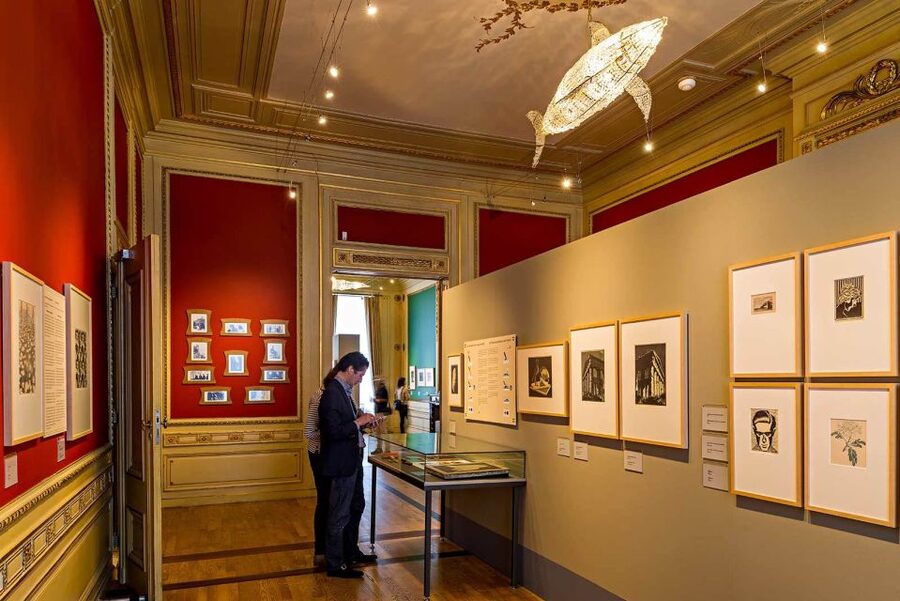
- More than 130 Escher prints: See famous works such as Day and Night and Climbing and Descending, along with earlier and less familiar pieces.
- A former royal Winter Palace: The building retains its original royal atmosphere, giving the art an unusual setting.
- Metamorphosis III is the visual centerpiece: The huge woodcut measures 7 meters and is shown in an unconventional format.
- Interactive exhibits on the top floor: Looking as Escher Does uses eye puzzles and hands-on activities to explain his methods.
- Good for families: Children up to age 6 enter free with a paying adult, and a free treasure hunt helps younger visitors stay involved.
- Flexible admission: The ticket is listed at $15 per person and is valid for 365 days, with free cancellation up to 24 hours before the visit.
Escher’s impossible worlds in a real palace
Escher in Het Paleis is not a guided walking tour. You visit independently, moving through a permanent museum devoted to the Dutch graphic artist M.C. Escher. Your admission covers the museum entrance, and an audio guide is available in English, Dutch, German, French, Chinese, Japanese, Ukrainian, and Korean.
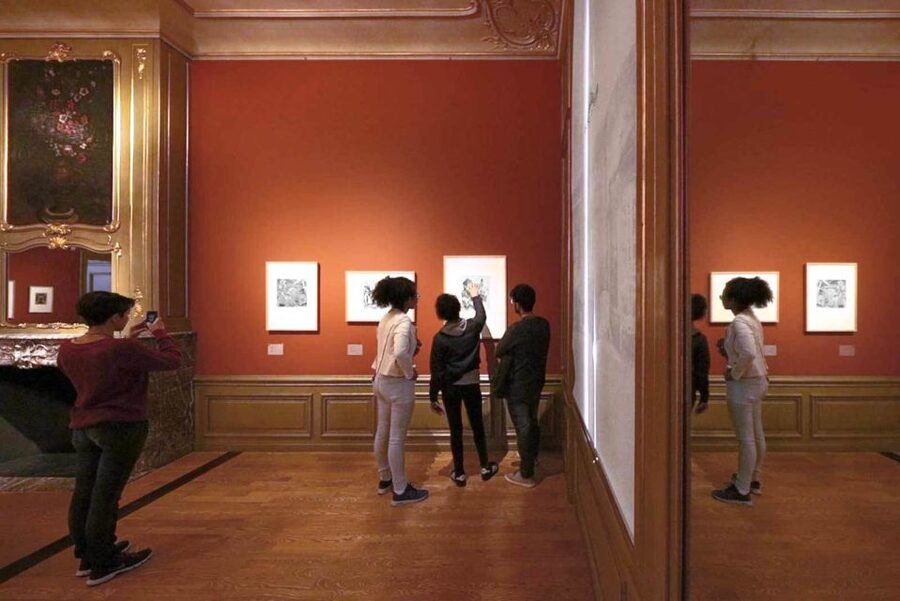
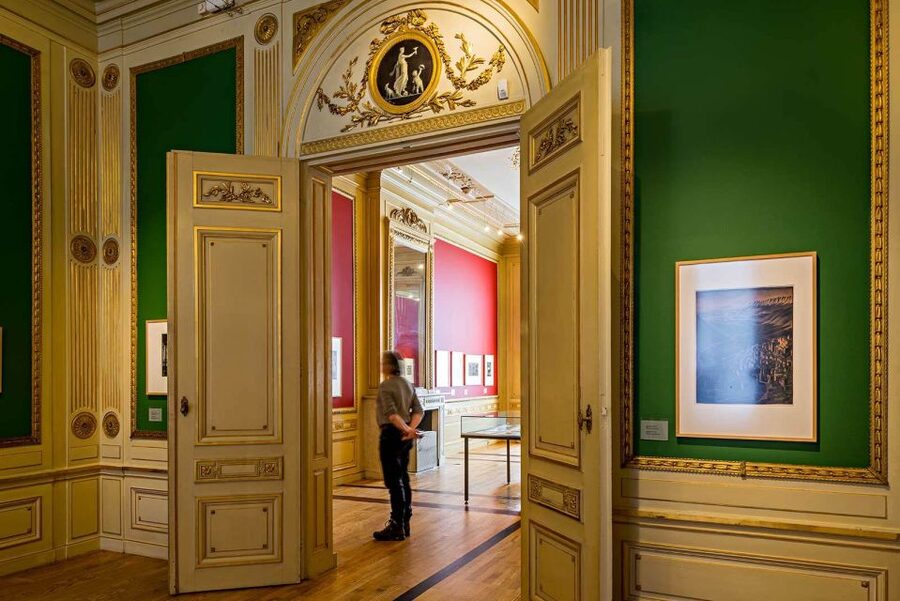
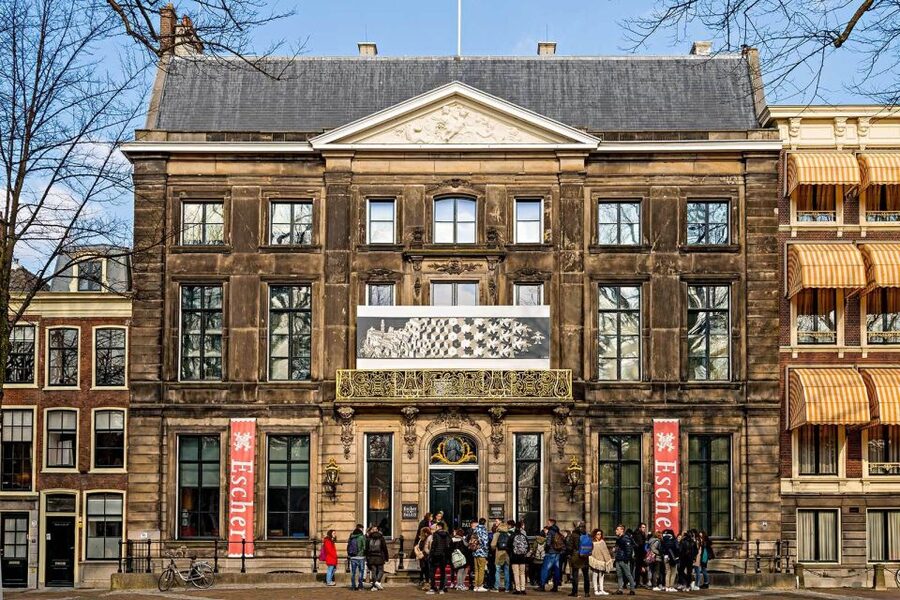
The setting matters. The museum occupies the former Winter Palace of Queen Mother Emma of the Netherlands on Lange Voorhout, one of The Hague’s most important central avenues. This is the only public building in The Hague where the original royal ambience has been maintained, so you are looking at Escher’s precise, often mathematical art inside rooms once used by Dutch royalty.
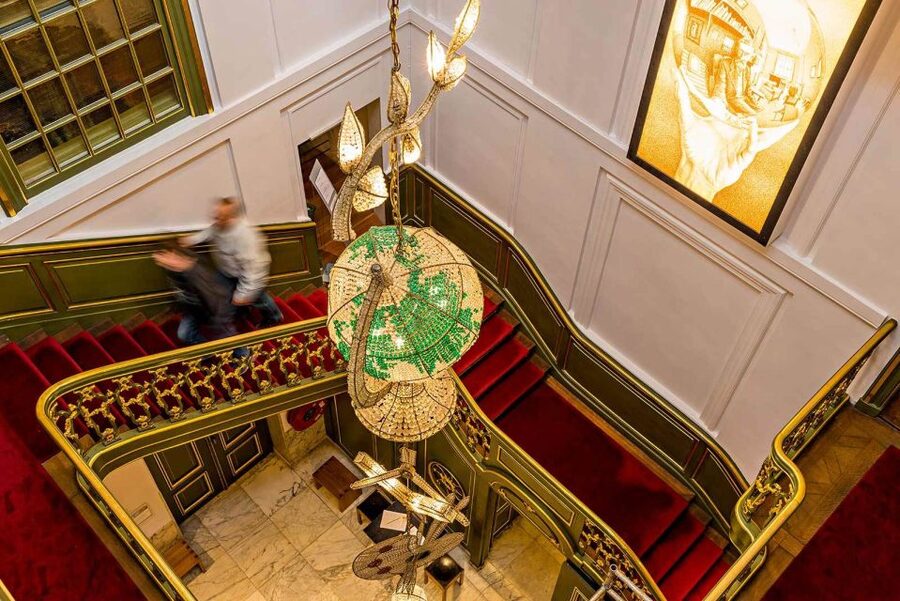
That contrast gives the visit its character. Escher’s black-and-white prints can feel cool, controlled, and almost scientific. The palace rooms bring warmth, ornament, and a sense of domestic royal life. Look up as you move through the building. Chandeliers and ceiling details are part of the experience, and even the floor can offer something worth noticing.
More Museums in The Hague
- Royal Delft: Delftblue Factory and Museum Admission Ticket
★ 4.5 · 145 reviews - The Hague: Panorama Mesdag Museum Entry Ticket
★ 4.8 · 143 reviews - The Hague: Prison Gate Museum
★ 4.5 · 58 reviews
Starting with Escher’s life and artistic growth
A short introductory film helps set the tone before you begin the collection. It provides a useful starting point for visitors who know Escher mainly from images of staircases, mirrored figures, and tessellations. You get a sense of the person behind the visual puzzles and the way his interests changed over time.
I find this background especially helpful because Escher did not begin with the impossible worlds that made him famous. The exhibition shows the development of his work, including designs and subjects that may be unfamiliar if you only know his best-known prints. You can follow how he refined pattern, repetition, perspective, and the relationship between solid forms and empty space.
That progression makes the museum more satisfying than a simple greatest-hits display. You are not just waiting for Day and Night or Climbing and Descending. You are watching Escher return to certain ideas, reshape them, and push them further.
The labels help explain the works in English and Dutch. If you want extra context without reading every panel, use the audio guide. It is included and offers a practical way to keep your visit moving while still getting information about the artist and his methods.
The major prints: Day and Night, staircases, and tessellations
The collection includes almost all of Escher’s major works, with more than 130 prints on display. The familiar pieces are here, but the pleasure comes from seeing them beside related works and tracing the repeated ideas.
In Day and Night, a Dutch countryside scene gradually transforms into a flock of birds. The image works first as a striking picture, then as a clever visual transition. Escher makes the boundary between the fields and the birds hard to pin down, so your eye keeps moving back and forth.
Climbing and Descending is another essential stop. Rows of figures endlessly walk up and down a staircase, creating a loop with no real destination. The image is funny at first, then slightly unsettling. It asks you to accept a structure that looks logical in pieces but cannot exist as a whole.
You will also see intricate designs built from repeated forms and tessellations. These patterns show how Escher used animals, birds, reptiles, and other shapes as building blocks. A figure may fit tightly against another figure, leaving no gap between them. The result is both decorative and tightly engineered.
Do not rush past works that seem less famous. The exhibition is useful partly because it shows the breadth of Escher’s work beyond the popular perspective pieces. You may find early experiments, natural forms, and designs that explain how he arrived at the images most people recognize.
Metamorphosis III and the challenge of scale
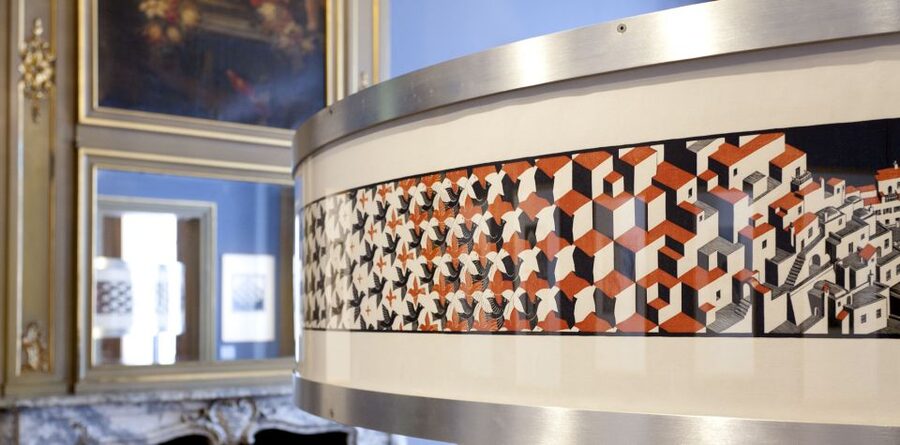
Metamorphosis III is the museum’s largest and most memorable work. At 7 meters long, this enormous woodcut is far bigger than the framed prints around it. It links letters, grids, animals, buildings, and other forms in a long visual chain.
The display format is unconventional, allowing you to experience the work as a movement through time and space rather than as a single static image. That matters because Metamorphosis III is not meant to be understood in one glance. Your eye follows the changes, notices a shape returning in another form, and then moves onward.
Give this piece time. Stand close enough to see the details, then step back to understand its full sequence. If you are with children, it can become a simple search game: find where one form begins changing into another.
The work also shows why Escher appeals to people with very different interests. You can approach it as graphic design, mathematics, storytelling, or pure visual play. You do not need technical art knowledge to enjoy it, but the more closely you look, the more connections you find.
Same country, a completely different kind of day:
- The Hague: Mauritshuis Entrance Ticket
★ 4.7 · 2,706 reviews - The Hague: City Canal Cruise
★ 4.6 · 2,024 reviews - The Hague: Madurodam Miniature Park Entry Ticket
★ 4.6 · 1,559 reviews - The Hague: The Pier SkyView Ticket with Drink and Snack
★ 4.4 · 1,398 reviews
Looking as Escher Does on the second floor
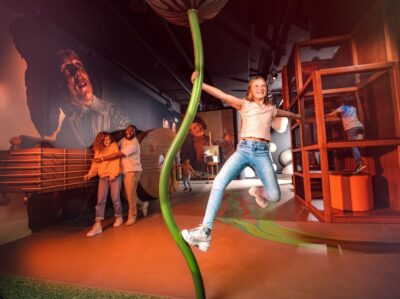
The interactive exhibition, Looking as Escher Does, occupies the second floor. This is where the museum shifts from quiet observation to hands-on problem solving.
Some activities are puzzles for your eyes. Others let you use your hands to explore the tricks behind Escher’s images. These exhibits help explain how perception can be guided, fooled, or redirected. Instead of being told that Escher played with perspective, you get a chance to feel the effect yourself.
This floor is a strong reason to bring children. A free treasure hunt gives younger visitors a clear task, while the interactive displays offer a break from reading labels and standing in front of prints. Children up to age 6 enter free when accompanied by a paying adult.
Adults should not skip this section. The hands-on activities make the prints easier to understand, especially if you have wondered how Escher created impossible structures or fitted repeating forms together. The interactive exhibits are not just filler at the end of the museum. They connect the visual tricks to the ideas shown in the galleries.
Allow extra time here if you are visiting with a family. The museum itself can be seen in about an hour, but the interactive floor may keep you occupied longer. One practical drawback is that the museum closes at 5 p.m., so a late afternoon arrival can leave you rushing.
The palace details are part of the visit
The art is the main reason to come, but the building is not a neutral container. The former palace gives you a glimpse of how the Dutch royal family lived and worked. Rooms, fixtures, and decorative details remain visible as you move between Escher’s works.
I especially like the way the museum encourages you to look in two directions at once. Escher’s prints demand close attention at eye level, while the palace invites you to look at the ceiling, floor, and chandeliers. Even the areas between exhibits can reward a second glance.
The royal rooms also make this a useful stop for people who are not already Escher fans. You can come for the building and still find plenty to see in the art. Likewise, an Escher enthusiast gets more than a standard art display, since the setting gives the visit a sense of place.
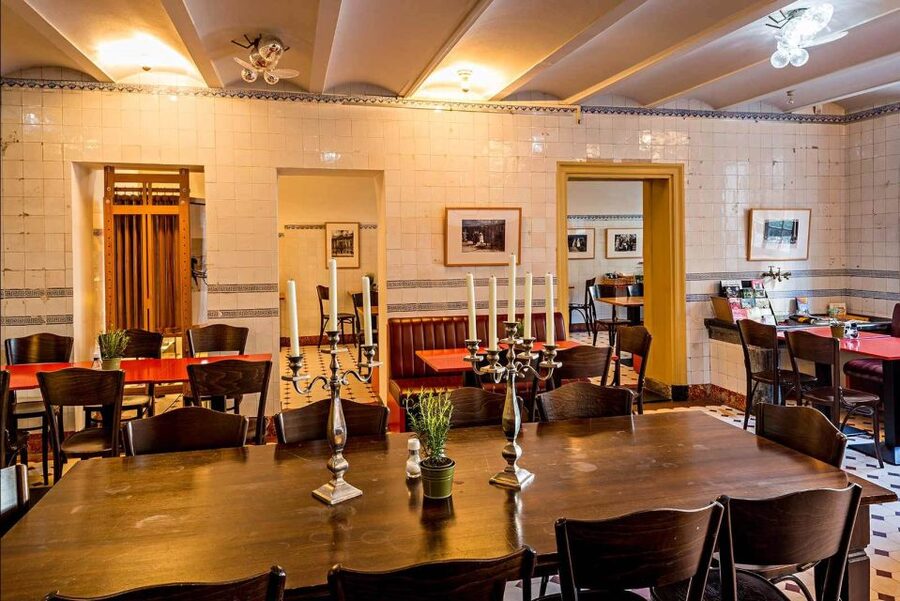
The museum café occupies the former palace kitchen. It is a handy spot for a pause after the collection, especially if you are building a longer afternoon around central The Hague.
How much time should you allow?
A quick visit takes about an hour. That is enough to see the main prints, understand the basic story, and spend a little time with the interactive displays.
I would allow closer to two hours if you want to read the labels, study the smaller prints, watch the introductory material, and give Metamorphosis III the attention it deserves. Families may need still more time because the treasure hunt and hands-on activities can slow the pace in a good way.
The building contains several floors of material, though the rooms themselves are relatively small. On a busy day, you may need to wait for a clear view of a popular print or interactive activity. One practical report also described some areas as dark and stuffy, so visitors sensitive to crowded indoor spaces should keep that in mind.
A morning visit or an earlier afternoon arrival gives you more breathing room. There is no reason to race through the museum simply because the ticket is valid for a set entry date. The booking information lists the admission as valid for 365 days, but you still need to check availability and the available starting times before going.
Getting there from The Hague Central Station
The museum is at Het Paleis, Lange Voorhout 74, Den Haag. From The Hague Central Station, take tram 9 to Korte Voorhout or tram 17 to Kneuterdijk.
The location works well as part of a central The Hague day. After your visit, you can walk near the park and see the Parliament buildings around the water. There are also lunch spots nearby, making it easy to combine the museum with other sights rather than treating it as a stand-alone trip.
Leave large bags and luggage behind. They are not allowed inside, and this is not the place to arrive with a full suitcase after checking out of your hotel. Small personal items are less of a concern, but pack lightly so you can move through the rooms without fuss.
Is the $15 ticket good value?
At $15 per person, the ticket is fairly priced for a permanent collection of this size, especially since the admission includes the audio guide and the interactive exhibition. You are not paying only to see a handful of famous images. The visit includes more than 130 prints, the palace interior, the introductory material, and the hands-on displays.
The value is strongest for people who already like Escher or who enjoy visual puzzles, design, and mathematics. You can spend an hour on the main collection, but the museum rewards a slower pace. The palace setting also gives the admission more substance than a basic single-artist room.
For families, the free entry for children up to age 6 and the treasure hunt improve the deal. Older children can take part in the interactive exhibits, while adults can focus on the art and building. The museum is compact enough to manage with a family, though small galleries may feel tight at busy times.
Online booking is useful if you want a simple entry plan. The ticket offers reserve now and pay later, and cancellation is free up to 24 hours in advance. A guided tour is not included. If you want one, a guide costs EUR 60 for a maximum of 20 people and must be reserved separately.
Who will enjoy this museum most?
You should book if Escher is already on your list, since the collection gives you a broad look at his work rather than only the famous optical illusions. It is also a good choice if you enjoy printmaking, graphic design, geometry, or art that rewards close inspection.
Families have plenty to do. The treasure hunt, eye puzzles, and hands-on exhibits give children a reason to stay engaged. The palace itself adds variety, so the visit is not simply a quiet march from frame to frame.
Even if you know little about Escher, the museum provides a clear introduction. The film, labels, and audio guide explain his development, while the best-known prints give you familiar reference points. You do not need to understand the mathematics to appreciate the visual effect.
The main weak point is the indoor layout. The rooms can be small, some areas may feel dim or stuffy, and a late arrival can cut short the interactive section. Visitors with large luggage also need to make other storage plans before entering.
Final verdict: should you book Escher in Het Paleis?
I would book this ticket if you want a focused, unusual museum visit in The Hague. The strongest reasons are the 7-meter Metamorphosis III, the chance to see more than 130 Escher prints in one place, and the interactive second floor that turns his ideas into something you can test.
I would plan for 90 minutes to two hours, arrive without large bags, and leave time to notice the palace ceilings and chandeliers. Combine the visit with the nearby park, Parliament buildings, and a meal in the area for a rewarding half-day in central The Hague.
Skip it only if you want a large, open museum with spacious galleries or if you have no interest in visual puzzles and graphic art. For most others, the $15 admission buys a memorable look at both Escher’s strange worlds and the royal rooms that house them.
FAQ
Where is Escher in Het Paleis located?
The museum is at Het Paleis, Lange Voorhout 74 in The Hague, South Holland.
How do I reach the museum from The Hague Central Station?
Take tram 9 and get off at Korte Voorhout, or take tram 17 and get off at Kneuterdijk.
What does the ticket include?
The ticket includes admission to Escher in Het Paleis. An audio guide is also included.
Which languages are available for the audio guide?
The audio guide is available in English, Dutch, German, French, Chinese, Japanese, Ukrainian, and Korean.
How long is the ticket valid?
The admission is listed as valid for 365 days. Check availability for the available starting times.
How much does admission cost?
The listed price is $15 per person.
Are children allowed to enter free?
Children up to 6 years old enter free when accompanied by a paying adult.
Is there anything for children to do?
Yes. The museum offers a free treasure hunt for children, and the second-floor interactive exhibition includes puzzles for the eyes and hands.
Is a guided tour included?
No. A guided tour is separate and costs EUR 60 per guide for a maximum of 20 people. It must be reserved in advance.
Are large bags and luggage allowed?
No. Luggage and large bags are not allowed inside the museum.
When is the museum closed?
Escher in Het Paleis is closed on Christmas Day and January 1. It is open on Easter, King’s Day, Ascension Thursday, Whitsun, and Whit Monday.
Can I cancel my booking?
You can cancel up to 24 hours in advance for a full refund. The booking also offers a reserve now and pay later option.
Just added around The Hague
- Private Tour of Rotterdam and The Hague including Transfer★ 5.0 · 3 reviews
- Private Tour of The Hague, Delft and Rotterdam with Lunch★ 5.0 · 3 reviews
- Discover Historical Delft with an Audio Guide★ 5.0 · 3 reviews
- The Hague Self-Guided Audio Tour★ 5.0 · 3 reviews
- 3 Course Walking Dinner in Delft with Guided Tours in Between★ 5.0 · 3 reviews
- Surprise Walk of The Hague with a Local★ 4.5 · 3 reviews
- Surfing at The Shore in The Hague★ 4.5 · 3 reviews
- Private Tour of Vermeer’s Delft + Tickets to Vermeer Museum★ 5.0 · 3 reviews
The Hague Tours, compared.
Hop-on Hop-off Old-Fashioned Heritage Tram Tour
Read our review →
Oranjehotel World War II Prison Entrance Ticket
Read our review →

Browse the lists this tour appears in