
Reviewed · THE HAGUE TOURS
Royal Delft: Delftblue Factory and Museum Admission Ticket
Royal Delft is not just a display of blue-and-white plates. It is a working pottery where artists still paint Delft Blue by hand, using methods carried on for centuries. The visit takes you from factory floor to museum rooms, with a close look at how plain black paint becomes the familiar blue after firing.
I like the working artists best, since watching a painter apply fine lines to a ceramic piece gives the craft a human scale. I also like the museum’s Royal Chambers and Vermeer room, which connect Delftware to Dutch court life and the city’s famous 17th-century painter.
The main thing to know is that this is a self-guided visit, not a hosted tour. You get an audio guide in one of eight languages, plus signs and video displays, but you need to set your own pace and find your way through the rooms.
Key points to know before you go
- Watch Delft Blue being painted by hand: The artists’ work is the most memorable part of the visit.
- See Delft’s last surviving Delftware factory: Royal Delft has operated since 1653.
- Follow the full production process: Displays explain shaping, painting, firing, and the change from black to blue.
- Look for the 480-tile Night Watch: This large ceramic artwork is an unexpected highlight.
- Plan 60 to 90 minutes: The advertised visit lasts about an hour, but careful readers may want longer.
- Finish with tea or lunch: The courtyard brasserie serves food and drinks separately from admission.
Why Royal Delft matters in Delft

Delftware grew famous in the Netherlands during the 17th century, when local potteries made blue-and-white earthenware influenced by Chinese porcelain. About 32 potteries opened in Delft during that period. Royal Delft, founded in 1653 as De Porceleyne Fles, is the only one from that era still operating as a Delftware factory in the city.
That fact gives the visit more weight than a standard ceramics display. You are seeing a live workshop tied to Delft’s long pottery tradition, not only objects in glass cases. The company became Royal Delft in 1919, after receiving permission to use the royal prefix because of its relationship with the Dutch royal family.
The site works as three places in one: a factory, a museum, and a shop. You can see old pieces, modern designs, production demonstrations, and items made for the House of Orange. That mix makes the visit useful for both art fans and people who simply want to understand why Delft Blue is so closely tied to the Netherlands.
The attraction is in Delft, although some booking details label the wider location as The Hague. It is near public transportation, and a small parking lot beside the building may help if you are driving.
More Museums in The Hague
- The Hague: Escher in The Palace Museum Ticket
★ 4.6 · 896 reviews - The Hague: Panorama Mesdag Museum Entry Ticket
★ 4.8 · 143 reviews - The Hague: Prison Gate Museum
★ 4.5 · 58 reviews
Entering the museum and choosing your pace
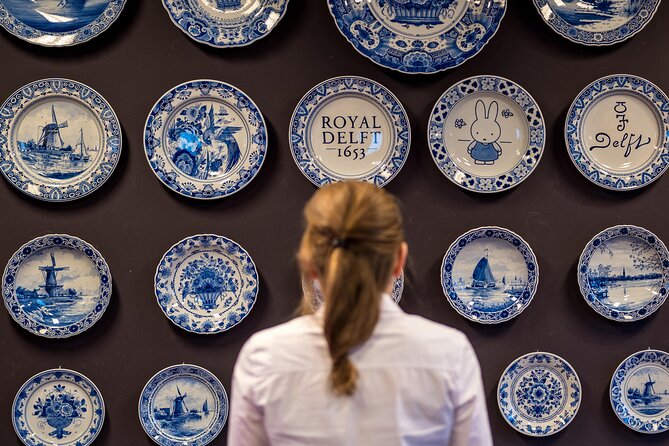
The admission is designed for independent exploring. You can use the included one-hour audio tour, available in eight languages, or follow the written displays and video screens placed around the museum. English is offered, and free Wi-Fi is included.
I like this format for a short stop because you are not tied to a group’s rhythm. You can pause at a display, move quickly through a section, or spend extra time beside a painter. The tradeoff is simple: nobody is there to organize the visit or answer every question as you go.
Some parts are laid out clearly, but the experience can feel a little loose if you expect a guided tour. The audio player follows stops around the site and covers much of the same material as the panels. You can use it for structure, or skip it and read at your own speed.
The advertised duration is about one hour. That works if you watch the presentation, follow the main displays, and keep moving. I would allow 90 minutes if you want to read the panels, watch artists at work, inspect the older ceramics, and browse the showroom. The compact size is useful on a busy Delft day, but it also means this is not an all-day museum.
Seeing Delft Blue made by hand
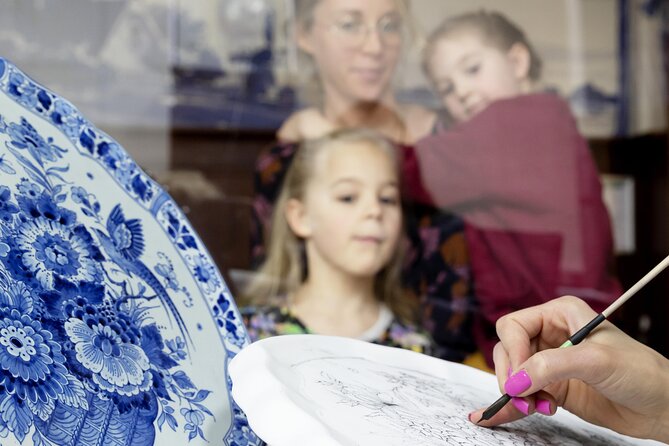
The factory section is the heart of the visit. Royal Delft still makes and hand-paints its Delftware according to old methods, and you can watch the work as it happens. A painter may be applying the detailed design while another part of the process is explained through screens or displays.
One useful detail concerns color. The paint looks black before firing, then changes to the familiar Delft Blue in the kiln. Seeing that transformation explained helps you understand why the finished pieces look so precise and controlled. The blue is not simply brushed on in its final appearance.
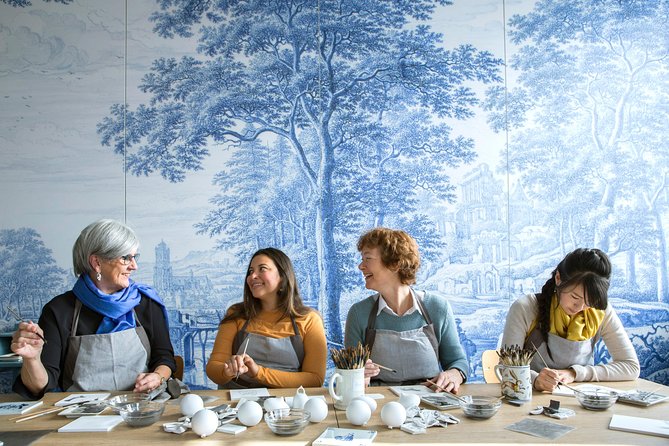
The work demands more skill than the finished plates suggest. A small mistake in a pattern can affect the whole piece, and each hand-painted object has slight differences. You can stand near the work area, watch the painter’s brush, and ask questions when someone is available.
This is also the part most likely to reward patience. A quick glance gives you the basic idea, but sitting for a few minutes and watching the brush move across a piece makes the craft easier to appreciate. If you have children with you, the active work area may hold their attention better than a room of display cases.
The factory is not presented as a theatrical show. You may see artists working during your visit, but the experience is built around observation, panels, and recorded material. That is a strength if you prefer an honest look at production, but a limitation if you want a scheduled demonstration or a formal presentation.
The museum rooms, from Vermeer to the Dutch royal family
The museum adds context to the factory process. One themed room recreates the dining room of Johannes Vermeer, the celebrated 17th-century painter from Delft. The connection gives the pottery a place in the city’s art story and helps you picture Delftware in a period setting.
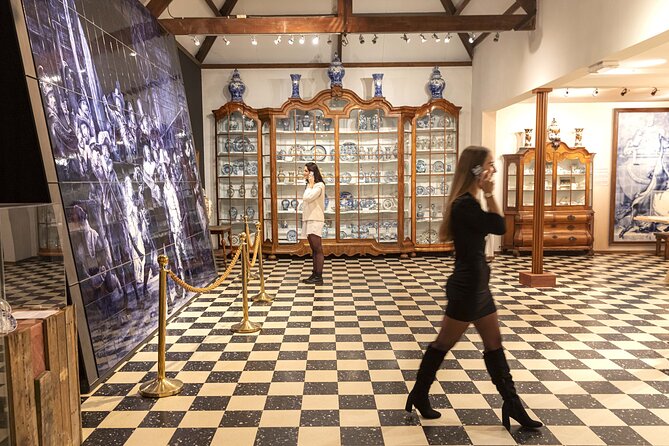
The Royal Chambers focus on Orange ceramics made over the years for the Dutch royal family. These objects show that Delftware was more than an everyday household product. Some pieces were made for special patrons and formal settings, and the royal connection explains why certain designs carry such importance.
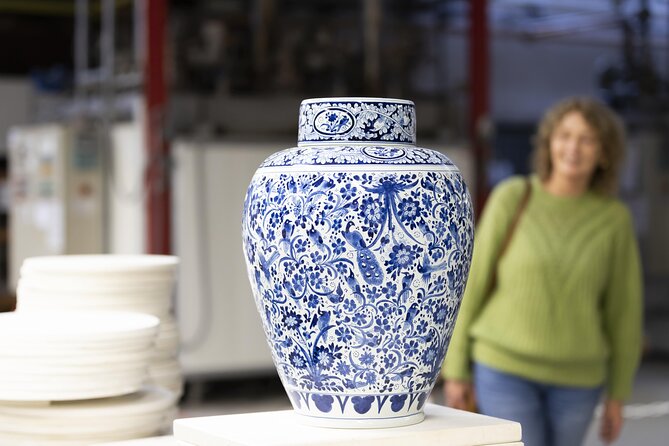
The collection includes antique and modern Delft Blue earthenware. You can compare older shapes and patterns with newer work, then see how the same blue-and-white language continues in current production. That contrast is more useful than a display made only of historic pieces, since it shows that Royal Delft remains a living company.
Another memorable object is the tile version of Rembrandt’s Night Watch, made from 480 tiles. It is an unusual way to present a famous Dutch painting, and it gives you a reason to slow down and study how a large image is assembled from many ceramic pieces.
The museum itself also has appealing architecture and display rooms. It is not huge, so you will not need to ration your attention. If you enjoy decorative arts, Dutch design, or royal collections, you can spend longer with the objects. If ceramics are not your main interest, the factory and the Night Watch help break up the case displays.
Same country, a completely different kind of day:
- The Hague: Mauritshuis Entrance Ticket
★ 4.7 · 2,706 reviews - The Hague: City Canal Cruise
★ 4.6 · 2,024 reviews - The Hague: Madurodam Miniature Park Entry Ticket
★ 4.6 · 1,559 reviews - The Hague: The Pier SkyView Ticket with Drink and Snack
★ 4.4 · 1,398 reviews
The audiovisual presentation and audio tour
The audiovisual presentation explains the story of Delft Blue and the production process. It is a practical introduction before you reach the working areas, especially if you do not know the difference between painted earthenware and porcelain.
The audio tour runs for about an hour and comes in eight languages. Since there is no guide included, it provides the main spoken explanation. You can also rely on the printed panels and screens, which is helpful if you would rather not carry an audio device or listen at every stop.
The audio content may repeat information found on the signs. That is not necessarily a problem, but it means you should choose one main method instead of trying to absorb everything at once. I would start with the video and panels, then use the audio at the rooms that interest you most.
The self-guided setup suits independent visitors, couples, and families who do not want a fixed schedule. It is less suitable if your ideal museum visit depends on a guide pointing out small details or adapting the explanation to your questions.
The showroom and the cost of Delft Blue
Admission costs $20.52 per person. I consider that fair if you want the factory, museum, and production story together. You are not paying only to look at finished plates. The price includes access to the working site and the one-hour audio tour, and the visit can fill an hour to an hour and a half without adding a separate guided-tour fee.
The value depends on what you want from Delft. If you are already planning to see the city and have little interest in ceramics, this may feel like a specialized extra. If you want to understand one of Delft’s signature crafts, the working factory makes the admission more worthwhile than a shop visit alone.
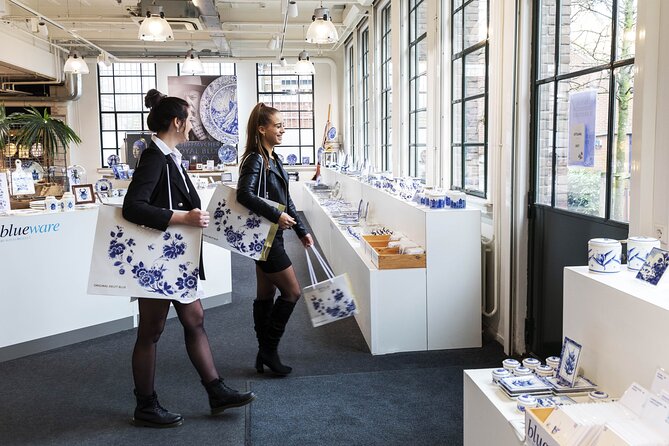
The showroom has a broad collection of Royal Delft hand-painted earthenware along with souvenirs. Prices vary, and signed pieces can be expensive. I would treat the shop as a place to see the finished results rather than assume you will take home a major piece.
You can browse without buying anything, of course. The showroom also helps you recognize the difference between factory-made souvenirs and more detailed hand-painted work. If you do plan to purchase a signed piece, set a generous budget before you arrive.
A courtyard brasserie worth building into your visit
The brasserie overlooks a courtyard and serves coffee, tea, lunch, and High Tea. Food and drinks are not included in the admission price, but the café gives you a pleasant way to extend the stop.
Tea served in Royal Delft tableware is a fitting finish. It lets you see the pottery in daily use, not only behind glass or on a display shelf. The menu is useful for a break, though you should budget separately for anything you order.
Some visitors spend about 90 minutes at the site, including time in the café. That makes sense if you want to watch the painters, explore the museum at a steady pace, browse the shop, and sit down afterward. If your schedule is tight, skip the meal and keep the core visit to about an hour.
Workshops are also offered, allowing you to try painting Delft Blue yourself. The admission ticket described here does not include a workshop, so check the details separately if hands-on painting is your main goal.
Who will enjoy this visit most
I would recommend Royal Delft to anyone interested in ceramics, Dutch design, decorative arts, or traditional craft. It is also a good choice if you want something beyond Delft’s streets and historic buildings. The working artists give the visit an active element that a standard museum cannot provide.
Families can manage the visit because most people can participate, and children must be accompanied by an adult. The factory work and color change may catch a child’s attention, while the museum rooms provide quieter material for older visitors.
The visit also suits independent sightseers who dislike fixed group tours. You can enter with a mobile ticket, use the audio guide, and take your time. Service animals are allowed, and the site is near public transportation.
I would be more cautious if you want a large museum with many rooms or a formal guide. The museum is relatively small, and the experience is mainly self-directed. The lack of a guide is the clearest drawback, especially for anyone who prefers direct explanations and a set route.
Opening hours are listed as 9:30 AM to 5 PM daily for 2026. Since the visit is often booked well ahead, with an average advance time of about 25 days, it is sensible to reserve before a tightly planned Delft day. Confirmation arrives at booking, and free cancellation is available until 24 hours before the start time. Changes or cancellations inside that window are not accepted for a refund.
Should you book Royal Delft?
Book it if you want to see Delft Blue as a living craft rather than a souvenir pattern. The painters at work, the explanation of black paint turning blue in the kiln, the royal ceramics, Vermeer-themed room, and 480-tile Night Watch give the visit plenty of substance for the price.
Skip it if you have only a few minutes in Delft and do not care about pottery. The museum is compact, and its self-guided format asks you to make your own discoveries. For the right visitor, though, Royal Delft offers a clear look at how Dutch art, royal taste, and careful handwork meet in one working factory.
FAQ
Where is Royal Delft located?
Royal Delft is located in Delft, Netherlands. The attraction is near public transportation, and a small parking lot is beside the building. Some booking details label the location as The Hague.
How long does the Royal Delft visit take?
The included audio tour lasts about one hour, and the visit is advertised as approximately one hour. You may want 90 minutes if you read the displays, watch the painters, browse the showroom, and stop at the brasserie.
Is the visit guided?
No. The admission is for independent exploration. An audio tour is included in eight possible languages, and you can also use written panels and video displays.
Is the audio tour available in English?
Yes. English is one of the languages offered for the included audio tour.
What can you see at Royal Delft?
You can see the Delft Blue production process, working painters, antique and modern Delftware, the dining room of Johannes Vermeer, Royal Chambers with Orange ceramics, and a 480-tile version of Rembrandt’s Night Watch.
Are food and drinks included?
No. The courtyard brasserie sells coffee, tea, lunch, and High Tea separately from admission.
Can I cancel the ticket?
Yes. You can cancel up to 24 hours before the experience start time for a full refund. Cancellations or changes made less than 24 hours in advance are not accepted for a refund.
Just added around The Hague
- Private Tour of Rotterdam and The Hague including Transfer★ 5.0 · 3 reviews
- Private Tour of The Hague, Delft and Rotterdam with Lunch★ 5.0 · 3 reviews
- Discover Historical Delft with an Audio Guide★ 5.0 · 3 reviews
- The Hague Self-Guided Audio Tour★ 5.0 · 3 reviews
- 3 Course Walking Dinner in Delft with Guided Tours in Between★ 5.0 · 3 reviews
- Surprise Walk of The Hague with a Local★ 4.5 · 3 reviews
- Surfing at The Shore in The Hague★ 4.5 · 3 reviews
- Private Tour of Vermeer’s Delft + Tickets to Vermeer Museum★ 5.0 · 3 reviews
The Hague Tours, compared.




Hop-on Hop-off Old-Fashioned Heritage Tram Tour
Read our review →
Oranjehotel World War II Prison Entrance Ticket
Read our review →
Browse the lists this tour appears in