
Reviewed · THE HAGUE TOURS
Private Tour of Rotterdam and The Hague including Transfer
Rotterdam and The Hague make an excellent double feature: one is the Netherlands’ political and royal center, the other a modern port city rebuilt with daring architecture. In about four and a half hours, you move from palace facades and parliament squares to cube-shaped homes, a giant market hall, and skyline views over the Maas.
I like the private format, since you can set the pace and ask questions that fit your interests. I also like that the Cubic House admission is included, giving you a chance to see how this odd-looking architecture works from inside. The main consideration is time. This tour covers two cities quickly, so you get a smart introduction rather than a slow, museum-heavy visit.
Key points to know before booking
- Two major Dutch cities in one half-day: Begin in The Hague or Rotterdam, then transfer between them by train or car.
- A private guide sets the rhythm: You can spend more time on politics, royal buildings, architecture, or local stories.
- The Hague focuses on power and ceremony: See parliament, the prime minister’s office, embassies, palaces, monuments, and old facades.
- Rotterdam delivers the visual punch: The Markthal, Cubic Houses, Old Harbour, White House, and Maas skyline show the city’s unusual character.
- The Cubic House interior is included: You do not just photograph the famous yellow buildings from outside.
- The finish is useful: The tour ends in Rotterdam’s Old Harbour, close to restaurants, terraces, the market hall, and the city center.
Why this pairing works so well
The Hague and Rotterdam sit close enough together for a short transfer, but they feel very different. The Hague is composed, formal, and tied to government, diplomacy, and the Dutch monarchy. Rotterdam is energetic in a visual sense, with bold postwar buildings and a skyline unlike other Dutch cities.
That contrast gives the tour a clear shape. You begin among old facades and political landmarks, then move toward experimental architecture and a working port city’s modern identity. If you have only a short stay in the Netherlands, this can help you understand two sides of Dutch urban life without spending a full day on each.
The format is also more personal than a standard group excursion. Your guide can explain why a building matters, point out a small detail you might miss, or adjust the pace if you are more interested in architecture than royal history. The tour is private, so only your group participates.
At $255.98 per person, the price is not a budget sightseeing option. Its value comes from combining two city tours, private guiding, transport between cities, an air-conditioned vehicle, and admission to a Cubic House. The calculation works best for couples, families, or small groups who would otherwise arrange separate transport and guides.
More private transfers in The Hague:
- Private Tour of Delft & Rotterdam with Cube House and Transfer
★ 5.0 · 12 reviews - Private Transfer from The Hague City to Schiphol Airport
★ 5.0 · 5 reviews - Amsterdam: Keukenhof Ticket and Roundtrip Shuttle Transfer
★ 4.7 · 11,799 reviews
The Hague begins with Dutch power at Het Plein
The Hague portion starts at Het Plein, a handsome square linked to Willem van Oranje, known as the Father of the Fatherland. Here, the guide explains his role in the 80 Years’ War and the Dutch revolt.
This is a useful opening because it gives you the political background before you see the institutions that shape modern Dutch life. The stop is short, about 10 minutes, so expect a focused explanation rather than an extended visit.
From here, you walk toward the Mauritshuis. The guide discusses the building and its past, with attention to the museum’s famous Johannes Vermeer paintings. Admission to the museum is not included, and the scheduled stop is about 10 minutes, so this is primarily an exterior and orientation visit.
If you want to enter the Mauritshuis, plan to do so separately at another time. That is one of the tour’s limits, but it also keeps the half-day schedule moving.
Parliament, the Hofvijver, and a working capital
The Binnenhof and Ridderzaal offer one of The Hague’s most important political settings. You briefly enter the square within the parliament complex and see the Knight’s Hall, while your guide explains why this place matters.
The stop lasts around 10 minutes. You may get a glimpse of ministers or even the prime minister passing through, though that is clearly a matter of luck rather than a promised feature.
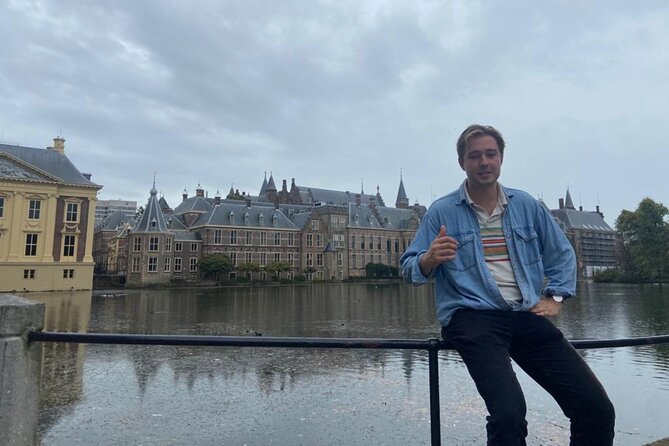
Next comes the Hofvijver, the pond in front of the parliament buildings and the prime minister’s office, known locally as the little tower. The guide adds stories about the site, including lighter details that make the setting easier to remember.
The nearby Thorbecke Monument receives only about a minute, but it connects the tour to the Dutch constitution. This is a quick visual stop, not a lengthy discussion. If political history interests you, ask your guide to spend more time here and trim another stop.
Lange Voorhout and the royal side of The Hague
Lange Voorhout is one of the city’s most elegant streets. The tour compares it to the Champs-Élysées, and the comparison helps explain its broad, formal character.
You walk along the street for about 20 minutes, passing embassies, an art museum, a famous hotel, a temporary Senate building, a gallery of statues honoring Dutch heads of state, and other royal or official buildings. This is one of the better sections for simply looking around, since The Hague’s character comes through in its architecture and institutions.
Noordeinde Palace follows. This is the Dutch king’s working palace, not simply a ceremonial monument. The guide uses the flag to explain if the king is in the country, giving you a small but memorable way to read the building.
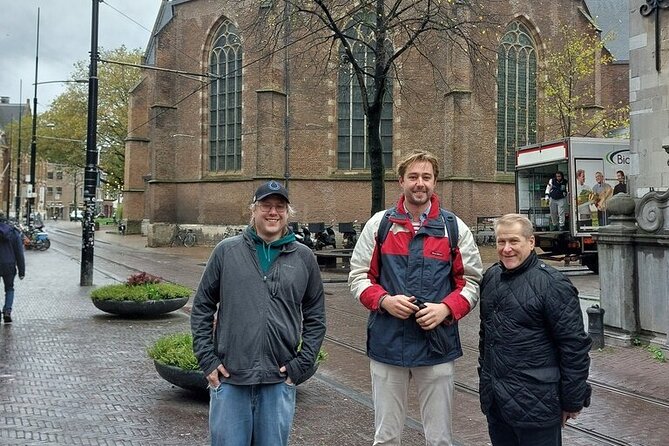
The route then reaches the Grote Kerk, or Big Church. You will hear about the church and the stork perched on top of it, an unusual detail that keeps the stop from becoming a dry architectural lecture. The visit lasts about 15 minutes.
A few more The Hague trips worth a look
- The Hague: Mauritshuis Entrance Ticket
★ 4.7 · 2,706 reviews - The Hague: City Canal Cruise
★ 4.6 · 2,024 reviews - The Hague: Madurodam Miniature Park Entry Ticket
★ 4.6 · 1,559 reviews - The Hague: The Pier SkyView Ticket with Drink and Snack
★ 4.4 · 1,398 reviews
The darker story behind Johan de Witt
The statue of Johan de Witt adds a sharper edge to the The Hague section. De Witt was a head of government who was eaten by an angry mob, an unsettling episode that sounds strange until the political story is explained.
The stop lasts about 15 minutes, making it one of the longer points in the city. It is a reminder that The Hague is not only about palaces and polished avenues. Power, conflict, and public anger are part of the story too.
Together, these stops give you a compact view of The Hague: national politics at the Binnenhof, constitutional change at Thorbecke’s monument, royal life at Noordeinde, diplomacy along Lange Voorhout, and older Dutch struggles in the stories attached to Het Plein and Johan de Witt.
The transfer to Rotterdam changes the mood
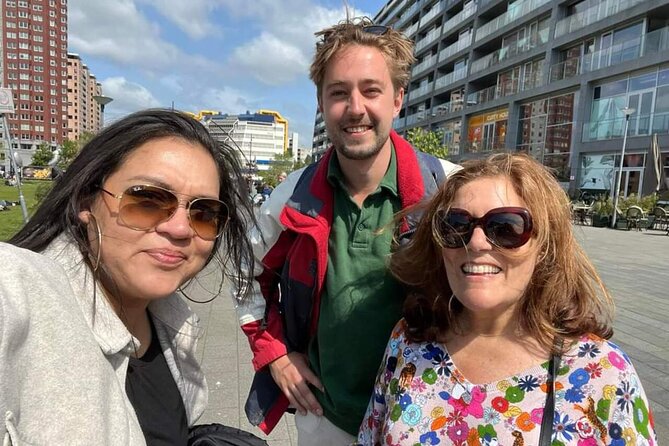
The transfer between The Hague and Rotterdam is included and can be made by train or car. An air-conditioned vehicle is part of the experience, and hotel pickup and drop-off by car are available if you book that option.
The tour can run in either direction. You may begin in The Hague and finish in Rotterdam, as described here, or start in Rotterdam. Pickup and drop-off can also be arranged elsewhere, including Amsterdam, according to the available option.
The stated meeting and ending point is Oudehaven in Rotterdam, but the flexible arrangement matters if you are building this into a larger Dutch itinerary. Confirm the exact pickup and return plan when booking, especially if you are not staying in The Hague or Rotterdam.
On the way to Rotterdam Blaak, you see Rotterdam Central Station from the car. The station opened in 2014 and has a striking design. You also pass a peculiar statue officially called Santa Claus, though locals know it by another name. These brief drive-by details are not full stops, but they add to the city’s eccentric tone.
Rotterdam Blaak and the city’s unusual center
The Rotterdam section begins at Blaak, where the UFO-shaped train station serves the market area connected to the city’s origins. This is where you leave the vehicle and continue on foot.
The contrast with The Hague is immediate. Instead of royal avenues and government buildings, you are surrounded by modern forms, open public spaces, and architecture that takes risks.
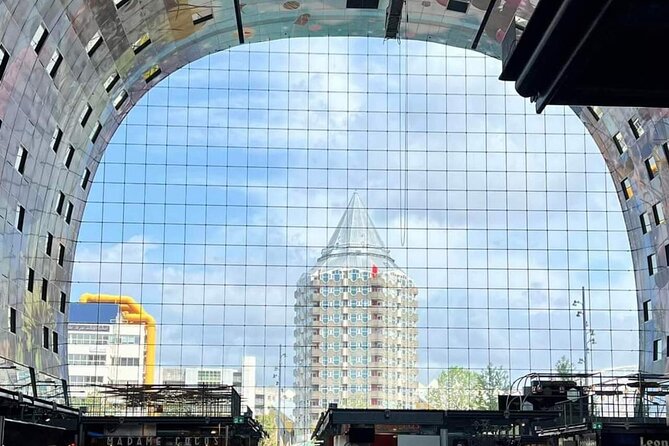
The Markthal is the first major stop. The guide takes you inside this large market building, whose outer sides contain apartments and whose interior offers foods from around the world.
You will at least try some Dutch cheese, and you should look up. The ceiling carries one of the largest pieces of art on the planet, making the building as much a visual experience as a food market. The scheduled visit is about 15 minutes, so it is a quick taste of the hall rather than a long meal.
The Markthal is particularly useful for first-time visitors because it combines daily life, design, and food in one place. If you want to shop or eat at length, you will need extra time after the tour.
A medieval church beside radical architecture
Close to the Markthal is the Grote of Sint-Laurenskerk, a 14th-century church. Its tower survived the bombing of Rotterdam, while much of the surrounding city was destroyed during the Second World War.
Today, the church is used mainly as an event location. The guide also connects it with Erasmus, the famous thinker born here. The stop lasts about 10 minutes, which is enough to understand why this building matters in a city known mostly for modern design.
This is one of Rotterdam’s strongest visual lessons. In a short walk, you see a medieval church, a huge contemporary market hall, and a cluster of experimental homes. The city’s identity comes from that collision of old and new.
Inside the Kijk-Kubus
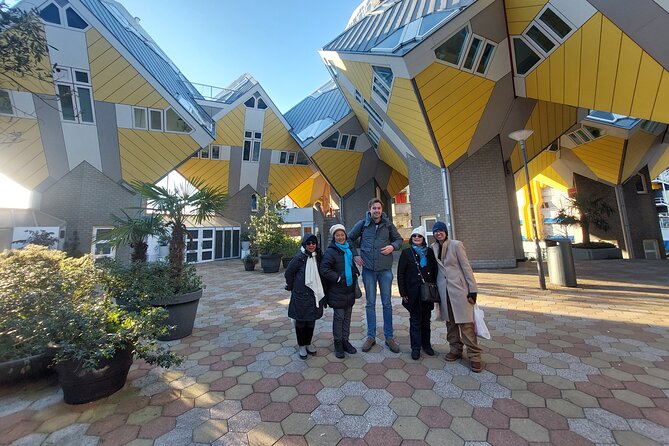
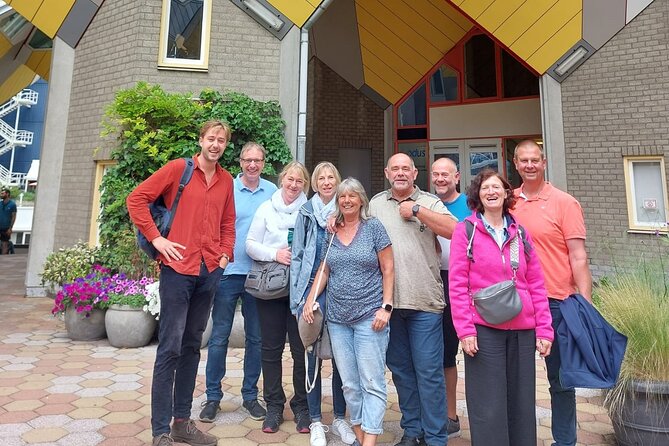
The Cubic Houses are among Rotterdam’s most recognizable buildings. Designed by Piet Blom, they were conceived as a kind of village inside a city. The concept began in the 1970s, and the buildings were constructed in the 1980s.
The outside is more famous than the inside, but this tour includes admission to one apartment, the Kijk-Kubus. That makes a real difference. You can understand the sloping walls and unusual angles rather than simply taking a photograph from the pavement.
The visit lasts about 20 minutes. It is enough to see how the space functions, though anyone who dislikes stairs, tight angles, or unconventional interiors should keep the design in mind before booking. The tour data states that most travelers can participate, and service animals are allowed.
I consider this included admission one of the clearest value points. You get access to a paid attraction without adding a separate ticket, and the interior helps explain why Rotterdam’s architecture is more than a collection of strange shapes.
Old Harbour and the oldest European skyscraper
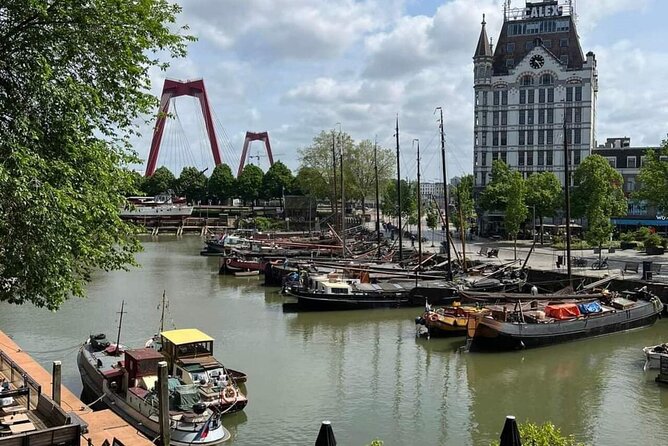
The Oude Haven, or Old Harbour, is now a recreational district with terraces and historic ships awaiting restoration. Rotterdam’s active port has moved many kilometers west, leaving this central waterway with a more relaxed character.
You see additional Piet Blom architecture here and have time to notice how the old ships contrast with the modern apartment buildings. The stop is about 10 minutes, but the area also makes a good place to remain after the tour ends.
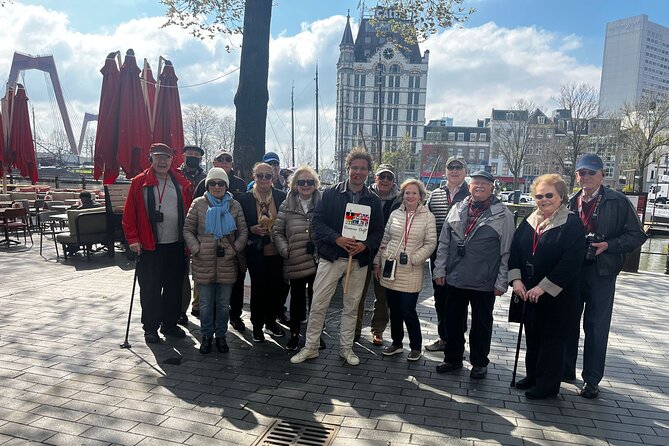
The White House, or Het Witte Huis, is the key building in the Old Harbour area. Dating from 1898, it is described as Europe’s oldest skyscraper. The guide explains its importance to Rotterdam and points out remnants of German bullet holes.
That detail gives the building emotional weight. You are not only looking at an early tall building. You are seeing evidence of the city’s wartime damage and survival.
The Maas skyline from Willemsbrug
The final walk leads toward the Maas and Willemsbrug. From here, you get the broadest view of Rotterdam’s skyline, a fitting end after the close-up look at markets, churches, houses, and the Old Harbour.
The scheduled stop is about 15 minutes. It is not a long city walk, but it gives you space to understand Rotterdam as a port city. This is the point where the nickname Manhattan on the Meuse makes sense, even if the comparison is intentionally playful.
The tour ends in the Old Harbour area. That is practical: terraces are nearby, and the Markthal and city center are around the corner. You can continue eating, shopping, or exploring without arranging another transfer.
Pace, transport, and practical value
The total duration is about four hours and 30 minutes. The listed sightseeing stops are short, often 10 to 15 minutes, with the longest walks in The Hague along Lange Voorhout and through the political center, plus the walking route in Rotterdam.
That pace suits you if you want orientation, stories, and highlights. It is less suitable if you want to enter several museums, linger over lunch, or explore every neighborhood on foot.
Because the tour is private, the guide can adjust the balance. You might ask for more time around the Binnenhof, the Mauritshuis, Rotterdam’s architecture, or the port story. The tradeoff is that adding time in one place means reducing time elsewhere.
The price also needs to be judged against the included services:
- Two private city tours
- Transfer between The Hague and Rotterdam by train or car
- Air-conditioned vehicle
- Cubic House admission
- Hotel pickup and drop-off by car when that option is booked
- Fees and taxes
Gratuities are optional. Free cancellation is available if you cancel at least 24 hours before the start time. Changes or cancellations inside that window are not accepted for a refund.
Who should book this private Rotterdam and The Hague tour?
I would choose this tour for a first visit, a short stay, or a day when you want both cities explained rather than simply photographed. It is especially useful for couples and small groups who value a private guide and do not want to work out the city-to-city connection themselves.
It also suits architecture fans. Rotterdam gives you a strong run of unusual buildings, while The Hague supplies a calmer setting of embassies, royal buildings, and historic facades.
Families may appreciate the short stops and the Cubic House, which gives younger visitors something concrete and odd to explore. The guide’s stories about the stork, the king’s flag, and Johan de Witt’s fate add variety.
I would think twice if your main goal is museum time. The Mauritshuis is discussed from the outside, but entry is not included. You also have limited time at the Markthal, so this is not a food tour.
Should you book it?
Book this private Rotterdam and The Hague tour if you want a quick, flexible introduction to two very different Dutch cities, with transport and a personal guide built in. The best parts are the sharp contrast between political The Hague and experimental Rotterdam, plus the included visit inside a Cubic House.
Skip it if you prefer slow sightseeing, long museum visits, or a single-city tour with plenty of free time. At $255.98 per person, it makes the most sense when private guiding, convenience, and broad coverage matter more than keeping costs low.
FAQ
How long does the tour last?
The tour lasts approximately 4 hours and 30 minutes.
Can I start the tour in Rotterdam instead of The Hague?
Yes. The tour can be taken in either direction, starting in The Hague or Rotterdam.
Is transportation between Rotterdam and The Hague included?
Yes. A short transfer between the cities is included, either by train or by car.
Is hotel pickup available?
Hotel pickup and drop-off by car are available if you book the option that includes them. Pickup and drop-off can also be arranged elsewhere, including Amsterdam, according to the available booking option.
Where does the tour end?
The stated end point is Oudehaven in Rotterdam. The area has terraces and is close to the Markthal and Rotterdam city center.
Is admission to the Cubic House included?
Yes. Admission to a Cubic House, also called the Kijk-Kubus, is included in the tour price.
Is admission to the Mauritshuis included?
No. The tour discusses the Mauritshuis and its history from outside, but museum admission is not included.
What happens if I need to cancel?
You can receive a full refund if you cancel at least 24 hours before the experience start time. Cancellations or changes made less than 24 hours before the start time are not accepted for a refund.
Just added around The Hague
- Private Tour of The Hague, Delft and Rotterdam with Lunch★ 5.0 · 3 reviews
- Discover Historical Delft with an Audio Guide★ 5.0 · 3 reviews
- The Hague Self-Guided Audio Tour★ 5.0 · 3 reviews
- 3 Course Walking Dinner in Delft with Guided Tours in Between★ 5.0 · 3 reviews
- Surprise Walk of The Hague with a Local★ 4.5 · 3 reviews
- Surfing at The Shore in The Hague★ 4.5 · 3 reviews
- Private Tour of Vermeer’s Delft + Tickets to Vermeer Museum★ 5.0 · 3 reviews
- Delft: City Walk with Audio Guide in 7 Languages on your Phone★ 5.0 · 4 reviews
The Hague Tours, compared.

Hop-on Hop-off Old-Fashioned Heritage Tram Tour
Read our review →
Oranjehotel World War II Prison Entrance Ticket
Read our review →
Browse the lists this tour appears in