
Reviewed · THE HAGUE TOURS
Private Tour of Delft & Rotterdam with Cube House and Transfer
Delft and Rotterdam make a smart pair: one is a graceful canal town tied to Vermeer and the Dutch royal family, while the other is a bold modern city rebuilt around daring architecture. This private tour links them by train, with a look inside Rotterdam’s famous Cube Houses.
I like the personal guide and the useful Delft-to-Rotterdam transfer. Guides including Remy, Robin, Alberto, and Tristan have been praised for clear storytelling, warmth, and flexibility. I also like the route’s variety: royal tombs, leaning churches, a Vermeer viewpoint, a 1970s apartment experiment, and a giant indoor market.
The main thing to understand before booking is that this is primarily a walking tour, not a chauffeur-driven sightseeing trip. Hotel pickup and drop-off by car are available with the appropriate option, but much of the sightseeing is on foot. That matters if rain, mobility limits, or a bad foot could make several hours of walking difficult.
Key points at a glance
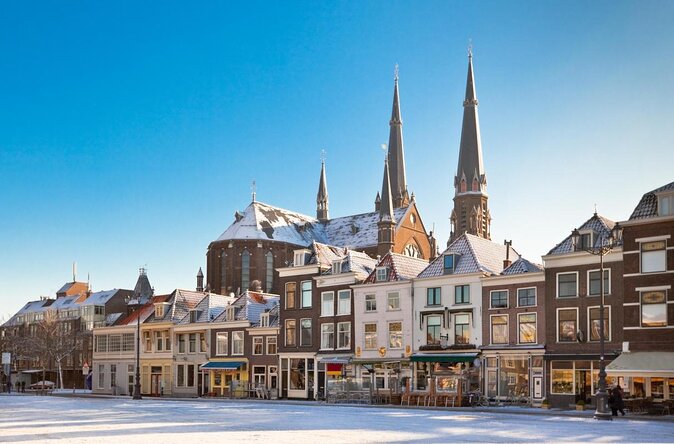
- Delft’s historic center: See the Prinsenhof, Old Church, New Church, town hall, old canals, and places linked to Johannes Vermeer.
- Rotterdam by public transport: The included train from Delft to Rotterdam Blaak takes about 18 minutes and costs €4.10 when booked as part of the tour.
- Cube House interior: Enter one of Piet Blom’s tilted, tree-like apartments rather than viewing the unusual buildings only from outside.
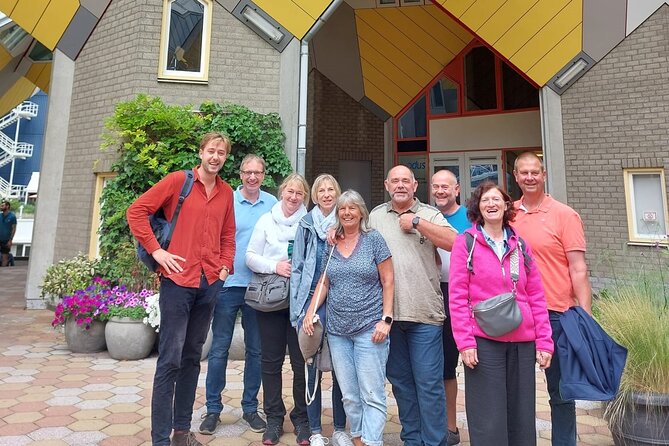
- Private attention: Your group has its own English-speaking guide, with time to ask questions and adjust the discussion to your interests.
- A full half-day: Plan on roughly four to five hours, with several short stops and plenty of walking between them.
- Flexible ending: The tour finishes around Blaak, so you can continue exploring Rotterdam or take a train home from there.
Why Delft and Rotterdam work so well together
Delft gives you the Netherlands many people picture first: canals, old brick buildings, church towers, and compact squares. Rotterdam offers almost the opposite experience, with large modern structures, broad rebuilding projects, and architecture that often asks you to stop and figure out how it works.
I like seeing both cities on the same outing because the contrast has a point. Delft helps explain the Dutch Republic, trade, religion, painting, and royal tradition. Rotterdam shows how a major port city created a new identity through modern design after wartime destruction.
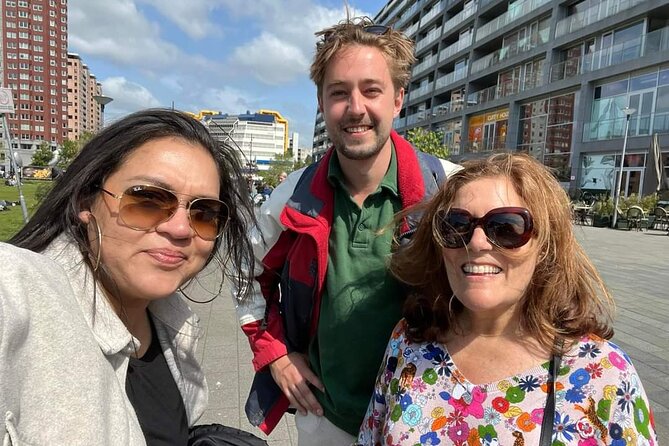
The tour is private, so you are not being moved along with a large group. You can ask why the Old Church leans, how Delft connects to Vermeer, or why Rotterdam’s Cube Houses are tilted without feeling you are holding up a busload of people. The guides are English-speaking, and the strongest praise has gone to their storytelling and ability to respond to individual interests.
More private transfers in The Hague:
- Private Transfer from The Hague City to Schiphol Airport
★ 5.0 · 5 reviews - Private Tour of Rotterdam and The Hague including Transfer
★ 5.0 · 3 reviews - Amsterdam: Keukenhof Ticket and Roundtrip Shuttle Transfer
★ 4.7 · 11,799 reviews
Walking into Delft’s Prinsenhof and old brewing quarter
The Delft portion begins at Museum Prinsenhof, a place closely tied to Dutch political history. The visit is brief and the walk-through does not include an admission ticket, but the setting gives your guide a useful opening for explaining why Delft mattered far beyond its pretty canals.
From there, you reach the Old Church, or Oude Kerk, in what was once Delft’s beer-brewing quarter. The building is one of the city’s most memorable sights, partly because of its pronounced lean. Your guide explains both its age and the practical reason for the tilt, turning a quick photo stop into a small lesson in how the city was built.
The itinerary allows about ten minutes at the church. That is enough for an introduction and exterior viewing, not a full church visit. If you want long interior visits at every stop, this pace may feel brisk. If you prefer a clear route with context at each place, the short stops keep the half-day moving.
Nearby, the elaborate facade of the Gemeenlandshuis van Delfland offers another useful pause. This was an important water management building, and its decorated exterior hints at how much Dutch civic life depended on controlling canals, rivers, and drainage. It is the kind of stop you could easily walk past without a guide.
Delft town hall, royal tombs, and the climb at the New Church
The route continues to Delft’s old town hall, partly dating from the 13th century. It sits beside the Grote Markt, a natural place to pause before crossing toward the New Church. The town hall is not treated as a grand interior tour here, but its age and role in city government give the square more meaning than a quick architectural glance.
The New Church, or Nieuwe Kerk, is one of Delft’s major landmarks. It is the second-highest church in the Netherlands, and members of the Dutch royal family are buried here. Your guide explains why the royal burial tradition is connected with Delft, which is one of the tour’s most useful pieces of context.
You can also choose to buy a ticket to climb the church tower. The warning is fair: it is quite a climb. The tower can add a strong view and a memorable physical challenge, but it may not fit comfortably into a four to five hour schedule for every group. Ask your guide early if this matters to you.
Delft is especially rewarding when you slow down enough to notice the connection between civic buildings, churches, canals, and trade. The private format gives you room to ask about the details that catch your eye instead of following a fixed speech.
Following Vermeer from the Armamentarium to his Delft viewpoint
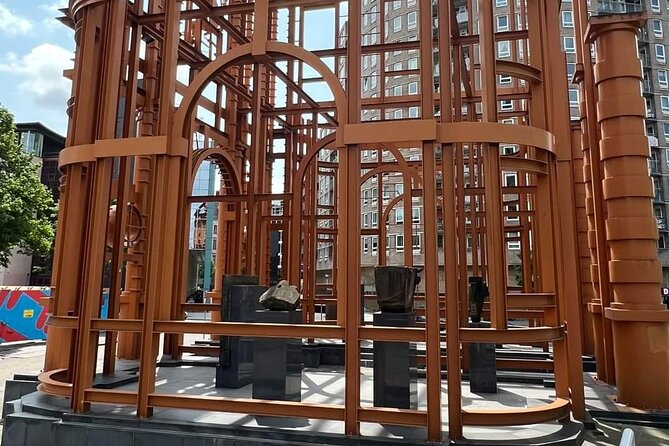
The walk then leaves the Grote Markt and follows Delft’s oldest canal toward the southern part of the center. Along the way, you pass the Armamentarium, a large former weapons storehouse connected with the Dutch East India Company, known as the V.O.C.
This stop opens a different chapter of Delft’s past. The city was not only a place of churches and paintings. It also played a role in the commercial and military power of the Dutch Republic. The building’s scale helps you picture that earlier purpose.
This part of the route also points out the exact location from which Vermeer painted his famous View of Delft. You do not need to enter a museum to get something valuable from the stop. The guide helps connect the city you see today with the scene Vermeer composed, which makes the canals and rooftops feel less like a generic old town.
The Vermeer connection continues at the Maria van Jessekerk. This was the first Catholic church built in Delft’s center, and its two towers have an unusual relationship that your guide points out. The church also occupies the site where Vermeer lived and painted.
The stop is planned for about 25 minutes, longer than some of the earlier exterior visits. That gives you time to take in the church and hear how Delft’s religious and artistic stories overlap. Still, the exact amount of time available can depend on walking pace, weather, and questions from your group.
A few more The Hague trips worth a look
- The Hague: Mauritshuis Entrance Ticket
★ 4.7 · 2,706 reviews - The Hague: City Canal Cruise
★ 4.6 · 2,024 reviews - The Hague: Madurodam Miniature Park Entry Ticket
★ 4.6 · 1,559 reviews - The Hague: The Pier SkyView Ticket with Drink and Snack
★ 4.4 · 1,398 reviews
A pause at Beestenmarkt before the train
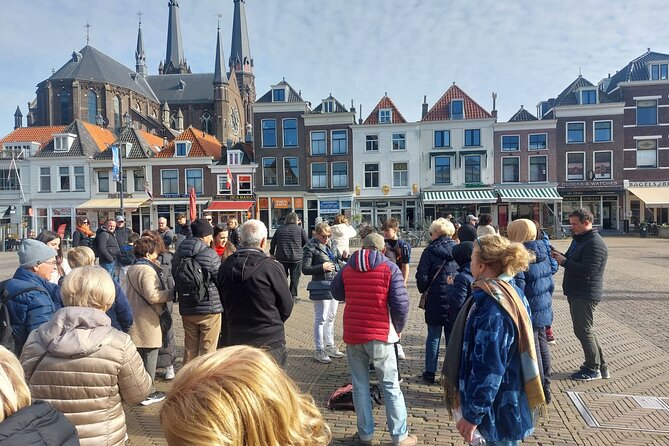
The Delft walk finishes around Beestenmarkt, a pleasant square lined with places suited to a drink or meal. Its earlier use was quite different, and the guide explains how the square changed over time.
This is the most obvious point to ask about lunch or a short break. The tour does not list a meal as included, so food and drinks are your own expense. If you want a relaxed meal here, confirm the timing with your guide because the route continues toward Delft railway station.
That walk to the station is part of the experience, not simply a transfer hidden behind the scenes. You get one last look at Delft before trading its old center for Rotterdam’s modern architecture.
The 18-minute train ride to Rotterdam Blaak
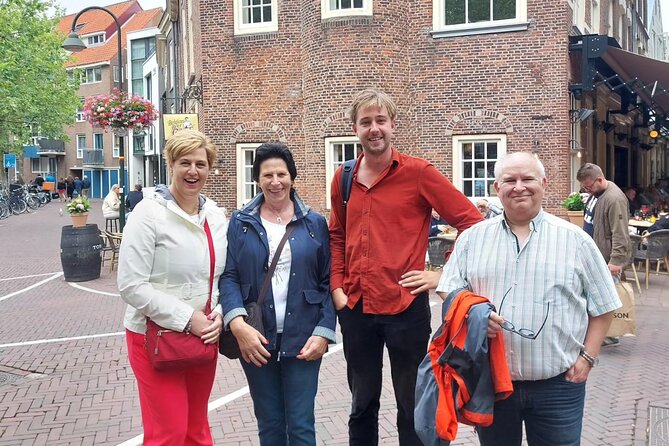
The train from Delft to Rotterdam Blaak takes about 18 minutes. The €4.10 fare is included, and the transfer can be made by train or car depending on the arrangement for the tour.
I like this part of the plan because the train is practical and gives you a brief change of pace. You are not spending a large block of the half-day in a vehicle, and arriving at Blaak places you close to several of Rotterdam’s key sights.
The public transport portion does require normal station movement and walking. It is not a private car transfer from one landmark entrance to the next. If you selected hotel pickup and drop-off, the car service applies to those arrangements, while the core Delft-to-Rotterdam route remains a short transfer by train or car.
Inside Rotterdam’s Cube Houses
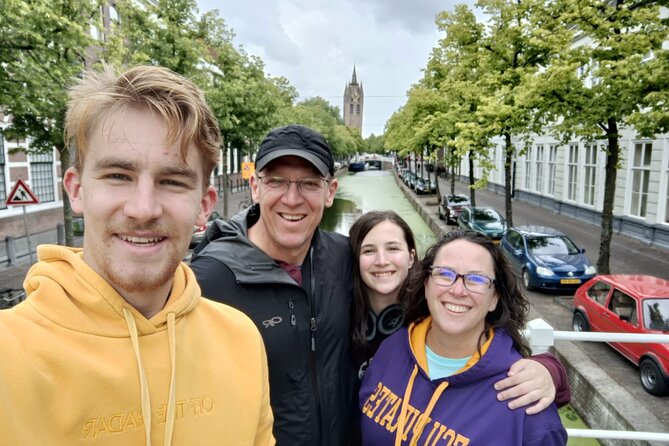
At Rotterdam Blaak, the Cube Houses come into view almost immediately. Designed by Piet Blom in the 1970s, they are tilted apartments meant to suggest a village within the city. Their unusual angles are easy to photograph, but entering one makes the idea much clearer.
The ticket to the Cube House museum-home is included. This is an important benefit because the interior answers questions that an exterior view cannot. You can see how rooms and living areas fit inside a structure turned on its side, at least in spirit.
Expect a short visit of about 15 minutes. It is not a full architectural lecture or an extended home tour, but it gives you enough to understand why the buildings are both clever and awkward. The Cube Houses are a good example of Rotterdam’s character: practical urban problems met with an idea that is not afraid to look strange.
Oude Haven and Europe’s oldest skyscraper
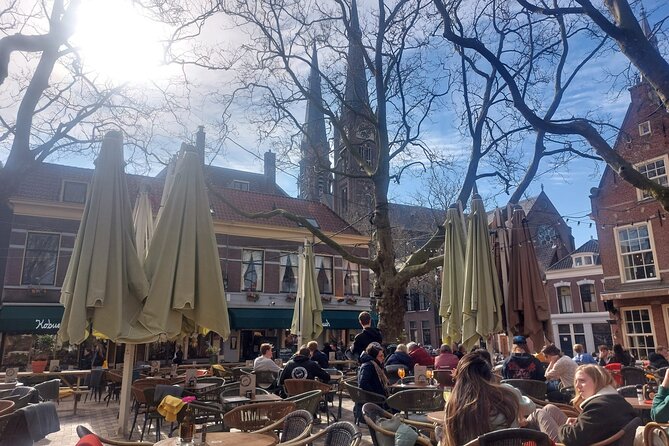
After the Cube Houses, the route enters Oude Haven, Rotterdam’s Old Harbour. Today it is a recreational area with terraces and old ships, some of them waiting for restoration. You will also see more work by Piet Blom in this area.
The harbour provides a useful pause after the dense architecture around Blaak. The boats and water soften the surroundings, while the modern buildings keep the view distinctly Rotterdam. The stop lasts about 15 minutes, enough for photos and an explanation of how the area is used now.
Nearby, Het Witte Huis, or the White House, is one of the city’s most prominent buildings. Completed in 1898, it is described as Europe’s oldest skyscraper. It was also one of the few buildings to survive the bombing of Rotterdam, making it an important link between the city’s earlier appearance and its rebuilt identity.
You will see the building from outside. The value is in understanding its age and survival rather than entering it. In a city known for modern structures, the White House reminds you that Rotterdam had an impressive vertical city before the 20th century changed everything.
Looking up inside the Markthal
The route returns toward Blaak and enters the Markthal. Its outer walls contain apartments, while the interior holds food stalls and vendors offering food from around the world. You have free time to look around, but purchases are not included.
The most striking feature is overhead: a huge interior artwork covering the vaulted ceiling. Your guide will direct your attention upward, which is good advice. Many people enter focused on food and forget to study the ceiling, even though it is the building’s most dramatic visual feature.
The Markthal is a useful stop for more than its appearance. It shows how Rotterdam mixes daily city life with large architectural gestures. You can browse the food hall, take photos, or simply compare the building with Delft’s older market square.
The Laurenskerk and the place where Rotterdam began
Next door is the Grote of Sint-Laurenskerk, a 14th-century church whose tower survived the bombing. Today the church is used mainly as an event location, but its survival gives it a special weight among the newer buildings around Blaak.
The final stop returns to the Markthal area, where the original dam over the Rotte was built. That dam gave Rotterdam its name. On Tuesdays and Saturdays, a large outdoor market adds another layer to the area, though the market schedule means you should not assume it will be operating on your tour day.
The tour ends around Blaak rather than returning you automatically to Delft. That is convenient if you want to keep exploring Rotterdam, but you should plan your onward route. If you booked hotel pickup and drop-off, the selected option includes the return by car afterward. Confirm the arrangements before the day begins.
Price, timing, and walking effort
At $228.78 per person, this is not a bargain-priced city walk. The cost needs to be judged against what you are getting: two private city tours, an English-speaking guide, the Cube House admission, the Delft-to-Rotterdam transfer, taxes, and possible hotel pickup and drop-off if you choose that option.
For a small group, private guiding can offer better value than paying for separate public tours in both cities. You get one guide who can connect Delft and Rotterdam, answer questions, and adjust the pace. For one or two people, the price is a bigger commitment, so the main benefit is personal attention rather than the number of inclusions.
The advertised duration is about four to five hours. The route includes many short stops, but the total walking time between them matters. Wear comfortable shoes and plan for outdoor conditions. The rain-related experience of one couple is worth taking seriously: the tour description can sound like a driven excursion, but most sightseeing is on foot.
The option with pickup and drop-off is the better choice if you are staying outside the central meeting area or want to avoid arranging your own transport. Pickup can occur up to one hour before the start, with the exact details coordinated in advance.
Who will get the most from this private tour
I would choose this for someone who wants history and architecture explained by a person rather than collected from plaques. It suits couples, families, and small groups who like asking questions and moving at a shared pace.
It is also a strong choice if you have only half a day and want to see two very different Dutch cities. Delft receives the more traditional treatment, while Rotterdam brings the design and urban change.
I would be cautious if you need a mostly vehicle-based sightseeing day. The tour is not built around staying in the car, and you should tell the provider about mobility concerns before booking. Service animals are allowed, the route is near public transport, and most people can participate, but the walking requirement remains the key practical issue.
The guides are a major part of the value. Remy is a high school history teacher, while Alberto, Tristan, and Robin have also been singled out for clear explanations, courtesy, and attention to individual needs. The strongest pattern is not a particular script or attraction. It is the guide’s ability to make Delft’s history and Rotterdam’s architecture understandable without making the walk feel like a classroom.
Should you book it?
Book this private tour if you want a focused introduction to Delft and Rotterdam, especially if Vermeer, Dutch civic history, royal tradition, and modern architecture all appeal to you. The Cube House interior and included train ride add real value, and finishing at Blaak lets you continue exploring on your own.
Think twice if you expected a private car tour with minimal walking. Choose the pickup and drop-off option if that service matters, and discuss pace or mobility needs before the tour begins. With free cancellation up to 24 hours before the start, you also have some room to adjust plans, but late cancellations and changes are not refunded.
FAQ
How long does the tour last?
The experience lasts approximately four to five hours.
Is this a private tour?
Yes. Only your group participates in the activity.
Is the tour conducted in English?
Yes. The tour is offered in English.
Does the price include the train from Delft to Rotterdam?
Yes. The short transfer from Delft to Rotterdam Blaak is included. The train journey takes about 18 minutes, and the listed fare is €4.10.
Is admission to the Cube House included?
Yes. The price includes entry to one of Rotterdam’s Cube House museum-apartments.
Does the tour include hotel pickup and drop-off?
Hotel pickup and drop-off are included only when you book the option that offers this service. Pickup may take place up to one hour before the tour, with details coordinated in advance.
Is the tour mainly a driving tour?
No. The sightseeing is designed mainly as a walking tour, with a short transfer between Delft and Rotterdam by train or car. The provider has acknowledged that the description should make the walking format clearer.
Can I cancel for a full refund?
Yes, if you cancel at least 24 hours before the experience start time. Cancellations or changes made less than 24 hours in advance are not refunded or accepted.
Just added around The Hague
- Private Tour of Rotterdam and The Hague including Transfer★ 5.0 · 3 reviews
- Private Tour of The Hague, Delft and Rotterdam with Lunch★ 5.0 · 3 reviews
- Discover Historical Delft with an Audio Guide★ 5.0 · 3 reviews
- The Hague Self-Guided Audio Tour★ 5.0 · 3 reviews
- 3 Course Walking Dinner in Delft with Guided Tours in Between★ 5.0 · 3 reviews
- Surprise Walk of The Hague with a Local★ 4.5 · 3 reviews
- Surfing at The Shore in The Hague★ 4.5 · 3 reviews
- Private Tour of Vermeer’s Delft + Tickets to Vermeer Museum★ 5.0 · 3 reviews
The Hague Tours, compared.

Hop-on Hop-off Old-Fashioned Heritage Tram Tour
Read our review →
Oranjehotel World War II Prison Entrance Ticket
Read our review →
Browse the lists this tour appears in