
Reviewed · THE HAGUE TOURS
Historical The Hague: Private Tour with Local Guide
The Hague’s political story unfolds in a compact walk, from Willem van Oranje and the Dutch revolt to the parliament buildings, the prime minister’s office, and the king’s working palace. I like that this is a private tour, so you can ask about Dutch life as you go, and I like the mix of major sights with odd details, such as the mob violence surrounding Johan de Witt. The guide may even point out Dutch ministers on the move.
The main consideration is that two hours goes quickly. You see the Mauritshuis from the outside rather than receiving museum admission, and most stops are brief. The route also requires a moderate level of fitness, with bicycles sharing the streets and paths.
Key points at a glance
- A private group price: The $287.95 cost covers up to 15 people, making the per-person value much better for a family or larger group than for one or two people.
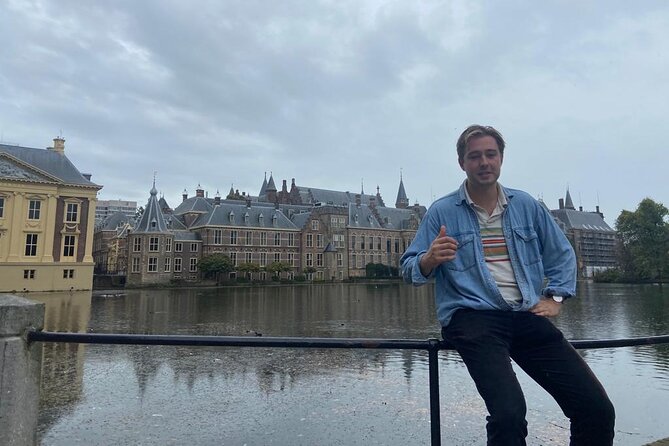
- A political heart: Binnenhof, the Ridderzaal, Hofvijver, and the prime minister’s office give the walk a clear focus on Dutch government.
- Royal and elegant streets: Lange Voorhout and Noordeinde Palace bring embassies, royal buildings, art, and grand city architecture into the route.
- History with unusual stories: Willem van Oranje, Thorbecke, and Johan de Witt help turn statues and squares into memorable stops.
- A flexible pace: You can ask about modern Dutch life, politics, food, and customs instead of following a fixed group script.
- A walking tour with no entry fees: The listed stops are viewed from public areas, so there is no museum or attraction ticket included or required for this route.
Why The Hague works so well on foot
The Hague can feel less immediately obvious than Amsterdam. It is not built around one single canal ring or one giant monument. Instead, its character comes from the way government, royal life, museums, embassies, churches, and daily city traffic sit close together.
This private walk gives you a useful framework. You are not simply passing a statue and taking a photograph. You are hearing how the Dutch revolt shaped the country, how the constitution changed political power, and why The Hague became the center of national government.
I especially like the private format for this city. Dutch political history is full of names, institutions, and complicated arrangements. With your own guide, you can stop and ask what a prime minister actually does, how the monarchy fits into public life, or what makes Dutch society work as it does. The tour description specifically invites questions about life in the Netherlands, which gives the experience a more personal feel than a standard sightseeing loop.
The guide can adjust the pace, but do not read that as unlimited time. The route includes nine stops in about two hours. You will get an introduction to each place, not a long visit inside every building.
More history tours in The Hague:
- The Hague: Hop-on Hop-off Old-Fashioned Heritage Tram Tour
★ 4.4 · 1,083 reviews - Photographic Tour in Delft Historical Center
★ 5.0 · 11 reviews - Private Walking Tour: Delft’s Royal History and Pottery
★ 4.0 · 5 reviews
Starting at Plein with Willem van Oranje
The tour begins at Plein, a central square near the political core of The Hague. It is a sensible meeting point because the first story concerns Willem van Oranje, often called the Father of the Fatherland, and his role in the 80 Years War, the Dutch revolt against Spanish rule.
This is a strong opening because it gives you the basic national story before you encounter government buildings. The Netherlands did not simply appear as a modern, tolerant trading country. Its political identity developed through conflict, resistance, and arguments over power.
Expect about ten minutes here. That is enough for a clear introduction, but not enough for an exhaustive account of the revolt. I would use this moment to ask the guide to connect Willem van Oranje with the later Dutch state. If your guide is Mario, you can also expect a blend of historical background and present-day perspective, the combination he has brought to other tours.
Plein is also a useful place to get your bearings. Since the tour ends back at the meeting point, you can return to the square later for food or onward transport. One practical note: stay alert while walking around The Hague. Bicycle riders move quickly, and one tour participant specifically highlighted the need to watch for them.
The Mauritshuis from the outside
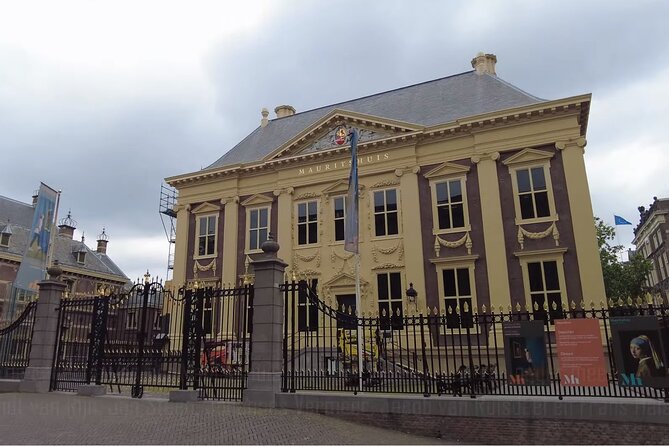
From Plein, the route heads toward the Mauritshuis. The guide explains the building and its past, including its connection to famous paintings by Johannes Vermeer housed inside.
This is an important distinction: the tour does not include admission to the museum. You receive an exterior introduction and historical context, but you do not spend time viewing the galleries as part of the two-hour walk.
That can be either a benefit or a limitation. If you already plan to visit the Mauritshuis separately, the guide’s explanation can help you understand the building before you enter. If you hoped to see Vermeer’s paintings during this experience, you will need a separate museum ticket and a separate visit.
The stop lasts about ten minutes. I would ask which artworks or artists deserve your attention inside, then decide if the museum fits your schedule later. This is one place where the private format helps, since the guide can tailor the advice to your interests.
Inside the political center at Binnenhof
The walk then reaches Binnenhof, the historic parliamentary complex, and the Ridderzaal, or Knight’s Hall. You briefly enter the square within the complex and hear why this site matters.
This is likely the core of the tour. The buildings are not just attractive old architecture. They represent the long connection between The Hague and Dutch national government. The Ridderzaal is especially important as a symbol of the country’s political life.
The stop is listed at roughly ten minutes, so the emphasis is on orientation and explanation rather than a full architectural visit. You will not be taking a formal tour of every room. Instead, you get a concise account of the complex and its place in Dutch government.
There is also a bit of present-day energy here. With luck, you might see ministers walking through the area. That possibility is modest, not a promise, but it adds a nice link between the historic setting and the government that still operates nearby.
If political systems interest you, this is where I would ask the most questions. The guide can explain the buildings in plain terms, and you can steer the conversation toward modern Dutch politics rather than staying only with dates and monuments.
A few more The Hague trips worth a look
- The Hague: Mauritshuis Entrance Ticket
★ 4.7 · 2,706 reviews - The Hague: City Canal Cruise
★ 4.6 · 2,024 reviews - The Hague: Madurodam Miniature Park Entry Ticket
★ 4.6 · 1,559 reviews - The Hague: The Pier SkyView Ticket with Drink and Snack
★ 4.4 · 1,398 reviews
Hofvijver and the little tower
The next stop is Hofvijver, the pond directly in front of the parliamentary buildings. Across or near this water, you can see the prime minister’s office, known as the little tower.
Hofvijver is valuable because it lets you take in several parts of The Hague at once: the water, the historic parliament complex, and the working center of government. The guide also shares stories about the site, including some humorous history.
Plan on another ten minutes. This is a good place for photographs and for a short pause after the denser material at Binnenhof. The view helps you understand the city’s layout, but the tour remains focused on explanation rather than a long scenic stop.
The sight of a prime minister’s office in an old, compact setting may surprise you. It makes Dutch government feel close at hand rather than hidden in a distant administrative district. That is one of the pleasures of this route: national institutions appear in ordinary city spaces.
Thorbecke and the Dutch constitution
Near Hofvijver, the tour pauses at the Thorbecke Monument. Johan Rudolf Thorbecke is tied to the Dutch constitution, so this statue becomes a chance to discuss how the country’s political system took shape.
A statue can be easy to ignore when you are sightseeing. Here, it has a purpose. The guide uses it to explain a major constitutional moment and the person associated with it. You do not need prior knowledge of Dutch politics to follow the basic idea.
Again, the stop is short, about ten minutes. I would not expect a detailed constitutional law lesson. What you should get is a useful explanation of why Thorbecke matters and how a monument can reflect the way Dutch government works.
This section may appeal most to adults and older children who enjoy connecting public spaces with real political change. It also gives the tour a stronger modern focus, balancing the earlier story of revolt and monarchy.
Lange Voorhout, The Hague’s grand avenue
Lange Voorhout is described as the Champs-Élysées of The Hague, and the comparison points to its broad, elegant character. The walk here lasts about 20 minutes, making it the longest single stretch on the route.
You pass embassies, an art museum, a famous hotel, a temporary senate building, a gallery of statues representing Dutch heads of state, and other royal or official buildings. This is where the city’s polished side comes forward.
I like this section because it shows that The Hague is more than a government town. Diplomacy, art, hotels, royal connections, and civic history all share one avenue. You can also ask the guide how these institutions fit into present-day Dutch life.
The description uses the phrase classy street, and that is a fair expectation. Still, do not expect a stop inside each building. The value is in the sequence and the commentary as you walk. The avenue also contributes to the physical demands of the outing, since the route is taken on foot and includes several stops before and after it.
Noordeinde Palace and the Dutch king
The route continues to Noordeinde Palace, the working palace of the Dutch king. You see the building from the outside and learn how to check the flag to find out if the king is in the country.
This is an appealing small detail because it turns a royal building into something you can interpret for yourself. Instead of only hearing that the palace is important, you get a simple visual clue connected to royal life.
The stop lasts about ten minutes. The tour does not include palace entry, and the focus is on the exterior, the monarchy, and the building’s role as a working palace. That makes it a good fit for a first look at Dutch royalty, though visitors wanting palace rooms or an indoor exhibition will need another activity.
Noordeinde also reinforces the contrast running through the tour. Government offices and parliamentary buildings sit close to royal spaces, yet they serve different functions. A local guide can make those distinctions easier to understand than a plaque can.
The Grote Kerk and its curious stork
The Grote Kerk, or Big Church, provides a change of mood. After the political and royal stops, you reach one of The Hague’s major religious and architectural landmarks.
The guide draws attention to the stork on top of the church and explains why it is there. That is exactly the kind of small, local question that makes a walking tour worthwhile. You might pass the building on your own, notice the bird, and never learn its meaning.
The planned stop lasts 15 minutes. As with the other sites, this is an exterior-focused visit unless a separate arrangement says otherwise. The church gives you another way to read the city, through local symbols and civic identity rather than national politics alone.
I would keep your eyes up here. The stork detail is easy to miss, and the point of the stop is not just the church façade. It is the story attached to it.
Johan de Witt and the darker side of politics
The final stop is the Statue of Johan de Witt, with one of the most startling stories on the route. De Witt was a head of government who was eaten by an angry Dutch mob.
That fact sounds almost impossible, which is why it tends to stay with you. The guide explains what happened rather than leaving the story as a gruesome shock. It also shows that Dutch political history includes public anger, violence, and power struggles, not only orderly institutions and attractive buildings.
The stop takes about 15 minutes. It is a fitting end because it brings the themes of political power and public opinion into sharper focus. After hearing about Willem van Oranje, parliament, constitutional change, and the monarchy, you finish with a reminder that government has always depended on more than buildings and titles.
The tour ends back at Plein. You can use the final moments to ask follow-up questions or get a restaurant suggestion. A restaurant recommendation was one of the useful personal touches associated with the guide Mario, so it is worth asking if you want help choosing where to eat afterward.
Price, group size, and what you actually receive
The price is $287.95 per group of up to 15 people. That is a high total for a two-hour walk if you are booking alone or as a couple, but the calculation changes quickly for a larger party.
For 15 people, the cost works out to about $19 per person. For four people, it is roughly $72 each. For two people, it is about $144 each. The private setting, guide access, and freedom to shape the conversation are the main reasons to consider the price.
No admission fees are part of the route because the stops are viewed from public areas. That keeps the outing simple, but it also means you are paying primarily for the guide’s interpretation, not for museum entry or an indoor palace visit.
Pickup is offered, while the stated meeting point is Plein and the tour returns there. Confirm the pickup details when booking if you need that option. Confirmation arrives at booking, and free cancellation is available until 24 hours before the start time. Changes or cancellations inside that window are not refunded.
Who will get the most from this walk
I would choose this tour if you want a first introduction to The Hague and prefer conversation over a large group presentation. It suits couples, families, and private groups who want to ask questions about Dutch politics, history, royal life, and everyday customs.
It also works well if you have only a short time in the city. In two hours, you cover many of the central sights without committing to a full-day program. The route can help you decide which places deserve a later, longer visit.
You should think twice if your priority is going inside museums, churches, or palaces. The Mauritshuis is discussed from the outside, and the other stops are also primarily exterior visits. You should also allow for walking, moderate physical fitness, and close attention to bicycles.
The small review sample gives the experience a perfect five-star rating, with particular praise for historical and modern information, the blend of old and new The Hague, and a restaurant recommendation. Those strengths are believable from the format: the tour has enough structure to teach you the city, but enough flexibility for a real conversation.
Should you book Historical The Hague?
Book it if you want the city explained by a local guide rather than simply photographed. The route gives you a clear story, from the Dutch revolt to constitutional change, royal life, and the modern political center. Mario is mentioned as a guide who offers both historical background and a present-day view, though your assigned guide may differ.
The best value comes when you share the fixed group price with several people. For a larger private party, the cost is quite reasonable. For one or two people, it is a premium for personal attention, flexible pacing, and the ability to ask exactly what you want.
I would treat it as a strong orientation walk, not a substitute for museum or palace visits. Keep your bicycle awareness switched on, ask questions freely, and save time afterward if you want to enter the Mauritshuis. For a concise, personal introduction to The Hague’s government, royal connections, and unusual political stories, this tour earns serious consideration.
FAQ
Where does the tour start?
The tour starts at Plein, 2511 Den Haag, Netherlands.
Where does the tour end?
The activity ends back at the meeting point at Plein.
How long does the experience last?
The tour lasts approximately two hours.
Is the tour private?
Yes. Only your group participates, and the group can include up to 15 people.
Is pickup available?
Pickup is offered. The stated meeting point is Plein, so confirm the pickup details when booking if you need this option.
Are attraction admission tickets included?
No attraction admission tickets are listed. The tour visits and explains the sights from public areas, and the listed stops have no admission charge.
Can I visit the Mauritshuis during the tour?
The route takes you toward the Mauritshuis and includes information about the building and its history. Museum admission is not included, so a museum visit would require a separate ticket and visit.
Is the tour suitable for someone with limited mobility?
The tour requires a moderate level of physical fitness. It is a walking experience with several stops around central The Hague.
What is the cancellation policy?
You can cancel up to 24 hours before the start time for a full refund. Cancellations or changes made less than 24 hours before the start time are not accepted for a refund.
Just added around The Hague
- Private Tour of Rotterdam and The Hague including Transfer★ 5.0 · 3 reviews
- Private Tour of The Hague, Delft and Rotterdam with Lunch★ 5.0 · 3 reviews
- Discover Historical Delft with an Audio Guide★ 5.0 · 3 reviews
- The Hague Self-Guided Audio Tour★ 5.0 · 3 reviews
- 3 Course Walking Dinner in Delft with Guided Tours in Between★ 5.0 · 3 reviews
- Surprise Walk of The Hague with a Local★ 4.5 · 3 reviews
- Surfing at The Shore in The Hague★ 4.5 · 3 reviews
- Private Tour of Vermeer’s Delft + Tickets to Vermeer Museum★ 5.0 · 3 reviews
The Hague Tours, compared.

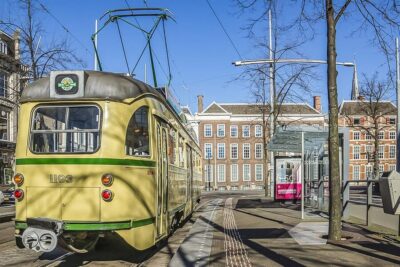
Hop-on Hop-off Old-Fashioned Heritage Tram Tour
Read our review →
Oranjehotel World War II Prison Entrance Ticket
Read our review →
Browse the lists this tour appears in