
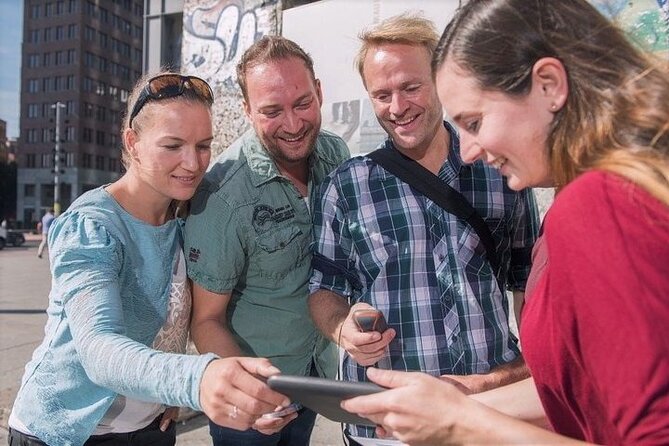
Reviewed · E-SCAVENGER HUNTS & CITY GAMES
e-Scavenger hunt Tilburg: Explore the city at your own pace
Tilburg’s best feature is its mix of old industrial character and modern culture, and this self-guided city game uses that mix as your playing field. You follow clues to places such as De Pont Museum, the TextielMuseum, LocHal, and Stadsbrouwerij 013, rather than simply walking past them. I like the freedom to set your own pace, and I like that a group of up to six can share one game and compete for the top score.
The main catch is that the game itself may feel basic for the price. Some tasks involve obvious sights, selfies, or multiple-choice answers, and a few questions may be hard for visitors who do not speak Dutch. At $37.33 per group, it is good value with six people, but less compelling for a small group expecting a detailed guided tour.
Key points to know before you play
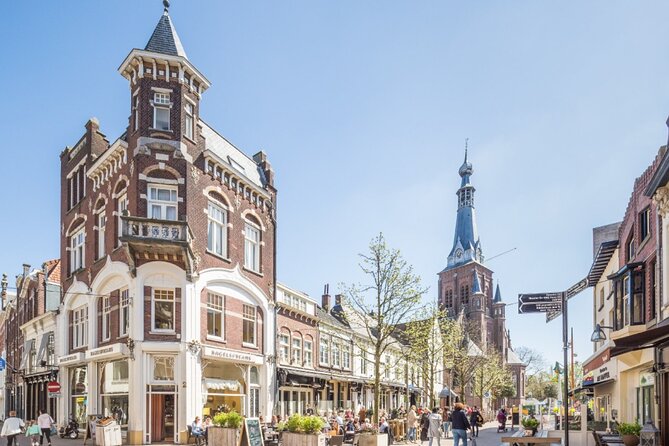
- Start at Spoorlaan 35: The game begins and ends at the same Tilburg meeting point, making it easy to plan around public transport.
- Expect two to four hours: Your pace, group size, breaks, and time spent at the stops will shape the total outing.
- Six people share one team: This works well for families, friends, and small company groups.
- Your phone is the guide: You need a smartphone, mobile data, and the free app. There is no listed live guide.
- The route covers more than famous sights: Museums, the Spoorzone, a brewery, and cultural meeting places give you a broad look at Tilburg.
- Admission is not included: The activity takes you to the museums, but museum entry tickets are separate.
How the Tilburg city game works
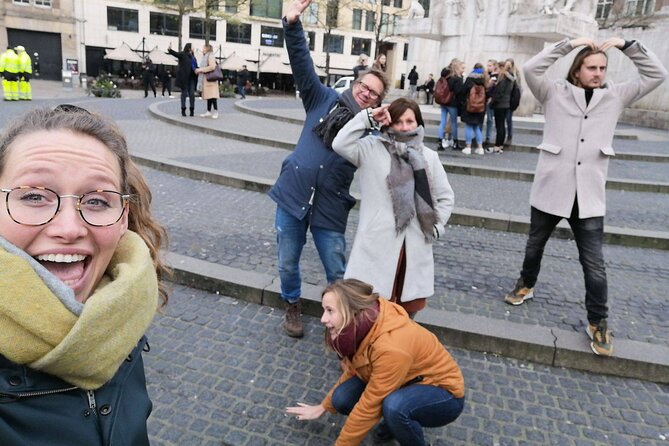
You meet at Spoorlaan 35, 5038 CA Tilburg, and open the game on your smartphone. From there, the app directs your team through a series of questions, location tasks, and challenges. The aim is not only to finish, but to collect points and rank on the leaderboard.
That competitive element changes the feel of the walk. You are not following a guide who sets the pace. Instead, you decide how quickly to solve each task, when to stop for a drink, and how much time to spend looking around. If your group likes puzzles and light competition, this gives an ordinary city walk more purpose.
The activity is private, so only your group plays together. With up to six people on one team, you can keep the group together without the fuss of a large organized party. Larger family groups can split into two teams, though each team would need its own booking.
The app is offered in English, which makes the game accessible to international visitors. Still, you should expect some questions to rely on local references. One reported audio question involving a Dutch politician was especially difficult for people from outside the Netherlands. If your group includes children or non-Dutch speakers, be ready to treat a few questions as guesses rather than fair tests.
More city games and scavenger hunts in Netherlands:
- e-Scavenger hunt Maastricht: Explore the city at your own pace
★ 4.5 · 110 reviews - e-Scavenger hunt Middelburg: Explore the city at your own pace
★ 4.5 · 55 reviews - Discover Utrecht with a self-guided Outside Escape city game tour
★ 4.5 · 51 reviews
Starting at Spoorlaan 35
The meeting point on Spoorlaan gives you a clear place to begin and return to. Since the activity is listed as being near public transportation, it can fit neatly into a day of exploring Tilburg without needing a car.
The opening window is unusually broad: the game is available Monday through Sunday from midnight to 11:59 p.m. That does not mean every museum or venue is open around the clock. It means you have flexibility in choosing when to launch the city game. For a practical visit, I would choose daylight hours so you can see the buildings and read any public information connected to the tasks.
The route may not always feel perfectly linear. The order of places has reportedly caused some teams to repeat part of the walk. If the app sends you back through an area you have already seen, do not assume you made a mistake immediately. Check the next instruction and keep an eye on your route so you do not waste time retracing steps unnecessarily.
De Pont Museum and Tilburg’s modern side
De Pont Museum is the first named stop. It is Tilburg’s contemporary art museum, with works by different artists and a larger exhibition program several times a year. The game allows about 10 minutes here, and museum admission is not included.
That short timing tells you how to approach this stop. You are likely using the museum as a landmark and cultural reference point, not taking a full museum visit. If you already planned to see De Pont’s exhibitions, you will need extra time and a separate ticket. The city game may give you a reason to notice the museum, but it does not replace the museum experience.
I like this as an opening stop because contemporary art quickly signals that Tilburg is not only an industrial or shopping city. The game connects the street outside with a major cultural venue, even if you do not go indoors. If your group includes art lovers, consider treating the game and the museum as two separate activities rather than trying to squeeze both into the same 10-minute slot.
Stadsbrouwerij 013 and the beer stop
Stadsbrouwerij 013 was founded in Tilburg in 2018 and brews six types of beer. It also offers guided brewery tours, though the city game does not include one.
This stop adds a social note to the route. After solving questions and walking through the city, a brewery can be a natural place to pause. You should not assume that a tasting or tour is part of the game, since neither is included in the stated package. If you want to visit the brewery properly, check its separate opening times and tour arrangements.
The brewery also gives the game a local flavor that a standard monument walk might miss. You are not only checking off museums and public buildings. You are seeing how Tilburg’s culture includes small-scale brewing and places built for meeting friends.
A few more Netherlands trips worth a look
- Amsterdam: 75 Minute City Canal Cruise with Audio Guide
★ 4.4 · 17,501 reviews - Amsterdam: City Centre Canal Cruise
★ 4.2 · 12,827 reviews - Amsterdam: Smoke and Lounge City Boat Cruise
★ 4.7 · 8,572 reviews - Amsterdam: City Canal Cruise and Heineken Experience Ticket
★ 4.5 · 5,367 reviews
Natuurmuseum Brabant in a five-minute stop
Natuurmuseum Brabant is described as a contemporary museum focused on the art, history, and culture of North Brabant, with changing and inventive presentations. The planned game stop is about five minutes, and admission is separate.
Again, the short stop is best understood as an introduction. You can note the museum, solve the task, and decide later if it deserves a longer visit. Families may find this stop useful because a museum connected to the region can give children a clearer sense of place than a string of abstract street clues.
Do not plan to see the full museum during the five-minute game slot. That would be rushed. The activity works better when you see these institutions as anchors along a walking route, with optional visits added if your schedule allows.
TextielMuseum and Tilburg’s working identity

The TextielMuseum is presented as a characteristic museum and an important part of the route. The supplied details do not specify a timed stop here, but its inclusion matters. Tilburg has a strong connection to textile production, and a museum devoted to that subject gives the city game a useful thread to follow.
This is one of the places where the route can add value even if you already know Tilburg. You might pass through familiar streets and still come away with a clearer idea of why the city developed as it did. The game’s questions may not provide the depth of a museum exhibition, but they can point you toward a place worth returning to.
As with De Pont and Natuurmuseum Brabant, entry is not included. Plan your budget and time accordingly. If you want a proper museum visit, build it into your day rather than expecting the puzzle walk to cover everything.
LocHal and the changing Spoorzone
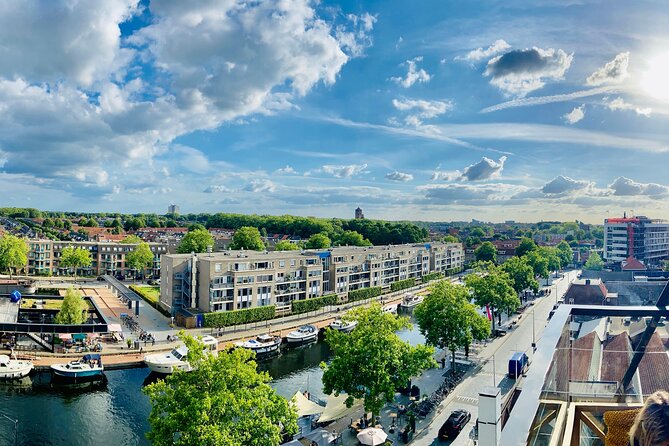
LocHal is one of the route’s most striking buildings. It sits in the Spoorzone, a former railway-related area that has become a major cultural and public space in Tilburg. The building is hard to miss, and its dramatic scale gives the game a strong visual stop.
The route describes LocHal as a new cultural landmark, and it is easy to see why it works well in a city game. Large public buildings make useful navigation points. They also show how Tilburg has reused industrial spaces instead of leaving them as background scenery.
The Spoorzone is particularly helpful for understanding the city’s present-day character. The game is not limited to old buildings and historical facts. It also shows how former work areas are being used for culture, events, food, and public life. I would allow a little extra time here if your group enjoys architecture or urban change.
Tilburg’s cultural meeting places
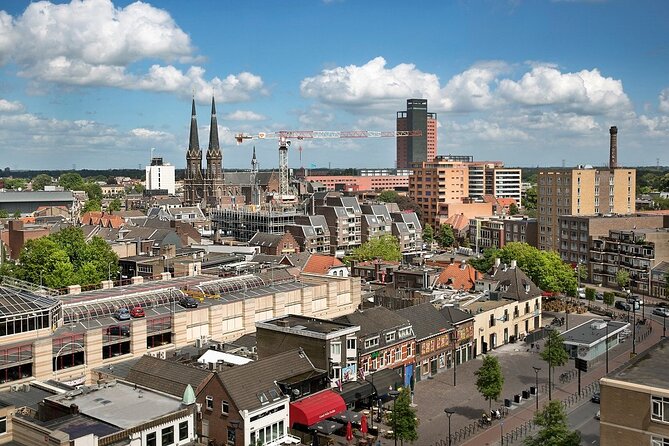
Another stop is described as a cultural meeting place where hospitality and a broad mix of offerings come together. The information does not identify the venue by name, so you should rely on the app’s directions rather than trying to plan this point independently.
This stop appears to add atmosphere rather than a single major sight. That is useful because a city is made up of social spaces as much as museums. You get a chance to see where people gather, eat, drink, or attend cultural events.
The tradeoff is that a general meeting place may feel less rewarding if you expect every stop to have a major historical explanation. The game is strongest when you approach it as a way to connect several kinds of Tilburg experiences, not as a formal lecture delivered through your phone.
Questions, selfies, and the quality of the game
The challenges include finding locations, answering questions, and taking selfies. Some questions test general knowledge, while others ask you to notice something in the surroundings. This mixture keeps the activity moving and gives different members of your group a chance to contribute.
The questions are not consistently difficult. Some are easy enough that you can answer without being in the exact place, which reduces the need to study a building or street closely. Other tasks may be too specific, especially for younger players or people unfamiliar with Dutch politics and religious references.
There is also a practical phone issue. A problem has been noted in which the answer choices appeared without the full question, making it hard for anyone without the phone to participate quickly. I would keep the screen visible to the whole team and read each prompt aloud before choosing an answer.
The game can still work well as a shared activity, but you should set expectations correctly. It is a light puzzle walk with local facts, not a carefully researched private tour led by a historian. That distinction is important when you compare it with a paper guide, an audio tour, or a museum ticket.
Timing, walking pace, and rainy weather
The stated duration is about two to four hours. That wide range makes sense for a self-paced game. A fast team that stops only to solve tasks may finish near the shorter end. A family group, a team that takes photos, or anyone who pauses for food and drinks may need closer to four hours.
Rain does not automatically ruin the activity. The route can still be completed in wet weather, and the flexible format lets you pause when needed. Still, you should dress for an outdoor walk and protect your phone. The game depends on your device, so a dead battery or damaged screen would cause a real problem.
I would not schedule a tightly timed museum reservation immediately afterward. The route may take longer if a question is unclear or if the order sends you back through part of the city. Give yourself a buffer and treat the game as the main event for the afternoon.
Price and group value at $37.33
At $37.33 per group of up to six, the price works out well when you have a full team. Six people pay roughly $6.22 each, before any separate museum admission or food and drink. For a family or group of friends, that can be a reasonable way to spend two to four hours.
The value drops when only two people play. You are still paying for the same app and route, but you lose the group advantage. I would compare the cost with a paper guide, a free walking route, or a regular guided tour before booking, especially if you prefer detailed information over competition.
Discounts can change the calculation. A discounted rate has previously made the activity feel much more attractive, while the full price may seem high if the questions are too simple for your group. The best case is a full team that likes games, wants a flexible schedule, and plans to enjoy the city rather than pay for museum access.
Who should book this Tilburg experience?
I would recommend it most strongly for families with older children, groups of friends, and small teams who enjoy solving clues together. It also suits people who have already seen Tilburg’s main sights and want a reason to explore them in a different order.
Younger children may enjoy the photos and competition, but some questions can be too difficult for the 10 to 20 age range, especially when they depend on faith, politics, or local knowledge. Adults should be ready to explain clues or keep the mood light when an answer feels unfair.
This is also a good choice for visitors who dislike rigid schedules. You can play in English, stop for a drink, and keep moving without a guide waiting for the whole group. It is less suitable if you want a polished account of Tilburg’s history, guaranteed route efficiency, or admission to the museums.
The activity is suitable for most participants, allows service animals, and is user-friendly for people with hearing impairments. Since it depends on a smartphone and mobile data, make sure the person carrying the phone can keep the group informed.
Should you book the Tilburg e-scavenger hunt?
Book it if you want a playful city walk, have four to six people to share the cost, and enjoy discovering museums, breweries, and the Spoorzone through simple challenges. The strongest parts are the freedom, the private format, and the chance to notice places you might otherwise skip.
Think twice if you are a pair, expect a professional guide, or want every question to teach something substantial. For the best value, use a discount if available, keep your team size near six, and add only the museum visits that truly interest you. You can cancel for a full refund up to 24 hours before the start time, but changes or cancellations inside that window are not refunded.
FAQ
How much does the e-scavenger hunt cost?
The price is $37.33 per group, with up to six people allowed to play together.
How long does the activity take?
The approximate duration is two to four hours, depending on your group’s pace and how long you spend at stops.
Is the game self-guided?
Yes. You play at your own pace using the free smartphone app, without a listed live guide.
What language is available?
The activity is offered in English.
Where does the game start?
It starts at Spoorlaan 35, 5038 CA Tilburg, Netherlands.
Where does the activity finish?
The activity ends back at the meeting point.
Do museum admission tickets come with the game?
No. Admission tickets for places such as De Pont Museum and Natuurmuseum Brabant are not included.
What do I need to bring?
You need a smartphone and mobile data. These are not included in the price.
How many people can play together?
A team can include a maximum of six people. The activity is private for your group.
Can I cancel for a refund?
You can cancel at least 24 hours before the start time for a full refund. Cancellations or changes made less than 24 hours before the start time are not refunded.
Just added around Netherlands
- Amsterdam: Giethoorn Tour with Canal Cruise and Windmills★ 5.0 · 3 reviews
- Full-day excursion to Edam, Volendam, and Marken★ 3.7 · 3 reviews
- Amsterdam: Chocolate Fondue in the Dark★ 5.0 · 3 reviews
- Historical Leiden: Private Tour with Local Guide★ 5.0 · 3 reviews
- Amsterdam Family Friendly Historical Walking Tour★ 5.0 · 3 reviews
- Amsterdam Private Walking Tour of Famous Painters★ 5.0 · 3 reviews
- Amsterdam Old-West Vegan Food Tour with Local Guide★ 4.7 · 3 reviews
- Groningen Private Custom Walking Tour With A Guide (Private Tour)★ 5.0 · 3 reviews
E-Scavenger Hunts & City Games, compared.

e-Scavenger hunt Maastricht: Explore the city at your own pace
Read our review →
Rotterdam Highlights & Spies: Interactive City Game
Read our review →
Discover Utrecht with a self-guided Outside Escape city game tour
Read our review →

e-Scavenger hunt Den Bosch: Explore the city at your own pace
Read our review →
Discover The Hague with a self-guided Outside Escape city tour
Read our review →
e-Scavenger hunt Deventer: Explore the city at your own pace
Read our review →
Discover Amerfoort’s city center in this Outside Escape game tour
Read our review →Browse the lists this tour appears in