

Reviewed · AMSTERDAM TOURS
Amsterdam: Anne Frank and Jewish Quarter Walking Tour (TOP RATED)
Amsterdam’s Jewish Quarter is best understood on foot, where memorials, old streets, and quiet corners put Anne Frank’s story into the wider story of Jewish life under Nazi occupation. This tour connects the Portuguese Synagogue, Auschwitz Monument, Hollandsche Schouwburg, Spinoza Monument, and other sites in about two hours.
I like the small maximum of 15 people, and I like that guides such as James and Aaron are praised for clear, sensitive storytelling. The main drawback is that this is almost entirely outdoors, and the experience can depend heavily on which guide leads your group.
Key points at a glance
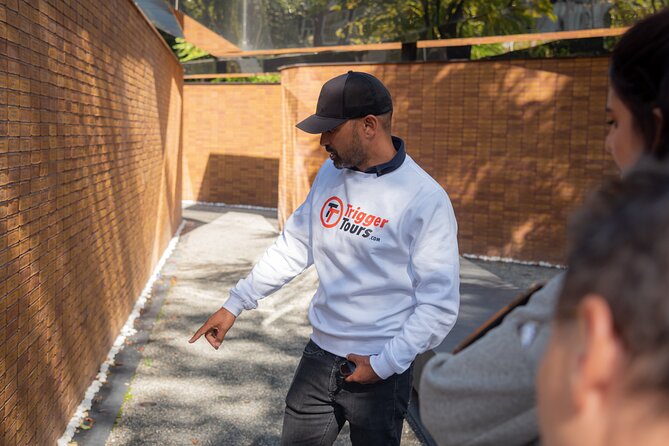
- A wider Anne Frank story: You learn about Jewish Amsterdam before, during, and after World War II, rather than focusing only on the Frank family.
- Small groups: The tour is capped at 15 people, with some departures potentially much smaller.
- Mostly outdoors: Plan for roughly 90 percent of the time outside, with warm clothing and weather protection.
- Important memorial sites: The route includes the Auschwitz Monument, Hollandsche Schouwburg, and other places tied to deportation and resistance.
- Not the Anne Frank House: This tour does not include admission to the Anne Frank House and works best as a separate historical walk.
- Good value at $33.26: For a two-hour guided walk, the price is fair if you want context you would not get by visiting memorials alone.
What this walk adds to Anne Frank’s story
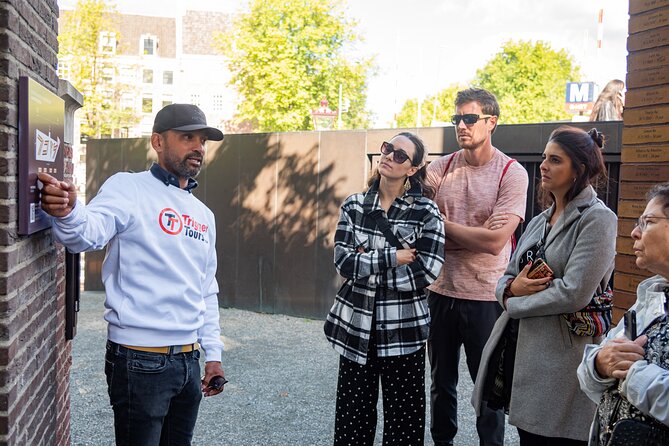
Anne Frank’s diary is personal and immediate. It tells you what hiding felt like for one young girl and her family. This walk widens the frame, showing how Amsterdam’s Jewish community formed, worshiped, resisted, was deported, and was remembered.
That wider view matters. You do not simply hear about Anne Frank and then go home. You connect her story with the Portuguese Sephardic community, the city’s wartime machinery, resistance activity, deportation sites, and memorials that preserve individual names.
I especially like this approach for a first visit to Amsterdam. The tour does not replace the Anne Frank House, but it gives you a better sense of the city around it. You see that the Holocaust was not an isolated event inside one hidden annex. It affected streets, synagogues, theaters, homes, public offices, and whole neighborhoods.
The tone should be serious. This is not a cheerful sightseeing walk with a few wartime facts added for color. Much of the material concerns persecution, deportation, collaboration, resistance, and murder. Several guides, including James, Aaron, Guido, Maria, and Andrea, have been praised for making difficult material clear and human without rushing through it.
More Walking Tours in Amsterdam
- Anne Frank’s Story – Guided Walking Tour through Amsterdam
★ 5.0 · 11,619 reviews - Amsterdam: Life of Anne Frank and World War II Walking Tour
★ 4.8 · 10,467 reviews - Absolutely Amsterdam – the Essential Introductory Walking Tour
★ 5.0 · 3,629 reviews
The Portuguese Synagogue and Amsterdam’s Jewish beginnings
The tour starts at Amstel 51C, near the Portuguese Synagogue. This is a useful place to begin because it takes you back before World War II and before Anne Frank was born.
Amsterdam’s Sephardic Jewish community grew during the Dutch Golden Age and became one of the largest and wealthiest Jewish communities in Europe. The scale of the synagogue reflects that past. It remains an active place of worship as well as a public attraction.
You spend about 10 minutes here, with admission listed as free for this stop. The value is not in entering for a long visit. It is in understanding that Jewish life in Amsterdam had centuries of roots, institutions, businesses, religious traditions, and cultural influence.
That context keeps the later wartime story from becoming a simple before-and-after tale. You first see a community with its own strength and identity. Then the guide explains how occupation and Nazi policy attacked that community piece by piece.
Auschwitz Monument and the weight of names
The Auschwitz Monument is one of the most important stops on the route. Here the guide explains the deportation of Amsterdam’s Jewish population and the meaning of the memorial.
Allow about 10 minutes, though the emotional weight may make this feel longer. A good guide needs to pause here and let the place speak. James is repeatedly praised for presenting the subject with care and accuracy, while Aaron is noted for combining facts with a calm, personal manner.
This is also where the outdoor nature of the tour matters. You are not in a heated museum room with benches and display panels. You are standing outside, so wear comfortable shoes and dress for the forecast. On a cold day, the weather can distract from the subject.
The memorial helps turn large numbers into human loss. You are not only hearing about deportation camps in the abstract. You are standing in Amsterdam, a real city where people lived ordinary lives before being forced from their homes.
Resistance and the Verzetsmuseum area
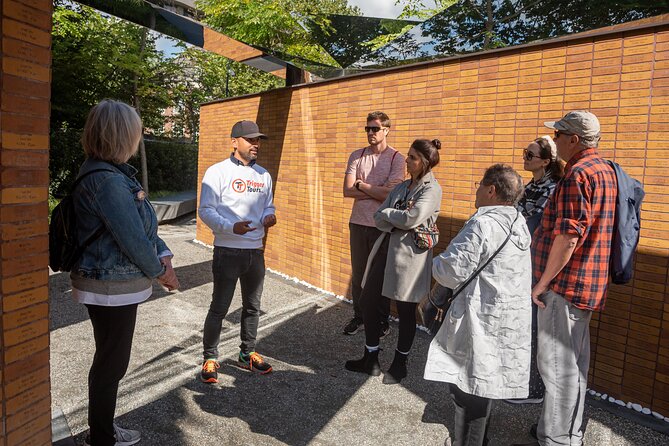
The route continues to the area around the Verzetsmuseum Amsterdam, where the guide discusses resistance by the Jewish community and the wider Dutch resistance.
The stop is listed at about 10 minutes, and the tour does not present itself as a full museum visit. That distinction matters. If you want the museum’s exhibits, photographs, and documents, you will need to make a separate plan. On this walk, the guide provides the street-level setting and explains what you might otherwise miss while passing by.
I like this part because it adds complexity. Wartime Amsterdam was not only a story of victims and occupiers. It also included people who resisted, helped, informed, hid, collaborated, or made impossible choices under pressure. A strong guide can explain those pressures without turning the past into a neat moral lesson.
One caution comes from the wide range of guide experiences reported for this tour. Most comments praise guides for being articulate and well prepared, but one serious complaint describes an uncomfortable manner, inappropriate humor, and claims that some facts were inaccurate. That is a reminder to listen critically, especially on a subject where dates and details matter.
More Anne Frank and Jewish Quarter walks:
- Amsterdam: Anne Frank Guided Small Group Walking Tour
★ 4.8 · 2,722 reviews - Amsterdam: Anne Frank Walking Tour – Guided in EN/DE/IT/ES
★ 4.9 · 2,676 reviews - Anne Frank Walking Tour Amsterdam Including Jewish Cultural Quarter
★ 5.0 · 1,879 reviews - Anne Frank’s Last Walk & See Anne Frank House in Virtual Reality
★ 5.0 · 957 reviews
Hollandsche Schouwburg and the machinery of deportation
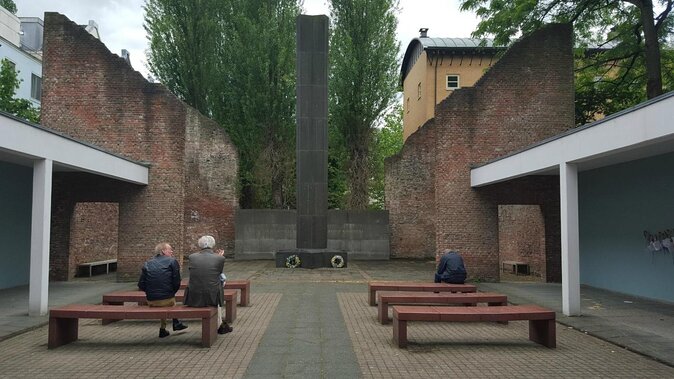
At the Hollandsche Schouwburg, the guide explains deportation camps and the role of this former theater in the persecution of Amsterdam’s Jews.
You spend roughly 10 minutes here. The site is powerful because it connects an ordinary public building with the forced removal of people. The guide’s job is to explain what happened without reducing the place to a quick photo stop.
This is one of the points where the tour’s value goes beyond a map. You could pass the building alone and know little about its wartime purpose. With a guide, you get the sequence of events and the human consequences.
The subject is painful, so consider your own tolerance for Holocaust history before booking. The route covers memorials and deportation sites in quick succession. You will receive a lot in two hours, but you will not have unlimited time for private reflection at each stop.
De Plantage, a quieter neighborhood with wartime echoes
The walk then moves through De Plantage, an attractive part of Amsterdam with its own history. This section gives the tour some visual breathing room after the memorial sites.
The guide discusses the area and its past for about 10 minutes. That can be helpful emotionally and geographically. You see a functioning neighborhood rather than a sequence of monuments, while still learning how the area fits into Amsterdam’s Jewish and wartime story.
Do not expect every minute to be a major landmark. A walking tour needs connecting streets, and this part helps join the route together. The benefit is that you begin to understand Amsterdam as a city where daily life, remembrance, and tourism occupy the same spaces.
The Spinoza Monument and ideas under pressure
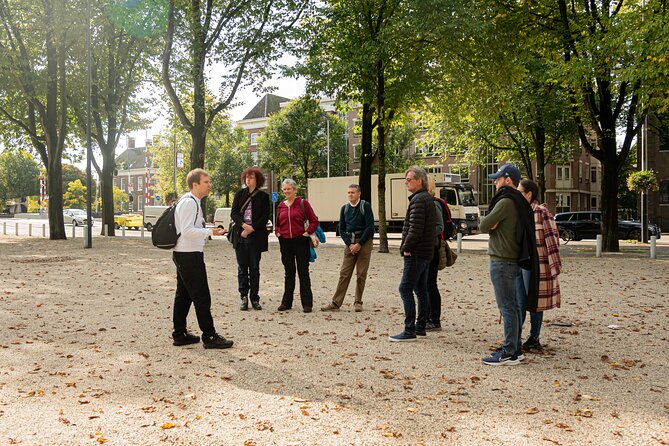
The Spinoza Monument offers another change of focus. Here the guide discusses Baruch Spinoza and the monument dedicated to him.
Spinoza is an important figure in Amsterdam’s Jewish and intellectual history. The stop gives the guide a chance to connect Jewish identity, philosophy, religious authority, and freedom of thought. It also breaks up the concentration on World War II while keeping the discussion tied to the city’s Jewish past.
Like several other stops, this one lasts around 10 minutes. The monument itself is not a full attraction visit, so your experience depends on the guide’s explanation. James, Aaron, and other guides are praised for bringing lesser-known sites into the story, which is exactly what makes a stop like this useful.
Dam Square, the Royal Palace, and Nieuwmarkt
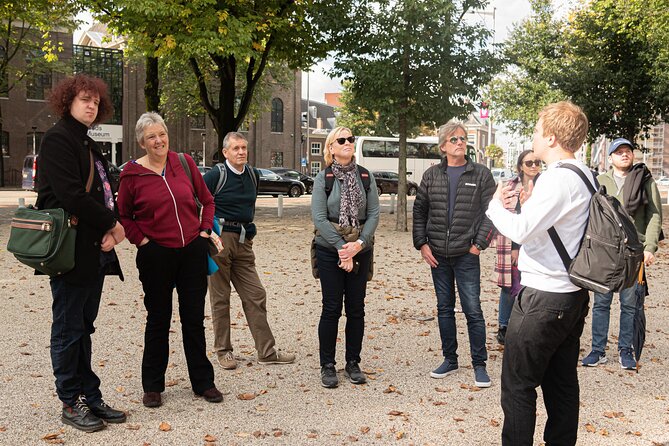
After the listed stops, the route walks toward the famous Dam Square monument and Royal Palace before finishing at Nieuwmarkt. These landmarks help place the Jewish Quarter within central Amsterdam rather than treating it as a separate district disconnected from the rest of the city.
At Nieuwmarkt, the guide returns to Anne Frank’s story and concludes the tour. This is a fitting ending because you have already learned about the community and the occupation. Anne Frank’s experience can then be understood as part of a larger citywide tragedy.
The itinerary gives about 10 minutes at Nieuwmarkt, and admission is not included. The activity ends back at the stated meeting point, although the route description also describes Nieuwmarkt as the finish. I would confirm the exact end point with Trigger Tours before setting a tight appointment afterward.
The route also includes a stop at the famous Dam Square monument and Royal Palace without a separate time allocation. Treat these as points along the walk, not as interior visits. The tour is about outdoor interpretation and memorial sites, not palace or museum admission.
Why the small group matters
The group limit is 15 people. That is a sensible size for Amsterdam streets and for a subject that benefits from being able to hear every word.
Some departures may be much smaller. One account describes a group of only three, while another person found themselves alone with the guide. A tiny group can feel almost private and allows more questions, though it may also feel different from what you expect if you booked a standard group walk.
A small group also helps with pace. Aaron is specifically praised for staying with a slower walker who had an injury. You should still expect to walk for two hours, but the group limit gives the guide a better chance to notice when someone needs to slow down.
Pickup is offered from select city-center hotels, though the published meeting point is Amstel 51C. Check the exact instructions after booking. Confirmation is provided at booking, and the activity is near public transportation.
Guides, tone, and the importance of accuracy
The strongest part of this tour is the guide. James receives especially warm praise for his command of Jewish Amsterdam from its early development through World War II and the Nazi occupation. Aaron is praised for being friendly, organized, considerate, and easy to talk with. Guido, Maria, and Andrea are also described as bringing the subject to life in a clear and engaging way.
Those details tell you what to look for. You want a guide who can explain dates and events, answer questions, treat victims with dignity, and avoid turning tragedy into entertainment. The subject needs warmth, but it also needs discipline.
There is one serious warning in the available feedback. A participant reported shouting, jokes during emotional moments, and unsupported conspiracy claims from a guide named Pilar. That account conflicts sharply with the many positive descriptions of other guides. I would not ignore it, but I also would not assume every departure will feel the same.
If a guide presents a disputed claim as fact, ask for the source or make a note to check it later. For a history tour about Nazi persecution, accuracy is not a small detail. It is part of the service you are paying for.
Price, timing, and practical value
At $33.26 per person, this is reasonably priced for a two-hour guided walk in central Amsterdam, especially with a maximum of 15 people. You are paying for structure, local explanation, and access to sites that are easy to overlook, not for museum entry.
The value is strongest if you would otherwise walk through the Jewish Quarter without knowing what you were seeing. It is weaker if you want long museum visits, extensive time at every memorial, or a private tour with a fixed guide.
The tour is offered in English and accepts mobile tickets. Group discounts may lower the price for some bookings. Free cancellation is available up to 24 hours before the start time. Changes made inside that window are not accepted, and a weather cancellation offers either another date or a full refund.
Most people can take part, and service animals are allowed. Still, remember that this is a walking tour with about 90 percent of the time outdoors. Bring warm layers, rain protection, and shoes you can comfortably wear for two hours.
Who should book this walk?
I would choose this tour if you want a guided introduction to Jewish Amsterdam and Anne Frank’s wider setting. It suits first-time visitors, history-minded families, and anyone who wants more than a single museum visit.
It is also a good option if you could not obtain Anne Frank House tickets. The tour is specifically described as an alternative, but it is not a substitute in the strict sense. You will not enter the Anne Frank House, see the secret annex, or experience the diary’s setting from inside.
You should also book it if you prefer seeing history in the streets. The memorials, synagogue, theater, monument, and neighborhood sites create a connected route that a museum alone cannot provide.
I would hesitate if you dislike walking outdoors in cold or wet weather, need a relaxed pace with long indoor breaks, or expect every claim to be delivered with academic detail. The guide assignment matters, and the mixed account about one guide means you should keep reasonable expectations.
Should you book the Anne Frank and Jewish Quarter Walking Tour?
Yes, if you want a compact, serious introduction to Amsterdam’s Jewish history and the Holocaust memorial sites tied to it. The small group, modest price, and route through the Portuguese Synagogue, Auschwitz Monument, Hollandsche Schouwburg, De Plantage, Spinoza Monument, Dam Square, and Nieuwmarkt make it a useful two-hour orientation.
Book the Anne Frank House separately if that is your main goal. Choose this walk for the wider picture, the outdoor memorials, and the chance to ask questions as you move through the city. Dress warmly, allow time for the subject’s emotional weight, and confirm the meeting and end points before you go.
FAQ
Does this tour enter the Anne Frank House?
No. The tour is an alternative walking experience and does not include a visit to the Anne Frank House.
How long does the tour last?
The tour lasts approximately two hours.
Where does the tour start?
The stated meeting point is Amstel 51C, 1018 EJ Amsterdam, Netherlands.
Where does the tour end?
The activity information says it ends back at the meeting point, while the route description says the guide finishes at Nieuwmarkt after walking past Dam Square and the Royal Palace. Confirm the exact end point with the provider.
How many people can join the tour?
The group is limited to a maximum of 15 people.
Is the tour indoors or outdoors?
About 90 percent of the experience takes place outside. Good clothing for the weather is important.
Is admission to the sites included?
Admission is listed as free for the Portuguese Synagogue, Auschwitz Monument, Verzetsmuseum Amsterdam, Hollandsche Schouwburg, De Plantage, and Spinoza Monument stops. Admission at Nieuwmarkt is not included. The tour does not include Anne Frank House entry.
What is the cancellation policy?
You can cancel at least 24 hours before the start time for a full refund. Cancellations or changes made less than 24 hours before the start time are not accepted for a refund. If poor weather cancels the tour, you can receive a different date or a full refund.
Just added around Amsterdam
- Amsterdam: Giethoorn Tour with Canal Cruise and Windmills★ 5.0 · 3 reviews
- Full-day excursion to Edam, Volendam, and Marken★ 3.7 · 3 reviews
- Amsterdam: Chocolate Fondue in the Dark★ 5.0 · 3 reviews
- Amsterdam Old-West Vegan Food Tour with Local Guide★ 4.7 · 3 reviews
- Amsterdam Private Walking Tour of Famous Painters★ 5.0 · 3 reviews
- Amsterdam Family Friendly Historical Walking Tour★ 5.0 · 3 reviews
- From Amsterdam: visit Zaanse Schans, Muiderslot and more!★ 5.0 · 3 reviews
- Amsterdam Walking Tour with Dutch Pancake Lunch★ 5.0 · 3 reviews
Amsterdam Tours, compared.

Amsterdam Classic Saloon Boat Cruise with Drinks and Cheese
Read our review →
Amsterdam Luxury Canal Cruise + Unlimited Drinks & Bites option
Read our review →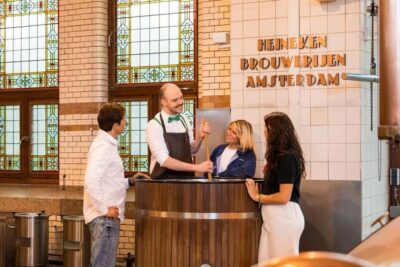
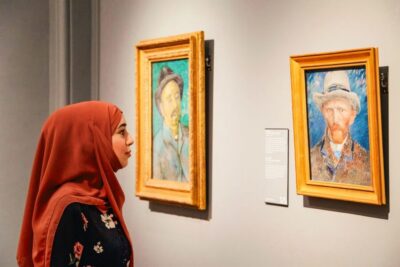
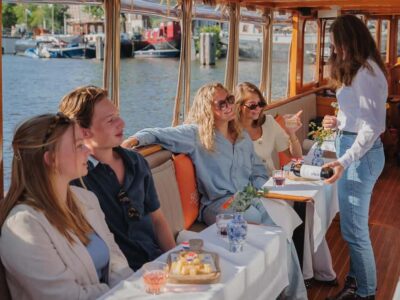
Classic Boat Cruise with Optional Cheese & Wine
Read our review →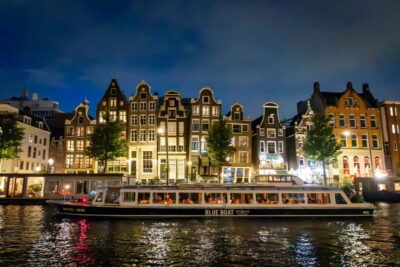
Evening Cruise with Optional Wine and Snacks
Read our review →
75 Minute City Canal Cruise with Audio Guide
Read our review →Browse the lists this tour appears in