

Reviewed · AMSTERDAM TOURS
Amsterdam: Anne Frank Walking Tour – Guided in EN/DE/IT/ES
Amsterdam’s Jewish Quarter is best understood on foot, where a quiet square, a synagogue gate, or a brass memorial stone can carry more weight than a museum label. This two-hour walk links Amsterdam’s Jewish past with Anne Frank’s story, using passages from her diary as the thread between sites connected to wartime persecution, resistance, and remembrance.
I especially like the way the tour covers both the Jewish community before the Holocaust and the people who resisted Nazi rule. I also like the guides’ use of Anne’s own words. Guides including Valentina, Emilia, Julia, Josh, Deborah, Bianca, and David have been praised for clear storytelling, thoughtful pacing, and emotional care. The main consideration is that this is a serious subject and a 2 to 3 kilometer walk, with no visit to the Anne Frank House itself.
Key points at a glance
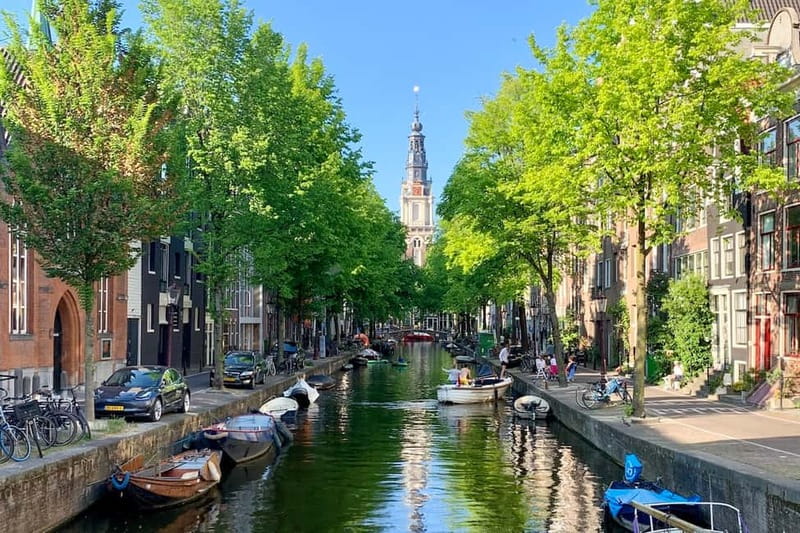
- Anne Frank’s diary shapes the walk: Passages from the diary help connect Amsterdam’s streets with the personal cost of persecution.
- A full Jewish Quarter route: See Nieuwmarkt, Rembrandt’s former neighborhood, the Portuguese Synagogue, Holocaust memorials, and the Jewish Historical Museum area.
- History before and during WWII: Learn how Jewish residents helped shape Amsterdam’s trade, architecture, and culture before the Nazi occupation.
- Resistance stories are central: The February Strike and acts by Jewish and non-Jewish Amsterdammers receive serious attention.
- Simple pricing with no entrance fees: At $28 per person, you pay for the guide and walking route, not admissions.
- Four language choices: Book in English, German, Italian, or Spanish. The tour is conducted in one language, not as a bilingual presentation.
Why this walk matters in Amsterdam’s Jewish Quarter

Amsterdam’s Jewish history did not begin with WWII. Jewish people expelled from Spain and Portugal after the Spanish Inquisition helped build new lives in Amsterdam, contributing to trade and the city’s growing wealth. Their presence shaped the Jodenbuurt, or Jewish Quarter, especially the area often called the Jewish Triangle.
That earlier story matters. Without it, the wartime section can feel like a list of dates and tragedies. Here, you first get a sense of a living community, its homes, religious buildings, businesses, and place in Amsterdam life. Then the tour shows how Nazi persecution broke that world apart.
Anne Frank’s diary gives the walk a human scale. The subject is too large to grasp through numbers alone. Passages from the diary bring you back to a young person trying to understand fear, family tension, hope, and the outside world while hidden from deportation.
The approach is emotional, but it is not only about Anne. You also hear about the thousands of Jewish people deported from Amsterdam, the few who returned, and the choices made by neighbors, officials, resistance workers, and families who tried to help. That wider view makes the tour more useful than an Anne Frank biography alone.
More Walking Tours in Amsterdam
- Anne Frank’s Story – Guided Walking Tour through Amsterdam
★ 5.0 · 11,619 reviews - Amsterdam: Life of Anne Frank and World War II Walking Tour
★ 4.8 · 10,467 reviews - Absolutely Amsterdam – the Essential Introductory Walking Tour
★ 5.0 · 3,629 reviews
Starting at Waag on Nieuwmarkt Square
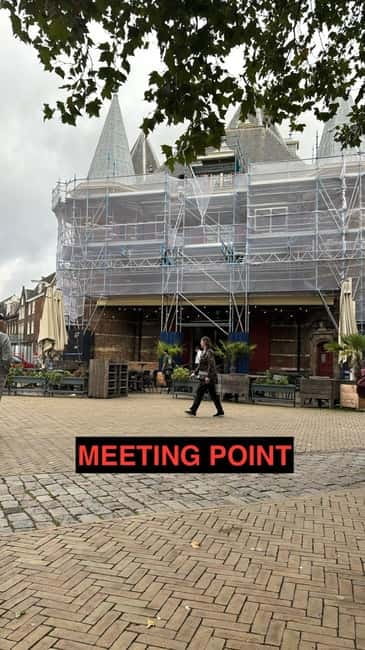
Meet at the entrance to De Waag, the historic building that looks a bit like a small castle in the middle of Nieuwmarkt. Look for the guide wearing a red name tag around their neck.
This meeting point is easy to miss if you follow a map too literally. Google Maps can lead you to the back of the building. If you see the Jolly Joker coffeeshop, you are on the wrong side. Walk around the building to find the main entrance.
Nieuwmarkt is a practical starting place because it puts you near the old city center and directly beside the first part of the Jewish Quarter route. Arrive ready to walk rather than expecting a museum-style gathering. The guide will lead the group through city streets and pause at the main sites.
Nieuwmarkt, Zuiderkerk, and Huis de Pinto

The first guided stop is Nieuwmarkt Square, where the tour begins to place Amsterdam’s Jewish Quarter within the broader city. You will spend about ten minutes here, listening to the local and historical background that helps explain why Jewish residents settled in this part of Amsterdam.
Next comes Zuiderkerk, with another ten-minute explanation. Churches, homes, and civic buildings sit close together in this part of the city, so the route shows that the Jewish Quarter was not an isolated settlement. Jewish and non-Jewish residents lived near one another, and the area became part of everyday Amsterdam life.
Huis de Pinto receives a shorter stop of about five minutes. The house adds another architectural marker to the route and helps show the character of the old neighborhood. Do not expect to enter each building. Much of the value comes from understanding what you are seeing from the street and how the guide connects it to the people who lived there.
Rembrandt’s Amsterdam and the Jewish community

The Rembrandt House is one of the longer early stops, with about fifteen minutes of guided explanation. Rembrandt van Rijn lived in the middle of the Jewish Quarter, a useful reminder that the area was not home only to Jewish residents.
The guide uses this stop to discuss the contact between Jewish and non-Jewish Amsterdam. Art, commerce, religion, and daily life overlapped here. You get a more grounded picture of the neighborhood than the usual postcard view of canals and grand facades.
I find this kind of context valuable because Anne Frank’s story is often separated from Amsterdam’s older Jewish culture. The route places her family’s experience within a community that had already shaped the city for centuries.
More Anne Frank and Jewish Quarter walks:
- Amsterdam: Anne Frank Guided Small Group Walking Tour
★ 4.8 · 2,722 reviews - Anne Frank Walking Tour Amsterdam Including Jewish Cultural Quarter
★ 5.0 · 1,879 reviews - Anne Frank’s Last Walk & See Anne Frank House in Virtual Reality
★ 5.0 · 957 reviews - Anne Frank and Jewish Quarter Amsterdam Private Walking Tour
★ 5.0 · 684 reviews
Sint Antoniesluis and the Portuguese Synagogue
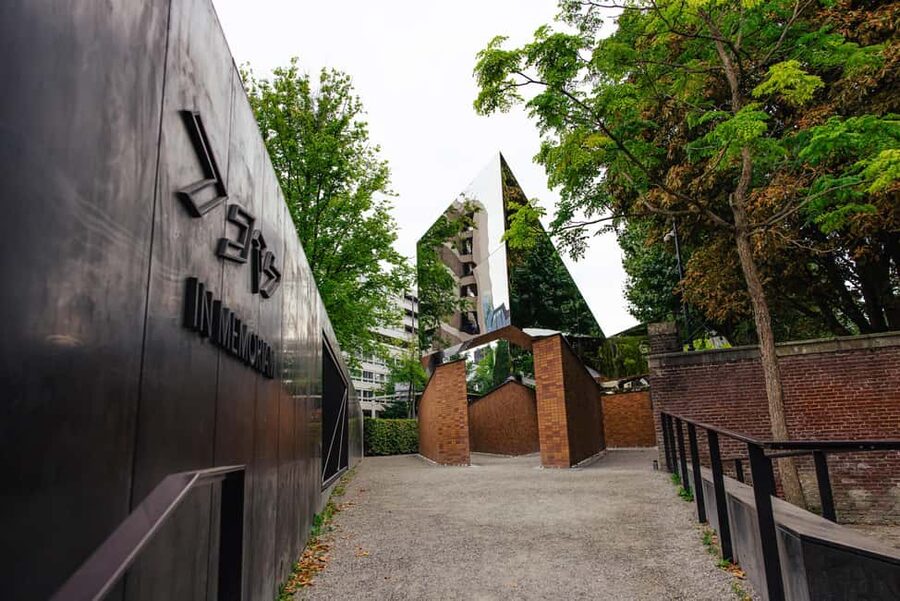
At Sint Antoniesluis, expect about ten minutes of guided discussion. The canal and surrounding streets offer another chance to see how geography shaped the neighborhood. The guide explains why this part of Amsterdam became important to Jewish residents and how the Jewish Quarter developed over time.
The Portuguese Synagogue is a photo stop and receives around ten minutes of explanation. Its presence is one of the clearest reminders of the Sephardic Jewish community that developed after persecution in Iberia. Even from outside, the building helps connect Amsterdam to a much longer European story of exile, migration, and rebuilding.
The tour does not list admission to the synagogue, and no entrance fees are required during the walk. You are seeing the area as part of a city route, not taking a full interior tour of every landmark. If religious architecture is your main interest, you may want a separate visit later.
The Jewish Historical Museum area
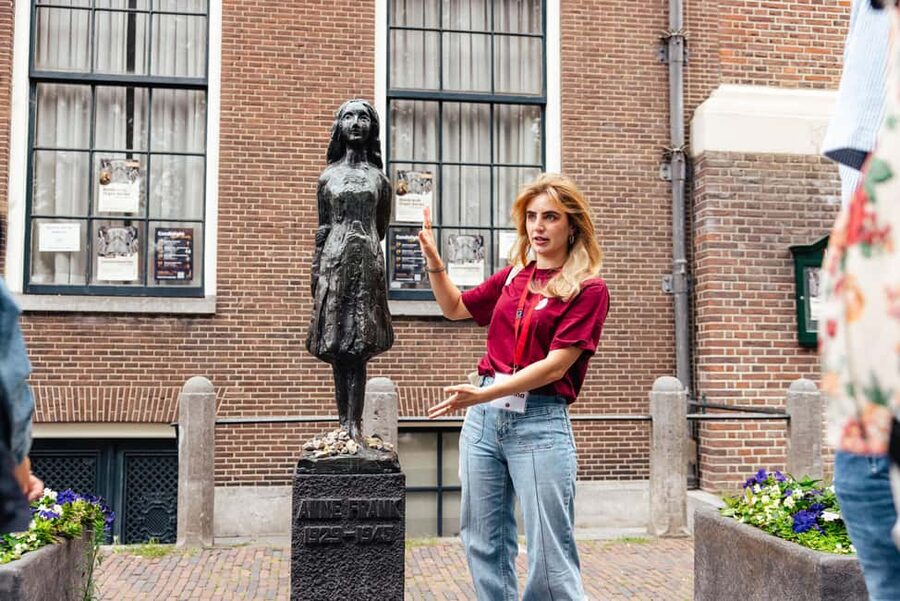
The route continues to the Jewish Historical Museum area for about five minutes of guided commentary. This stop places the walk beside one of Amsterdam’s major centers for Jewish cultural memory.
The short pause is not meant to replace a museum visit. Instead, it gives you a sense of how the surrounding sites fit together. You can use that context to decide if you want to return for a longer indoor visit during your stay.
This is also where the tour’s focus shifts more firmly toward WWII. The earlier stops establish Jewish life and influence. The later stops show what happened when Nazi policies targeted that community.
Auschwitz Monument and the weight of remembrance
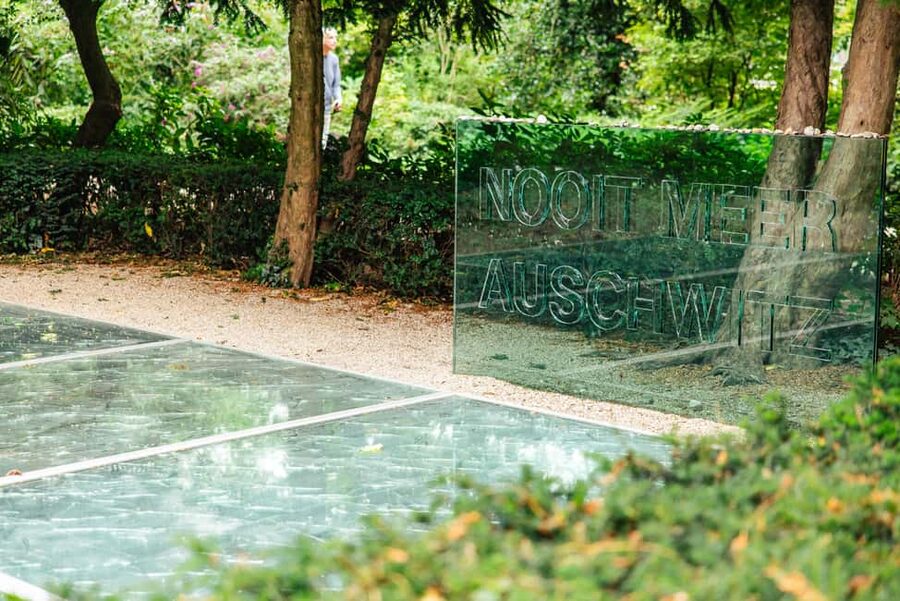
The Auschwitz Monument receives about ten minutes of guided attention. It is a solemn stop, and the tone of the tour becomes more reflective here.
The monument connects Amsterdam to the extermination camp system and to the people deported from the Netherlands. The guide explains the scale of the loss while keeping the discussion tied to Amsterdam and its Jewish residents.
This is one place where the tour’s use of Anne Frank’s diary can have particular force. Her words do not describe every part of the Holocaust, and the guide does not treat her story as a substitute for the wider history. Instead, her experience helps you understand how persecution entered ordinary family life.
You should give yourself emotional room during this section. The subject is painful, and the tour does not soften it with cheerful sightseeing chatter. That seriousness is appropriate, but it may not suit someone looking for a light introduction to the city.
The February Strike and The Dokwerker
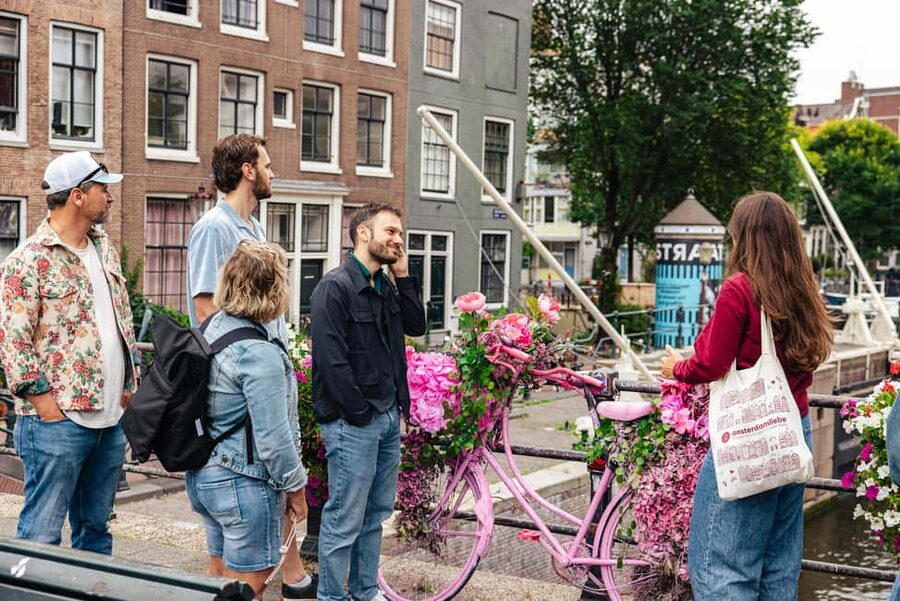
The Dokwerker is linked to the February Strike of 1941, one of the most important acts of public protest against Nazi persecution in the Netherlands. The stop lasts about five minutes, but its meaning reaches well beyond the short pause.
You learn that resistance did not come only from one group. Jewish and non-Jewish Amsterdammers took risks, and some people helped others hide or avoid deportation while placing their own lives in danger.
This part of the tour keeps the story from becoming only a record of suffering. It also asks what people did when forced to choose between safety and opposition. The guide explains the courage involved without turning resistance into a simple heroic tale.
Stolpersteine, old gates, and small signs of loss
Along the way, the guide points out Jewish relics and memorial traces, including Stolpersteine, the brass paving stones set into sidewalks to remember people who were deported or murdered. These are easy to miss when walking alone.
You may also see the gate of the old plague cemetery. The site adds another layer to the neighborhood’s difficult past and shows how places connected to Jewish life can be modest, functional, and easy to overlook.
These details are part of what makes a walking tour useful. A large monument tells you to stop and remember. A small stone at your feet asks you to notice the ordinary street around it. Keep your eyes down occasionally, especially when the guide points out memorial stones.
The National Holocaust Names Monument
The final major stop is the National Holocaust Names Monument, which includes a photo stop and about fifteen minutes of guided explanation. It is also listed as the end of the route.
The memorial gives the tour a strong closing point because individual names bring the loss back to people rather than statistics. After hearing about Amsterdam’s Jewish community, Anne Frank, deportation, and resistance, you arrive at a place designed specifically for remembrance.
The supplied meeting information also describes the activity as ending back at the meeting point, so check the directions shown with your selected departure when booking. The route details identify the National Holocaust Names Monument as the finish, and it is wise to allow a few minutes afterward to orient yourself before making another appointment.
How the guides handle Anne Frank’s story
The strongest feature of this experience is the storytelling. Guides such as Valentina and Emilia are noted for linking each location to Anne Frank’s life and to the history of Amsterdam. Lili and Kaya are also praised for reading diary passages in a way that makes the young writer’s voice part of the walk.
David’s tour is described as well-paced, with time for questions and a careful reading of the diary. Bianca’s approach combines emotional storytelling with a manageable pace, including an unplanned bathroom stop. Those details suggest a guide-led experience that is attentive rather than rushed, although the exact guide depends on your booking.
Josh is praised for patience, clear explanations, and using pictures to help explain the past. Deborah is noted for giving useful background about the Jewish Quarter, Nazi occupation, and Dutch life more generally. Charlotte is described as engaging and eloquent, with a route that moves away from the most crowded areas fairly quickly.
No guide can make this subject easy, but a good guide can make it understandable. The best moments here seem to come from clear structure, diary readings, room for questions, and a respectful tone.
Walking conditions, languages, and timing
The tour lasts two hours and covers about 2 to 3 kilometers. You will be on city streets for the full experience, so wear comfortable shoes and bring water.
The tour operates in all weather. Amsterdam rain can arrive without much warning, so bring an umbrella and wear weather-appropriate clothing. The activity is listed as wheelchair accessible, but you may still want to confirm route conditions if you have specific mobility needs.
Choose English, German, Italian, or Spanish when booking. The tour is conducted in one selected language, not in two languages at once. That matters because bilingual guiding can cut the time available for each explanation.
A private group option is available. That can make sense if you want to ask many questions, need a more personal pace, or are arranging the walk for family or friends. The standard experience may suit you well if you are happy to share the guide’s attention with a small group.
Is $28 a fair price?
At $28 per person, the price is reasonable for a two-hour guided walk through central Amsterdam. There are no food, drink, or entrance costs included, but there are also no admission fees required during the route.
You are paying mainly for interpretation. The buildings and memorials are part of the city, yet their meaning is easy to miss without context. A good guide turns a short stretch of Amsterdam into a connected story about migration, commerce, religion, occupation, deportation, and resistance.
The value is highest if this is your first serious look at Amsterdam’s Jewish history. It can also help you prepare for a later visit to the Anne Frank House, although you must reserve and pay for that separately. This tour does not enter the house, pass by it, or include a view of it.
Who should book this experience?
I would choose this tour if you want a focused historical walk rather than a general city tour. It suits visitors interested in Anne Frank, WWII, Jewish culture, Amsterdam’s architecture, and the moral questions raised by occupation and resistance.
It is also a good first-day activity if you want historical context for the rest of your time in Amsterdam. Deborah’s style, as described in the supplied information, includes broader background about Dutch life, which can help you read the city with more understanding afterward.
Families with older children and teenagers may find the diary passages a useful way into a difficult subject, though parents should decide if the Holocaust content is appropriate for their children. The route is not a playful sightseeing activity.
You might skip it if you want to see the Anne Frank House interior, prefer museum displays to outdoor commentary, or have only limited energy for walking. You should also avoid placing it immediately before another tightly timed booking, since weather, questions, and group pace can affect the finish.
Final decision: should you book it?
Book this walk if you want Anne Frank’s story set within the larger history of Amsterdam’s Jewish community. The diary readings, memorials, resistance stories, and neighborhood landmarks work best together, and the $28 price is fair for that level of guided context.
Do not book it expecting entry to the Anne Frank House. Choose the correct language, wear solid walking shoes, allow for rain, and approach the subject with time to think afterward. Guides such as Valentina, Emilia, Josh, Deborah, Bianca, Julia, Lili, Kaya, Charlotte, and David have all been praised for warmth, clear storytelling, and care with the material, though your assigned guide will vary.
FAQ
Does this tour visit the Anne Frank House?
No. The Anne Frank House is not visited or seen during this walking tour, and entry is not included.
How long is the walking tour?
The tour lasts two hours and covers about 2 to 3 kilometers.
What languages are available?
You can book the tour in English, German, Italian, or Spanish. It is conducted in one language, not as a bilingual tour.
Where does the tour start?
Meet at the entrance to De Waag in the middle of Nieuwmarkt Square. The guide wears a red name tag.
How can I find the correct entrance to De Waag?
Google Maps may take you to the back of the building. If you see the Jolly Joker coffeeshop, walk around the building to reach the main entrance.
Are entrance fees included?
No entrance fees are needed during the walking route. Food and drinks are not included.
Is the tour available as a private activity?
Yes. A private group option is available, and the activity is listed as wheelchair accessible.
Just added around Amsterdam
- Amsterdam: Giethoorn Tour with Canal Cruise and Windmills★ 5.0 · 3 reviews
- Full-day excursion to Edam, Volendam, and Marken★ 3.7 · 3 reviews
- Amsterdam: Chocolate Fondue in the Dark★ 5.0 · 3 reviews
- Amsterdam Old-West Vegan Food Tour with Local Guide★ 4.7 · 3 reviews
- Amsterdam Family Friendly Historical Walking Tour★ 5.0 · 3 reviews
- Amsterdam Private Walking Tour of Famous Painters★ 5.0 · 3 reviews
- From Amsterdam: visit Zaanse Schans, Muiderslot and more!★ 5.0 · 3 reviews
- Amsterdam Walking Tour with Dutch Pancake Lunch★ 5.0 · 3 reviews
Amsterdam Tours, compared.

Amsterdam Classic Saloon Boat Cruise with Drinks and Cheese
Read our review →
Amsterdam Luxury Canal Cruise + Unlimited Drinks & Bites option
Read our review →
Classic Boat Cruise with Optional Cheese & Wine
Read our review →
Evening Cruise with Optional Wine and Snacks
Read our review →
75 Minute City Canal Cruise with Audio Guide
Read our review →Browse the lists this tour appears in