
Reviewed · AMSTERDAM TOURS
Absolutely Amsterdam – the Essential Introductory Walking Tour
Amsterdam’s story comes together through its contradictions: a trading empire built on water, a legal red-light district beside old churches, and a tolerant city shaped by both idealism and hard economics. This 2.5-hour walk moves through those contrasts at street level, from the former harbor to Dam Square.
I like the tour’s clear route through Amsterdam’s old center, and I like its price of $5.93 per person, which makes a broad first look easy to fit into a trip. Guides including Raymond, Jaap, Sergio, David, and others are praised for humor, local insight, visual aids, and useful suggestions for the rest of your stay.
The main catch is that this is an outdoor orientation, not a museum tour. You see the church at Ons’ Lieve Heer op Solder from outside, and the Royal Palace and other sights are not included inside the ticket price. Busy streets and bicycles can also make listening tricky.
Key things to know before you book
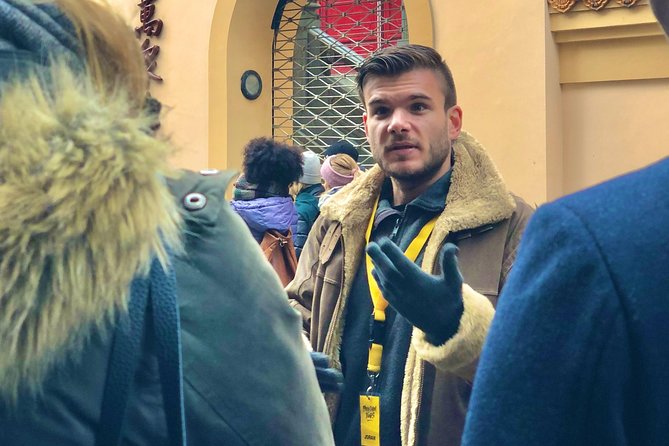
- The route covers ten central stops: You move from Beurs van Berlage and Damrak through Chinatown, Waterlooplein, the Amstel, and Dam Square.
- The focus goes beyond pretty canals: Expect frank explanations of prostitution, Dutch drug policy, slavery and trade, religious tolerance, Jewish life, Nazi occupation, and the monarchy.
- Guides shape the experience: Raymond is a lifelong local, while Jaap, Sergio, David, Fernando, Roman, and others are praised for humor, storytelling, and practical advice.
- The group is capped at 15 people: That is small enough for questions, though busy city streets can still spread the group out.
- You do not enter every sight: The hidden church, Royal Palace, and some other locations are discussed from outside or with images.
- Wear good shoes: The walk lasts about two and a half hours, and you cover a fair stretch of the old center at an easy pace.
Why this makes a smart first walk through Amsterdam
I like starting Amsterdam with a walk instead of a string of isolated attractions. The city’s center is compact, but its meaning can be hard to read at first. A narrow canal house, an old market square, or a church facade can look merely picturesque until you learn what trade, law, religion, and war were doing there.
This tour gives you that basic map. It links the old harbor to the financial center, the Red Light District to religious policy, Chinatown to drug law, and the Jewish Quarter to the Second World War. You also get a practical introduction to bikes, canals, architecture, and the Dutch royal family.
The price makes the choice simple for many people. At $5.93, you are paying very little for a long guided orientation, while the tip-based setup lets you decide what the experience was worth. That low cost also means you should not expect entry to major museums or the Royal Palace. Think of it as a street-level introduction that helps you choose where to spend your later admission fees.
The tour is offered in English and is limited to 15 people. Most people can participate, service animals are allowed, and the meeting point is near public transportation at Freedam Tours, Beursplein 5. I would book it early if your dates are fixed, since it is often reserved about 24 days ahead.
More Walking Tours in Amsterdam
- Anne Frank’s Story – Guided Walking Tour through Amsterdam
★ 5.0 · 11,619 reviews - Amsterdam: Life of Anne Frank and World War II Walking Tour
★ 4.8 · 10,467 reviews - Amsterdam: Anne Frank Guided Small Group Walking Tour
★ 4.8 · 2,722 reviews
Beurs van Berlage and Damrak: water, money, and the city’s oldest tensions
The walk begins at Beurs van Berlage, in front of the old stock and commodities exchange buildings. The opening lesson is basic but useful: Amsterdam grew where the Amstel met the water, and its fortunes were tied to shipping, trade, finance, and control of the harbor.
The guide explains that the exchange buildings were built where the Amstel River once flowed. That detail gives you a quick way to understand Amsterdam’s old center. The city was not simply built beside water. It was repeatedly shaped, redirected, and organized around it.
From there, you move toward Damrak, the old harbor. This is where the tour turns to Amsterdam’s most famous contradiction, the relationship between the holy and the profane.
You learn how the Red Light District developed, how the Church operated within that setting, and how prostitution changed from a tolerated practice into a legal profession. The talk also covers its condition in the 20th and 21st centuries and the current pressures facing the neighborhood.
I value this part because it avoids treating the district as a sideshow. You get law, religion, commerce, and public policy instead of a quick joke and a photo stop. The drawback is that Damrak and the Red Light District can be crowded, noisy, and difficult for a whole group to hear. A guide’s voice may compete with foot traffic, bicycles, and the general commotion.
Ons’ Lieve Heer op Solder: tolerance with strict limits
At Our Lord in the Attic Museum, you discuss the period when Catholic worship became illegal but was still tolerated under narrow conditions. The building’s exterior points to a time when private belief and public law were forced into an uneasy arrangement.
The guide uses the site to compare 17th-century tolerance with the way tolerance works today. That makes the stop useful even if you have no special interest in church architecture. It asks you to consider the difference between being accepted in principle and being allowed to exist only under strict limits.
You do not enter the hidden church on this tour. Instead, you see it from outside and use pictures to view the interior. This is one of the clearest limits of the experience, especially if the museum is high on your list. You will need a separate admission if you want to explore it properly.
Still, the stop earns its place because it connects a specific building to a larger question about Dutch society. It is a short talk, not a full museum visit.
Chinatown: Amsterdam’s drug policy in plain language
The Chinatown stop shifts from religion to public policy. Here you hear how the area became considered a no-go district in the 1970s and how that helped lead to the rise of coffeeshops selling marijuana.
This is not presented as a simple tale of Dutch freedom. The point is to explain the policy choices and the setting in which they developed. You get a useful distinction between what is legally tolerated and what people may casually assume is fully legal.
I like this stop because it gives context to something many visitors see without understanding. It also keeps the tour from becoming a parade of old buildings. Amsterdam’s identity includes modern debates about regulation, public space, and neighborhood change.
As with Damrak, the urban setting can be a practical nuisance. Stay close to the guide and watch for bicycles. The city’s bike traffic is part of the lesson later, but it can also interrupt the walk.
Same country, a completely different kind of day:
- Amsterdam: Van Gogh Museum Ticket
★ 4.7 · 52,054 reviews - Amsterdam Classic Saloon Boat Cruise with Drinks and Cheese
★ 5.0 · 31,825 reviews - Amsterdam Luxury Canal Cruise + Unlimited Drinks & Bites option
★ 5.0 · 30,518 reviews - Amsterdam: Heineken Experience Ticket
★ 4.6 · 30,055 reviews
The Waag: art, medicine, and Rembrandt’s breakthrough
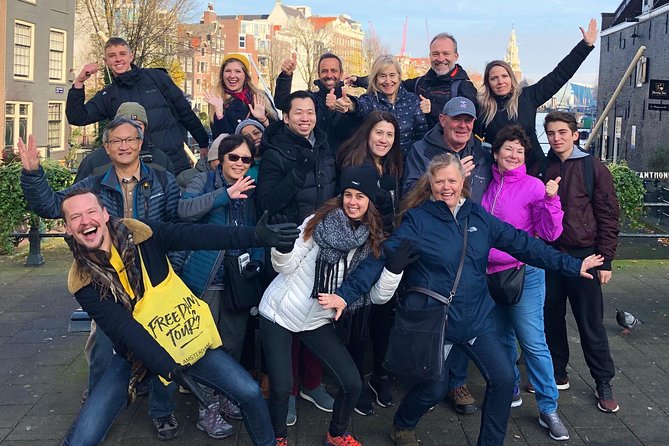
At the Waag, the guide discusses where Rembrandt painted his first major work and how it changed portrait making. A copy of the painting is used to point out details that are easy to miss when you only see a reproduction in a book or walk past the building without context.
This is a compact art-history stop. You are not expected to spend hours studying a painting. Instead, the guide shows how a single work can reflect changing ideas about group portraits, status, and the way people wanted to be represented.
The Waag itself is a strong place to pause because it links the city’s civic and artistic life. The tour does not include an admission ticket here, so the value comes from the explanation and the visual aid rather than an interior visit.
If you want a full Rembrandt experience, you will need to visit a museum separately. On this walk, the goal is to give you a reason to look more carefully at Dutch art later.
Oostindisch Huis: Amsterdam’s global trading power
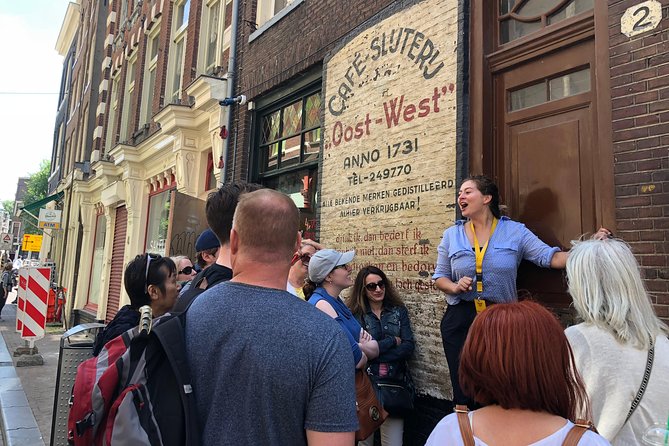
The Oostindisch Huis is one of the most important stops for understanding Amsterdam’s Golden Age. Inside is a striking 17th-century courtyard, but access is limited to weekdays. If the courtyard is available, it adds a memorable sense of place to the discussion.
Here you learn how Amsterdam became the center of a global trading empire and one of the wealthiest cities in the world during the 17th century. The building served as the headquarters of the Dutch East India Company, described here as the first and largest corporation in human history.
The guide also addresses the darker side of that success. That matters. A tour about wealth and trade is incomplete if it only celebrates clever finance, ships, and city growth. The conversation includes the legacy of exploitation tied to the trading system.
This stop is a good example of why the walk works best as an introduction. You will not get every detail of Dutch imperial history in 15 minutes, but you will get a clear framework for understanding why Amsterdam’s elegant center became so wealthy.
Plan around the weekday restriction if seeing the courtyard matters to you. The broader talk remains worthwhile even when the interior space is unavailable.
Waterlooplein: Jewish Amsterdam and the hunger winter
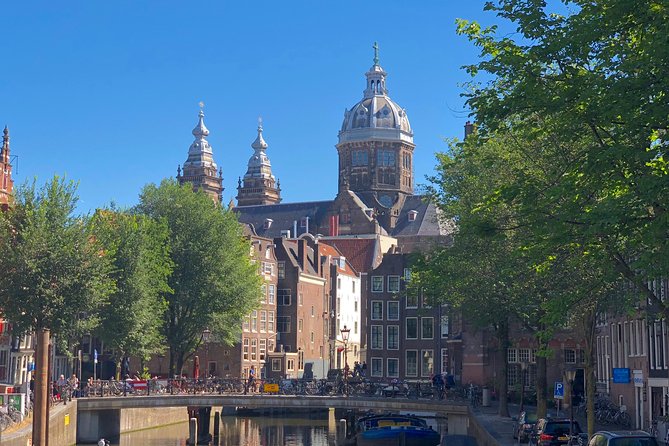
Waterlooplein is home to Amsterdam’s oldest market and sits in the former Jewish Quarter. The subject here is painful and important: the destruction of much of the neighborhood during the Second World War and the collapse of a Jewish community that had once found safety in Amsterdam.
The guide explains the effects of Nazi occupation, the decimation of the Jewish population, and the desperate conditions of the final hunger winter. You also hear what Amsterdammers had to do to survive those last months of the war.
One useful feature is the correction of a common oversimplification about the neighborhood’s destruction. The stop deals with responsibility and consequences rather than offering a vague wartime story. You leave with a clearer sense of how occupation changed daily life, not just political borders.
This is not a light market stop, so the mood shifts. That is appropriate, but you should know the tour does not keep every subject cheerful. The market itself may be active, yet the historical talk asks for attention and respect.
The Amstel: canal houses that reveal how the city worked
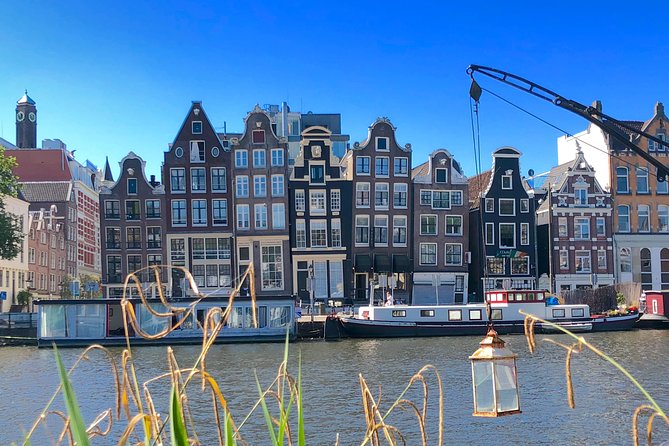
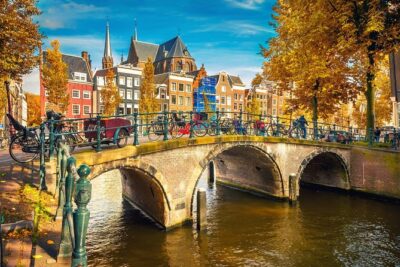
At the Amstel, or another canal if the weather or guide requires it, the focus returns to Amsterdam’s physical character. You learn why the city has canals and how the canal houses were designed.
The guide explains why many houses are narrow, why some lean, why the lean can be intentional, and why houses have hooks near the roof. You also get the famous explanation for open curtains, a small cultural detail that can make the streets feel less mysterious.
This is one of the most immediately useful parts of the walk because it teaches you how to read the city as you continue exploring. Afterward, you may notice the relationship between a building’s width, its height, its roofline, and its position along the canal.
The stop also provides a pause from heavier subjects. You are looking at the city itself, not only hearing about its politics. Weather matters here, and the exact canal location can change, so keep a light rain layer handy if conditions look uncertain.
Oudemanhuispoort: the city’s bicycle culture
Oudemanhuispoort is a former monastery that later became a hospital and is now part of the University of Amsterdam. It is a tucked-away passage, and the setting gives the guide a quieter place to explain Dutch bicycle culture.
You learn why Amsterdam has more bikes than people and why so many bicycles look plain, worn, or downright ugly. That question sounds comic, but it leads to a practical point: bikes here are working transport, not showroom ornaments.
This is a useful lesson before you spend more time in the city. You need to understand that bicycle lanes and moving bikes are part of the normal traffic pattern. Several guides are praised for making the walk easy paced, but you still need to watch where you stand and cross carefully.
The passage itself also reinforces the tour’s interest in ordinary spaces. Amsterdam’s best stories are not always at the grandest monument. Some are in a former religious building now serving university life.
Royal Palace Amsterdam and Dam Square: from republic to monarchy
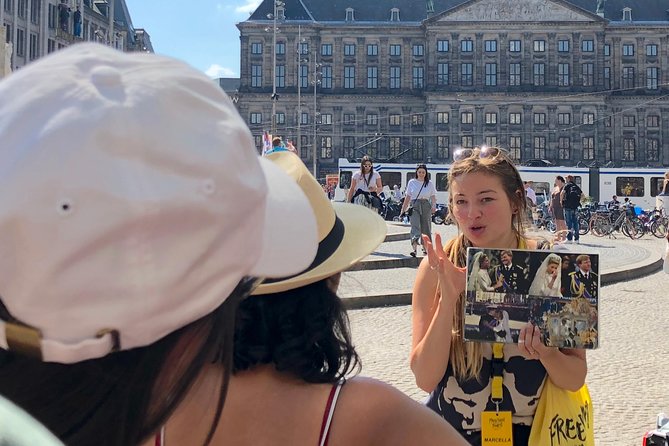
The final stop is the Royal Palace Amsterdam, where the guide explains the unusual shift from a Dutch republic to a monarchy. You also get an introduction to the current royal family, supported by pictures, along with some lighter royal gossip.
Dam Square is a fitting finish because it brings the walk back to the political and civic center. The tour begins with finance and urban power, then moves through religion, trade, war, city planning, and daily life before ending with the modern state.
You do not enter the Royal Palace on this experience. The palace talk is therefore an orientation, not a substitute for a proper visit. If you are interested in royal interiors, check the separate opening and ticket arrangements for the palace during your stay.
The ending back at the meeting point is practical. You are in a central part of Amsterdam, with the rest of the city’s old center already familiar enough to revisit on your own.
What the guides add to the walk
The strongest part of this experience is the guide-led storytelling. The guide roster changes, but several names receive especially warm praise for different strengths.
Raymond is described as a lifelong local who combines strong city knowledge with humor. Jaap is praised for an entertaining style and a firm grasp of Dutch history. Sergio is noted for passion, jokes, and helpfulness, while David brings enthusiasm and lively stories.
Other guides add their own character. Fernando is especially useful if you want ideas for the rest of your stay. Roman is praised for remembering names and connecting history with Dutch food. Esi, Alexander, Sebastien, Dani, Ramses, Carl, and Samuel are also singled out for clear explanations, humor, local perspective, or a good sense of group pace.
That range means the exact feel can vary by departure. The common thread is a friendly, human presentation rather than a dry lecture. Visual aids, including maps and a copy of Rembrandt’s painting, help make difficult subjects easier to follow.
Pace, group size, and practical value
The advertised duration is about two hours and 30 minutes, though some descriptions place the actual walk closer to two hours. Either way, plan for a substantial period on your feet.
The pace is generally manageable, and the route is designed for most people who can take part in a city walking tour. Wear comfortable shoes and carry water. The city center has uneven, crowded stretches, and you will need to stay alert around bikes.
A maximum of 15 people is a helpful limit. It does not turn the walk into a private tour, but it should make it easier to hear the guide and ask questions. On crowded days, the group may still bunch up or separate briefly at crossings.
Because the tour is in English only, you should be comfortable following a fairly detailed spoken explanation. The topics move quickly, from trade to war to drug policy, so this suits you if you like a brisk overview rather than a slow, single-subject tour.
Free cancellation is available if you cancel at least 24 hours before the start time. A late cancellation or change is not refunded, and the minimum group requirement means the operator may offer another date or a full refund if the tour cannot run.
Who should book this Amsterdam walk?
I would choose this tour for a first visit, especially if you want to understand the city before selecting museums and paid attractions. It is also useful for repeat visitors. One guide’s local perspective can reveal things you missed on earlier trips, even if you already know the main streets.
It suits people who enjoy history presented with humor, travelers who want candid discussion of sensitive subjects, and anyone looking for practical ideas for the rest of a stay. It is less suitable if you want long interior visits, a quiet route, or a narrow focus on art, architecture, or royal life.
Should you book Absolutely Amsterdam?
Book it if you want a low-cost, wide-ranging introduction to Amsterdam’s old center. The route covers more than postcard views, the guides bring personality, and the discussions give you useful context for places you will pass again.
Skip it if you mainly want to enter museums or monuments. You will see the outside of several important sights, but admission is not part of the experience. For most first-time visitors, though, the combination of price, central route, small group, and lively storytelling makes this a sensible first morning or afternoon in Amsterdam.
FAQ
How long does Absolutely Amsterdam last?
The tour lasts approximately 2 hours and 30 minutes. Some descriptions of the walk indicate that it may take closer to two hours.
What language is the tour offered in?
The tour is offered in English.
Where does the tour start?
It starts at Freedam Tours, Beursplein 5, 1012 GZ Amsterdam, Netherlands.
Where does the tour end?
The activity ends back at the meeting point in the city center.
How much does the tour cost?
The listed price is $5.93 per person. It is described as a budget-friendly experience where you can tip as much as you would like.
How many people can join the tour?
The maximum group size is 15 people.
Does the tour enter the hidden church at Ons’ Lieve Heer op Solder?
No. The church is discussed from the outside, and pictures are used to show the interior. Admission is not included.
Does the tour include entry to the Royal Palace?
No. The Royal Palace is discussed from outside, and admission is not included.
Can I cancel for a full refund?
Yes. You can cancel at least 24 hours before the experience starts for a full refund. Cancellations or changes made less than 24 hours before the start time are not refunded.
Just added around Amsterdam
- Amsterdam: Giethoorn Tour with Canal Cruise and Windmills★ 5.0 · 3 reviews
- Amsterdam: Chocolate Fondue in the Dark★ 5.0 · 3 reviews
- Full-day excursion to Edam, Volendam, and Marken★ 3.7 · 3 reviews
- Amsterdam Old-West Vegan Food Tour with Local Guide★ 4.7 · 3 reviews
- Amsterdam Private Walking Tour of Famous Painters★ 5.0 · 3 reviews
- Amsterdam Family Friendly Historical Walking Tour★ 5.0 · 3 reviews
- From Amsterdam: visit Zaanse Schans, Muiderslot and more!★ 5.0 · 3 reviews
- Amsterdam Walking Tour with Dutch Pancake Lunch★ 5.0 · 3 reviews
Amsterdam Tours, compared.

Amsterdam Classic Saloon Boat Cruise with Drinks and Cheese
Read our review →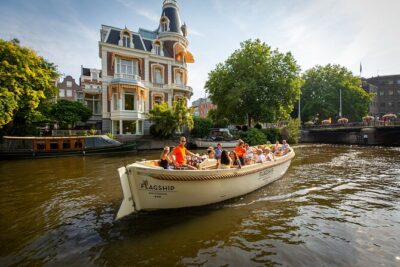
Amsterdam Luxury Canal Cruise + Unlimited Drinks & Bites option
Read our review →
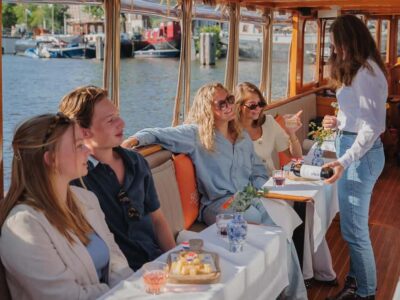
Classic Boat Cruise with Optional Cheese & Wine
Read our review →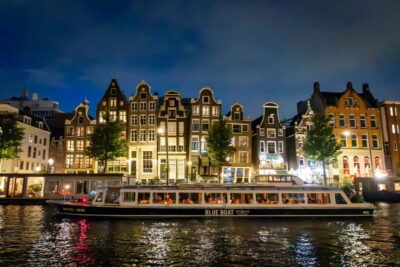
Evening Cruise with Optional Wine and Snacks
Read our review →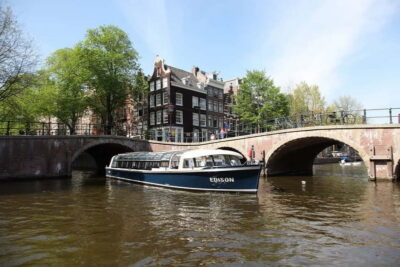
75 Minute City Canal Cruise with Audio Guide
Read our review →Browse the lists this tour appears in