
Reviewed · ROTTERDAM TOURS
Rotterdam: Art and Architecture Highlights Walking Tour
Rotterdam makes more sense when you read it as a city rebuilt through bold ideas. This 2.5-hour walking tour starts at the striking Central Station, follows postwar buildings and public art, and ends inside the eye-catching Markthal.
I like the clear architectural story and the mix of famous buildings with outdoor art by names such as Henry Moore, Rodin, Picasso, and Joep van Lieshout. I also like the route through Witte de Withstraat, Rotterdam’s artsy core, before reaching the Cube Houses and Markthal. The main thing to consider is the pace: you’ll be on foot in all weather, and entry tickets, food, drinks, and transport are not included.
Key points
- Central Station sets the theme: Begin with Rotterdam’s modern rebuild and its bold new gateway.
- The Depot is a rare sight: See the first publicly accessible museum depot from the outside and learn why it matters.
- Public art fills the route: Outdoor works connect Rotterdam’s wartime destruction with its creative present.
- Witte de Withstraat adds street life: Walk through one of the city’s best-known arts and culture streets.
- Cube Houses and Markthal finish strong: The route ends with two of Rotterdam’s most recognizable architectural projects.
- Diana brings useful context: Her explanations of the city’s postwar planning and architecture have been especially well received.
Why Rotterdam’s architecture needs a walking tour
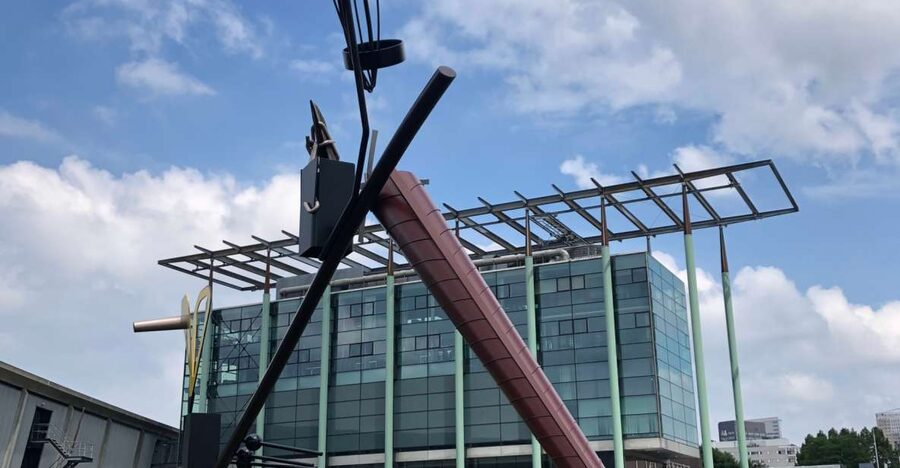
Rotterdam is not a city you understand fully from a canal cruise or a quick photo stop. Its identity comes from contrast: old street names and new buildings, quiet memorial art and loud contemporary design, practical rebuilding and playful experiments.
The city center was heavily bombed during the Second World War. Much of what you see today came later, as planners and architects chose not to rebuild the old center exactly as it had been. Instead, Rotterdam became a testing ground for modern design.
That story is the backbone of this tour. You are not simply ticking off buildings. You are learning why Rotterdam looks so different from Amsterdam, Delft, or Leiden. The guide links the city’s architecture to its wartime damage, its planning choices, and its ongoing interest in public art.
I find that useful because modern buildings can seem random when viewed one by one. Seen together, Central Station, the Calypso building, the Theater square, the Museum Quarter, the Cube Houses, and the Markthal form a clear progression. Rotterdam keeps asking the same question: how can a city rebuild, move people, and still make room for imagination?
More Walking Tours in Rotterdam
- Rotterdam: Architectural Highlights Guided Walking Tour
★ 4.8 · 215 reviews - Rotterdam Walk: Hilights, Gems, Architecture & WWII | 2 or 3hrs
★ 5.0 · 149 reviews - Rotterdam: Highlights & Gems Walking Tour with Dutch Local
★ 5.0 · 133 reviews
Starting beneath Central Station’s clock
The meeting point is by the main entrance of Rotterdam Central Station, under the station clock. This is a practical place to begin, since the station is easy to recognize and well connected to the city.
Central Station is also an excellent opening stop. It gives you an immediate sense of Rotterdam’s preference for large-scale, modern design. Your guide uses the building to introduce the city’s postwar development and explain how the new station fits into Rotterdam’s renewed center.
The first part of the walk also includes the Calypso building and Theater square. These stops show different sides of the city’s modern character. The Calypso building brings high-density urban living into the story, while Theater square connects architecture with public gathering and cultural life.
You should expect commentary and exterior viewing rather than a series of indoor visits. Entry tickets are not included, so this experience works best as an architectural orientation walk, not as a museum tour.
From the Museum Quarter to the Boijmans Depot
The route continues toward Rotterdam’s Museum Quarter, where the Kunsthal and the New Institute introduce the city’s relationship with art, design, and architecture.
The Kunsthal is important to the route because it represents Rotterdam’s open approach to exhibitions and contemporary culture. The New Institute adds another layer, focusing attention on design and architecture. Even if you do not plan to enter either venue, seeing them as part of the city’s cultural district helps explain why Rotterdam attracts so much modern creative work.
Then comes the Boijmans Depot, one of the route’s most unusual sights. It is described as the first accessible museum depot in the world. A conventional museum displays a selected portion of its collection. A depot is where works are stored, cared for, and managed, so the building gives museum storage a public face.
That makes the Depot more than a shiny new building for photographs. It raises a useful question about what normally happens behind museum walls. The tour gives you a chance to understand the building’s purpose and its role as a new Rotterdam icon.
The information provided does not promise an interior visit, and entry tickets are excluded. If going inside the Depot is important to you, check the current arrangements before booking. The walking tour itself is designed around the architecture and the explanation of its place in the Museum Quarter.
Public art and the memory of the bombed city
One of the strongest parts of the route is its open air art collection. Rotterdam’s public art is not treated as background decoration. The guide uses it to connect the city’s present-day creativity with the destruction that shaped its center.
You’ll encounter works linked to the drama of the bombarded city, along with pieces by artists including Henry Moore, Rodin, Picasso, and Joep van Lieshout. The exact stops can depend on the route and current access, but the larger idea is clear: Rotterdam puts serious art into streets and squares, where you meet it as part of daily life.
This is valuable for anyone who does not want architecture presented as a list of dates and building names. A sculpture can make the city’s rebuilding feel more human. It can also show how Rotterdam moved from grief and practical reconstruction toward experimentation and self-expression.
I would pay close attention here to the guide’s explanations rather than rushing from one photo stop to the next. The art section gives the tour its emotional weight. It also helps you see why Rotterdam’s public spaces can feel more daring than those in many Dutch cities.
Same country, a completely different kind of day:
- Rotterdam: Harbor Sightseeing Cruise
★ 4.3 · 7,599 reviews - Rotterdam: 1-Hour Sightseeing Splash Tour
★ 4.5 · 3,299 reviews - Rotterdam: Rotterdam Zoo Blijdorp Entry Ticket
★ 4.6 · 2,754 reviews - Rotterdam: Euromast Lookout Tower Ticket
★ 4.4 · 2,549 reviews
Witte de Withstraat brings a different energy
The walk through Witte de Withstraat changes the mood. This is known as Rotterdam’s most vivid and artsy street, and it is a natural place to see how galleries, street art, culture, and nightlife fit into the city center.
After the large public buildings and formal Museum Quarter, the street offers a more immediate view of Rotterdam’s creative side. You are still looking at the built environment, but now at street level. The scale is closer, the atmosphere more informal, and the route connects architecture with the city’s everyday cultural life.
This stop suits first-time visitors especially well. It gives you a useful area to return to after the tour, although the activity itself does not include food or drinks. You can make a note of the street and explore it independently later.
The guide’s role matters here. Without context, a walk along an arts district can become a simple stroll. With an explanation of how the street fits Rotterdam’s art scene, it becomes part of the larger story of a city that keeps using public space for new ideas.
Cube Houses: architecture that refuses to sit still
The Cube Houses are one of Rotterdam’s most recognizable architectural projects, and they make a lively stop on the route. Their tilted forms challenge the usual idea of a house as a simple box placed upright on the ground.
You can expect the guide to explain the complex as part of Rotterdam’s modern architectural experiments. The point is not only that the buildings look unusual. It is also that they test how people might live in an urban setting when an architect treats the whole block as a design problem.
The Cube Houses are especially good for visitors who want more than conventional monuments. They are bold, easy to photograph, and close to the final stop at the Markthal. At the same time, their unusual design can be easier to admire than to understand without commentary. The guide helps connect the visual stunt to Rotterdam’s wider planning culture.
Do not expect a long interior visit based on the information available. Entry tickets are not included, so treat the Cube Houses as an exterior architectural stop unless your booking details say otherwise.
Finishing inside the Markthal
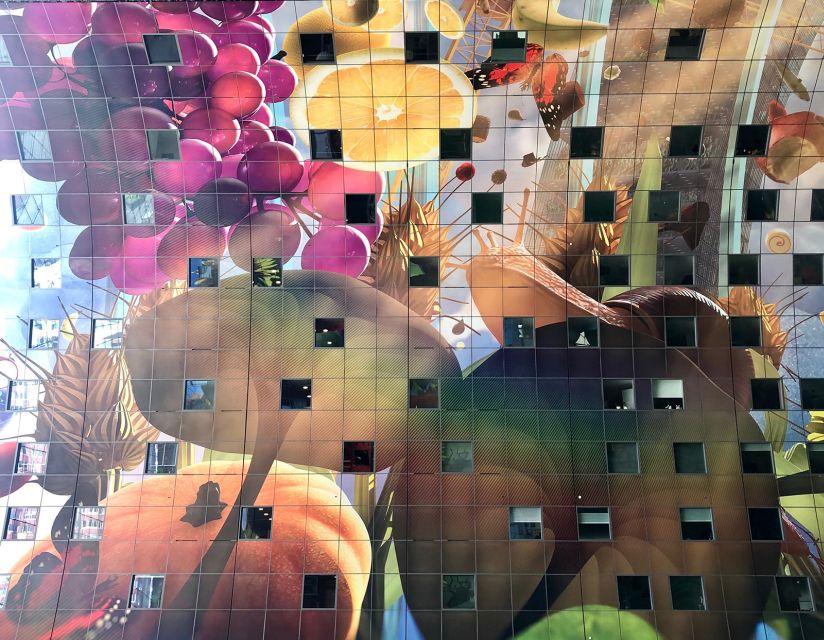
The tour ends at the Markthal, where architecture and art combine on a huge scale. The building is known for its dramatic interior, with the market function placed beneath a sweeping decorated arch.
This is a fitting final stop because it brings together several themes from the walk. It is practical, commercial, public, and highly designed. Art is not isolated in a gallery here. It becomes part of the building you use.
The Markthal also gives the route a satisfying change of scale. You begin beneath the station clock, pass cultural institutions and street art, examine experimental housing, and finish in a building that turns an everyday market into a major architectural sight.
Food and drinks are not included, but the ending gives you a convenient chance to continue on your own. You can explore the hall, find something to eat, or use the surrounding area as a base for more independent sightseeing.
What the 2.5-hour format gives you
Two and a half hours is long enough to create a connected story without taking over your entire day. That timing works well in Rotterdam, where many of the major stops sit within a walkable central area.
The route has a lot packed into it: Central Station, Calypso, Theater square, the Museum Quarter, the Depot, public art, Witte de Withstraat, the Cube Houses, and the Markthal. You will not have unlimited time at each place. This is a guided overview with interpretation, not a slow architectural sketching walk or a museum day.
I would book it near the start of your Rotterdam visit. The route gives you a map in your head and helps you decide which buildings or districts deserve a longer return visit. It can also prevent a common mistake: assuming Rotterdam’s modern architecture is just a collection of odd shapes. The guide supplies the links between them.
Comfort matters. Wear proper walking shoes and seasonal clothing. The tour runs rain or shine, so a wet forecast does not automatically cancel the experience. Bring only what you need, since oversize luggage is not allowed.
Guide quality and the value of live explanation
The experience includes a live English-speaking guide, and that is the main reason to choose it over walking the route alone. Rotterdam’s buildings are visually memorable, but their purpose and history are not always obvious from the pavement.
Diana is one guide associated with the experience. Her approach focuses on the historical, planning, and architectural development of postwar Rotterdam, beginning with the new Central Station. That combination is particularly useful because the tour is not limited to design vocabulary. It explains how the city changed and why.
The high rating of 4.9 out of 5 from 10 reviews reflects strong satisfaction, with comments describing the walk as informative, pleasant, and a good overview for a first visit. One four-star assessment still found it very good for a first look at Rotterdam, which is a fair way to frame the experience: it gives you the keys to read the city, but it cannot cover every building or museum in two and a half hours.
A private group option is available. That may be worth considering if you want a more personal pace or are traveling with a small party, though the supplied details do not specify the private-group price or size.
Price, access, and who should book
At $65 per person, this is not the cheapest way to spend a morning in Rotterdam. The price pays for a live guide and a focused route through several major architectural areas, rather than for admission to attractions or transportation.
I think the value is good if you care about architecture, public art, urban planning, or modern European cities. It is also useful for a first visit, since the route covers several central sights without requiring you to plan the order yourself.
The value is weaker if you mainly want indoor museum time, food tasting, or a relaxed wander with no fixed pace. You will need to pay separately for anything you choose to enter, and there is no hotel pickup, drop-off, or included transport.
The tour is wheelchair accessible, but the information says it is not suitable for people with visual or hearing impairments. Unaccompanied minors are not permitted. Children must therefore attend with an accompanying adult.
Free cancellation is available up to 24 hours before the tour for a full refund, and you can reserve now and pay later. Those terms help if your Rotterdam schedule is still changing, but the key practical question remains your comfort with an outdoor walk in uncertain weather.
Should you book the Rotterdam architecture walk?
Book this tour if you want Rotterdam explained through its buildings and public art rather than simply photographed. The best reason to go is the connected route: Central Station introduces the rebuilt city, the Museum Quarter shows its cultural ambition, Witte de Withstraat adds street-level creativity, and the Cube Houses and Markthal provide memorable finishes.
I would especially recommend it for first-time visitors, architecture fans, and anyone curious about how a bombed city chose to rebuild in a modern style. It is also a smart opening activity before exploring Rotterdam on your own.
Skip it if you want included museum entry, a food-focused experience, or a short ride between sights. For everyone else, the $65 cost buys useful context, a strong overview, and a better way to look at Rotterdam’s unconventional center.
FAQ
Where does the tour meet?
The meeting point is by the main entrance of Rotterdam Central Station, under the station’s clock.
How long does the tour last?
The walking tour lasts 2.5 hours.
What language is the tour conducted in?
The live tour is conducted in English.
What sights are included on the route?
The route includes Central Station, the Calypso building, Theater square, the Kunsthal, the New Institute, the Boijmans Depot, public art, Witte de Withstraat, the Cube Houses, and the Markthal.
Does the tour include entry tickets?
No. Entry tickets are not included.
Are food and drinks included?
No. Food and drinks are not included.
Is transportation provided?
No. Transportation is not included. The experience is a walking tour.
Is the tour wheelchair accessible?
Yes, the activity is listed as wheelchair accessible.
Can I cancel for a full refund?
Yes. You can cancel up to 24 hours in advance for a full refund.
Just added around Rotterdam
- Discover Rotterdam: Classic Highlights Bike Tour by a Local★ 5.0 · 3 reviews
- Rotterdam: Capture the most Photogenic Spots with a Local★ 5.0 · 3 reviews
- Private tour: Markthal, Cube houses and Rooftop Het Witte Huis★ 4.5 · 3 reviews
- Private Transfer from Rotterdam Port to Amsterdam Airport (AMS)★ 5.0 · 3 reviews
- Rotterdam: 2.5-Hour Leckers Boat Cruise and Buffet★ 3.2 · 3 reviews
- Discover Rotterdam’s most Photogenic Spots with a Local★ 5.0 · 3 reviews
- Rotterdam: Wilhelminapier, High-rise & floating architecture★ 4.0 · 3 reviews
- Private Transfer from Rotterdam City to Amsterdam Schiphol Airport★ 5.0 · 4 reviews
Rotterdam Tours, compared.


Kinderdijk UNESCO World Heritage Entry Ticket
Read our review →
Browse the lists this tour appears in