
Reviewed · ROTTERDAM TOURS
8 hour Walking and Boat Tour to Rotterdam and Kinderdijk
Rotterdam makes a strong first impression: a city of daring buildings, working waterways, old scars, and bold bridges. This tour links the best of central Rotterdam with Kinderdijk’s 19 windmills, giving you two very different views of Dutch water management in one long day. Guide Alex leads the walk, explains the city’s past and present, and handles the bus trip to the polder.
I like the small maximum of four people, which should make it easier to ask questions and keep the walking pace sensible. I also like the practical touches: bus tickets are included, along with coffee, tea, and a serving of patatje oorlog, a famous Rotterdam snack. The main caution is simple: this is a serious walking day, and the schedule may feel demanding if you have mobility concerns or prefer a relaxed pace.
Key points at a glance
- Two major sights in one day: Walk through Rotterdam, then spend about three hours at Kinderdijk.
- A very small group: The tour accepts a maximum of four people, giving the guide room to tailor explanations.
- A strong architecture focus: See Rotterdam Centraal, Markthal, the Cube Houses, Witte Huis, De Hef, and Erasmus Bridge.
- Transport is covered: Bus tickets between Rotterdam and Kinderdijk are included.
- You pay the main extra fee on site: Kinderdijk admission costs €19 per person and is not included.
- Expect plenty of walking: The tour is not a good choice if you have mobility concerns.
Why Rotterdam and Kinderdijk belong together
At first, Rotterdam and Kinderdijk may seem like an odd pair. One is a modern port city filled with daring structures. The other is a quiet polder area shaped by centuries of pumping and drainage.
That contrast is exactly why the combination works. Rotterdam shows how the Dutch rebuilt and reimagined a city after the destruction of May 1940. Kinderdijk shows the older, slower work of keeping low-lying land dry. Together, they explain why water is not just scenery in the Netherlands. It is part of daily life, engineering, politics, and city design.
The day begins at Rotterdam Centraal Station, at Stationsplein 48. This is an easy meeting point because the station is connected to public transportation and is one of Rotterdam’s main architectural landmarks. With about 170,000 passengers passing through each day, it is more than a place to catch a train. Its angled roof and broad entrance announce the modern city before your walk even begins.
From there, the route moves into central Rotterdam and continues toward the river. The walking portion includes many stops, but the time at each one varies. You will often pause for an explanation and photographs rather than enter every building.
More Boat Tours in Rotterdam
- Rotterdam: Harbor Sightseeing Cruise
★ 4.3 · 7,599 reviews - Rotterdam: Pancake Cruise
★ 4.4 · 1,986 reviews - Rotterdam: Harbor Cruise with Live Guide
★ 4.0 · 1,270 reviews
From a water board office to Rotterdam’s oldest church
The former headquarters of Waterschap Schieland is an early reminder that Rotterdam’s survival has always depended on water policy. The 17th-century building once housed the local water authority and briefly served as accommodation for Napoleon Bonaparte. You get 30 minutes here, enough time for context about the institution and its role in managing water in South Holland.
Next comes Grote of Sint-Laurenskerk, a late Gothic church completed in 1525. It is Rotterdam’s oldest building and one of the few structures in the city center to survive the bombing of May 15, 1940. The stop is short, about 10 minutes, so do not expect an extended church visit. Its value lies in seeing a rare piece of prewar Rotterdam in the middle of a city known for postwar construction.
The Erasmus Sculpture adds another layer. Desiderius Erasmus, also called Erasmus of Rotterdam, was a 16th-century philosopher, theologian, scholar, and priest. The monument honors one of the city’s most famous sons, whose name appears on public buildings, schools, and institutions across Rotterdam. You have about 15 minutes here, which is enough to view the statue and hear why Erasmus remains so important to the city.
Markthal and the Cube Houses: Rotterdam’s playful side
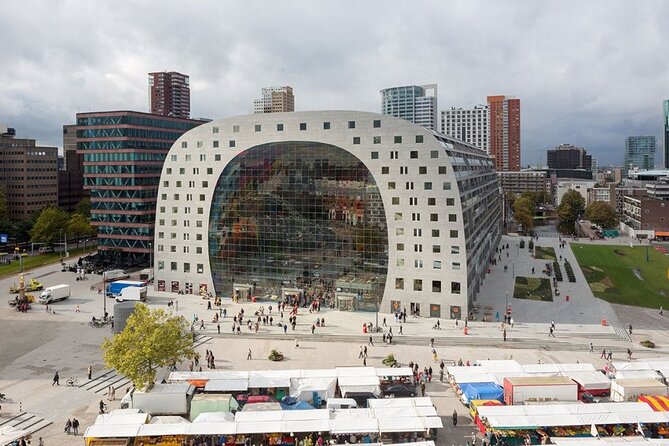
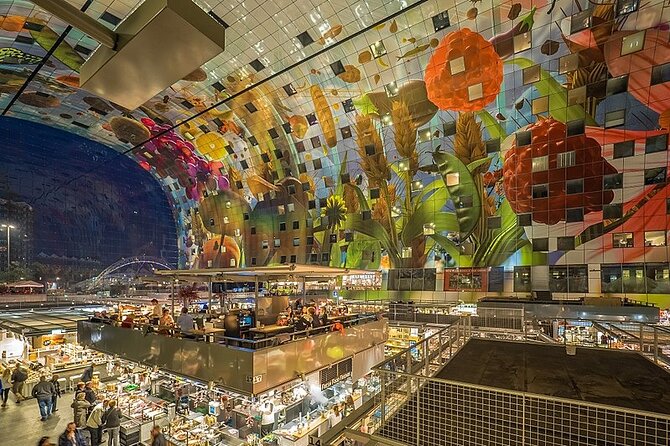
The Markthal is one of the city’s most recognizable modern buildings. Its horseshoe shape combines a covered market with apartments and other facilities. The interior artwork has earned it the nickname the Sistine Chapel of Rotterdam, though the comparison is playful rather than architectural.
You get about 20 minutes at the Markthal. That is enough to look up at the huge interior artwork and get a sense of the building, but not necessarily enough for a leisurely meal or extended shopping. If you want to browse food stalls in detail, you may need to do that on another visit.
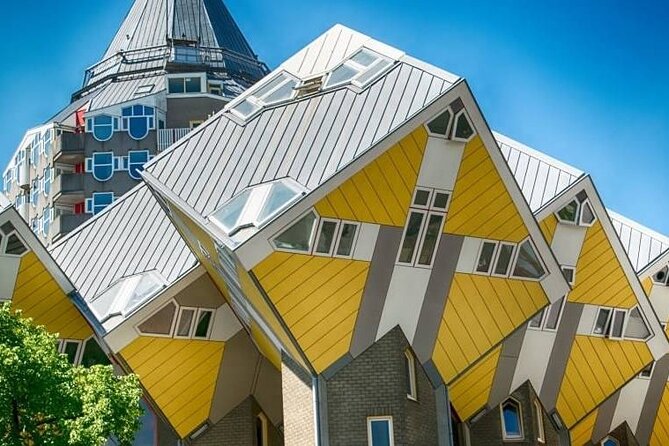
The nearby Kijk-Kubus houses offer a more hands-on architecture stop. These cube-shaped apartments sit on top of angled support columns, creating a group of homes that look a little like trees. Because of the unusual form, only about three quarters of each interior is suitable for ordinary living.
Entrance to the Kijk-Kubus buildings is included. That matters because seeing the inside makes the design easier to understand. From the street, the houses look like a clever visual trick. Inside, you can see how slanted walls and limited usable space affect daily life. The stop lasts about 20 minutes, so it is an efficient way to examine Rotterdam’s experimental housing without spending half a day at a museum.
Oude Haven, Witte Huis, and the city’s working river
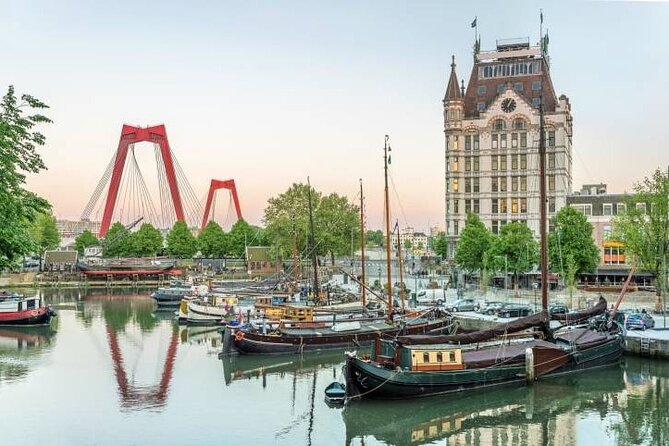
Oude Haven is one of medieval Rotterdam’s oldest ports, though it is not the city’s oldest port. It once marked the mouth of the River Rotte where it met the Nieuwe Maas. Today, it is a popular gathering place with coffee bars, restaurants, taverns, and clubs.
The tour gives you about an hour here, making it one of the best pauses in the city section. This is where you can slow down, watch the water, and see how an old harbor has become part of modern city life. The included patatje oorlog also fits the setting. The name means war fries, and the snack is a Rotterdam specialty made with fries and sauces. It is a useful little taste of local food rather than a formal meal.
Nearby, Witte Huis recalls a different era of construction. Completed in 1898, it was once the highest building in Europe and is often described as Europe’s first skyscraper. Like many older Amsterdam buildings, it rests on 1,000 wooden pillars, a practical answer to the soft ground beneath Dutch cities.
The stop lasts around 15 minutes. You will not spend long inside, but the building gives useful perspective. Rotterdam is famous for its new architecture, yet Witte Huis shows that the city also took part in Europe’s early race toward vertical construction.
More Walking Tours in Rotterdam
- Rotterdam: Architectural Highlights Guided Walking Tour
★ 4.8 · 215 reviews - Rotterdam Walk: Hilights, Gems, Architecture & WWII | 2 or 3hrs
★ 5.0 · 149 reviews - Rotterdam: Highlights & Gems Walking Tour with Dutch Local
★ 5.0 · 133 reviews - Rotterdam 2-Hour Walking Tour | Discover The City With A Local
★ 4.5 · 111 reviews
Red bridges, raised tracks, and wartime memory
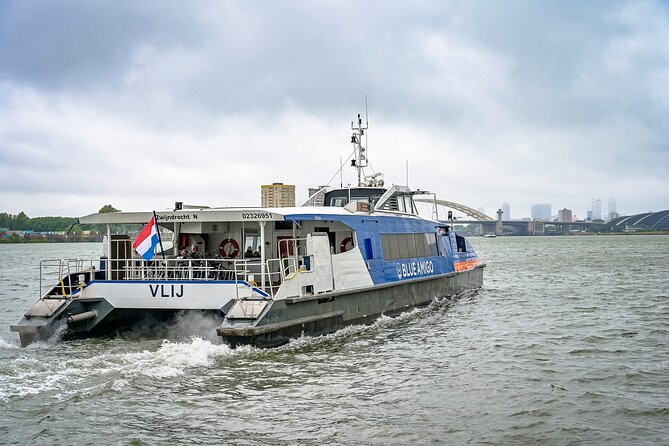
Willemsbrug, known as the Red Bridge, connects central and northern Rotterdam with districts south of the river. The tour allows about 15 minutes to view it. The bridge is dedicated to Willem III and is one of three Rotterdam bridges linking the central and northern parts of the city with the southern districts.
The route then reaches De Hef, whose name means the lift. This large steel structure once functioned as a lifting and rotating railway bridge over the Nieuwe Maas. It served before a rail tunnel was built beneath the river. The stop is brief, about 10 minutes, but the bridge is a striking piece of industrial engineering.
De Boeg shifts the mood. This war memorial on the right bank of the Nieuwe Maas honors the 3,500 people aboard Dutch merchant ships who died during World War II. You have about 15 minutes here. It is not a long memorial visit, but it gives the walk a quiet pause and connects Rotterdam’s port activity with the human cost of wartime shipping.
The open-air section of the Maritiem Museum at Leuvehaven continues that maritime theme. The collection includes steamships, cargo-handling machines, equipment, ship engines, and other objects connected with Dutch shipping and naval work from the mid-19th century through the 1970s.
The planned time here is about 20 minutes. That is enough for a quick look at the vessels and machinery, not a complete museum visit. If maritime technology is your main interest, you may want to return separately. During this tour, the stop works best as part of the larger story of Rotterdam as a port city.
Erasmus Bridge and the move to Kinderdijk
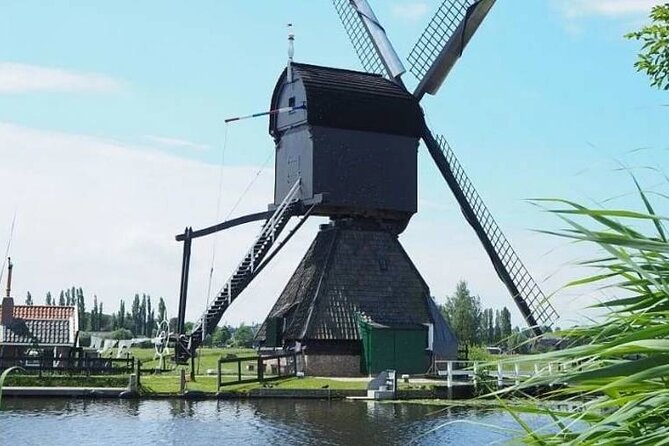
The Erasmus Bridge is Rotterdam’s most famous modern bridge. Its single white pylon and cable design have earned it the nicknames the Swan and the Harp. It crosses the Nieuwe Maas and includes an 80-meter opening section, described as the largest and heaviest opening part of a bridge in Europe. The pylon rises 139 meters.
You get about 30 minutes here, a generous stop for photographs and an explanation of how the bridge fits the city. The Erasmus Bridge is more than a postcard view. It helps you understand Rotterdam’s scale, its connection to the river, and its continuing link to shipping.
After the city walk, included bus tickets take you to Kinderdijk and back. The tour description gives the overall experience a duration of about 7 hours and 40 minutes, while also calling it an eight-hour tour. In practical terms, plan on giving it most of your day. The exact balance between walking, explanations, and transport may vary.
Three hours among Kinderdijk’s 19 windmills
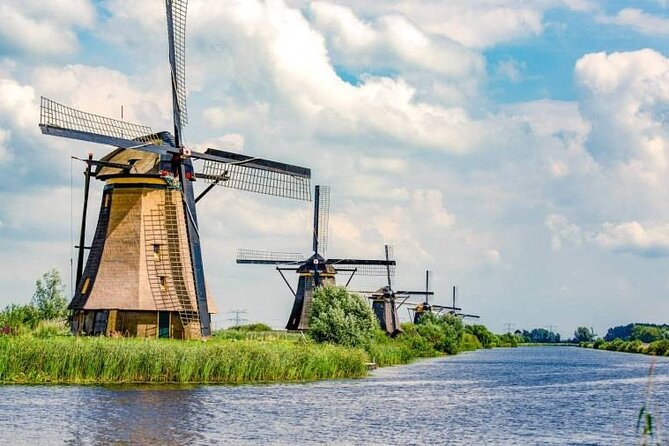
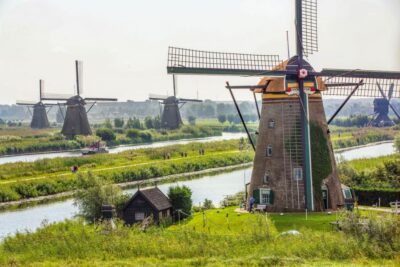
Kinderdijk is the day’s longest stop, with about three hours set aside. The area contains 19 authentic polder windmills dating from the first half of the 18th century. They form one of the clearest examples of organized Dutch water management through the centuries.
The windmills are not simply decorative country buildings. Their purpose was to help move water through the polder system and keep reclaimed land usable. At Kinderdijk, you can see how Dutch communities worked with wind, canals, mills, and carefully managed levels of land and water.
Three hours gives you time to walk through the area without treating it as a quick photo stop. You can take in the rows of mills, the waterways, and the open setting after the tight streets and tall buildings of Rotterdam. It is also the part of the day where comfortable shoes matter most.
Admission to Kinderdijk costs €19 per person and is not included in the tour price. That extra fee is easy to overlook when comparing options, so add it to your budget before booking. The bus tickets, guide service, coffee or tea, patatje oorlog, and entrance to the Kijk-Kubus buildings are included.
What the $591.46 group price really buys

The listed price is $591.46 per group of up to four people. If four people join, that works out to about $147.87 per person, before the €19 Kinderdijk admission fee. For a solo visitor or couple, the per-person cost is much higher, so the tour makes the most financial sense for a small private group that can share the group rate.
The price pays for more than transportation. You are getting a guide for a long walking route, a carefully connected city itinerary, bus travel to and from Kinderdijk, the Kijk-Kubus entrance, and a few food and drink extras. You also avoid arranging the city route and the Kinderdijk connection yourself.
The value depends on what you want from a visit. If you prefer independent wandering and already understand Rotterdam’s transport system, the cost may feel high. If you have only one day and want a guide to connect architecture, port life, wartime memory, and water management, the package is easier to justify.
The maximum of four is important. This is not a large coach excursion. A small group can usually keep questions direct and avoid the slow movement that comes with a big crowd. Alex’s role is especially useful because the tour covers a wide range of subjects, from Erasmus to railway bridges and polder mills.
Who should book this walking day
I would choose this tour if you want a broad introduction to Rotterdam and do not want to spend time planning the transfer to Kinderdijk. It suits first-time visitors who enjoy architecture, engineering, city history, bridges, ports, and Dutch water management.
It is also a good fit for a group of up to four people. Sharing the group price lowers the cost per person and gives you the benefit of a small setting.
I would think twice if you have mobility concerns. The route covers many stops on foot, and the Kinderdijk visit adds another extended walking period. The schedule also leaves limited room for lingering at the Markthal, maritime museum, or Oude Haven.
The experience has a perfect five-star rating from five submitted reviews, with specific praise for Alex’s explanations of Rotterdam, Kinderdijk, and the history of both places. That matches the structure of the tour: its strength is not one single attraction, but the way the guide connects many different parts of the region.
Free cancellation is available if you cancel at least 24 hours before the start time. Changes or cancellations made less than 24 hours ahead are not accepted for a refund. Confirmation is sent within 48 hours of booking, subject to availability.
My call: a strong choice for an active small group
Book this tour if you want one full day that joins Rotterdam’s striking city design with Kinderdijk’s old-fashioned windmill system. The small group, included transport, and guide-led explanations make the day straightforward, while the city route gives you far more than a quick bridge-and-market photo tour.
Skip it if you want a slow schedule, a full museum visit, or a short outing with little walking. Also remember to add €19 per person for Kinderdijk admission. For an active group of two to four people, the tour offers a practical way to see two very different sides of Dutch life in one day.
FAQ
Where does the tour begin?
It begins at Stationsplein 48, 3013 AJ Rotterdam, Netherlands, at Rotterdam Centraal Station.
Where does the tour end?
The activity ends back at the meeting point.
How long does the tour last?
The stated duration is approximately 7 hours and 40 minutes, and it is also described as an eight-hour tour.
How many people can join?
The tour has a maximum of four participants.
Is transportation to Kinderdijk included?
Yes. Bus tickets from Rotterdam to Kinderdijk and back are included.
Is Kinderdijk admission included?
No. Admission costs €19 per person and must be paid separately.
Is the Kijk-Kubus entrance included?
Yes. Entrance fees to the Kijk-Kubus buildings are included.
Is the tour suitable for people with mobility concerns?
The tour involves substantial walking in both Rotterdam and Kinderdijk. The available information says it is not a good option if you have mobility concerns.
More Kinderdijk Windmill Trips
- Rotterdam: Kinderdijk UNESCO World Heritage Entry Ticket
★ 4.6 · 1,477 reviews - Rotterdam: Waterbus Ticket to Dordrecht and/or Kinderdijk
★ 4.6 · 542 reviews - All-Inclusive Private Windmill Tour to Kinderdijk from Rotterdam
★ 4.5 · 59 reviews - Kinderdijk Bike Tour
★ 5.0 · 35 reviews
Just added around Rotterdam
- Discover Rotterdam: Classic Highlights Bike Tour by a Local★ 5.0 · 3 reviews
- Rotterdam: Capture the most Photogenic Spots with a Local★ 5.0 · 3 reviews
- Private tour: Markthal, Cube houses and Rooftop Het Witte Huis★ 4.5 · 3 reviews
- Private Transfer from Rotterdam Port to Amsterdam Airport (AMS)★ 5.0 · 3 reviews
- Rotterdam: 2.5-Hour Leckers Boat Cruise and Buffet★ 3.2 · 3 reviews
- Discover Rotterdam’s most Photogenic Spots with a Local★ 5.0 · 3 reviews
- Rotterdam: Wilhelminapier, High-rise & floating architecture★ 4.0 · 3 reviews
- Private Transfer from Rotterdam City to Amsterdam Schiphol Airport★ 5.0 · 4 reviews
Rotterdam Tours, compared.

Kinderdijk UNESCO World Heritage Entry Ticket
Read our review →
Browse the lists this tour appears in