
Reviewed · AMSTERDAM TOURS
Walking Tour about Golden Age Architecture, private local guide
Amsterdam’s Golden Age architecture is best understood from street level, where grand merchant homes, leaning façades, warehouses, and tiny carved stones tell the story. This private walk with local guide Anna links those details to Amsterdam’s rise as a 17th-century trading power.
I like the one-on-one format, which gives you room to ask about buildings you have passed without understanding. I also like the focus on engineering and design, especially how builders worked on soft marshy ground. The main drawback is pace: 90 minutes covers many stops, so this is a brisk introduction rather than a slow architectural study.
Key points at a glance
- Private attention with Anna: Your group takes the tour alone, making it easier to ask questions and pause for photos.
- A clear Golden Age route: Walk from the Royal Palace and Dam Square through the canal belt and Jordaan to Westerkerk.
- Architecture beyond pretty façades: Learn about clay foundations, hoisting beams, domes, crooked houses, and canal planning.
- Small details with big stories: Look for gevelstenen, carved façade stones that reveal a building’s trade, owner, or original use.
- Useful for first-time visitors: The walk covers several central landmarks in a short period and ends near the Anne Frank House.
- A walking-intensive outing: Expect about 1.5 hours of standing and walking, with no mobility aids available.
Why Amsterdam’s Golden Age looks the way it does
Amsterdam’s 17th-century success came from trade, shipping, finance, and an expanding population. That prosperity changed the city’s streets. Merchants built narrow canal houses with tall windows, decorative gables, storage space, and hoisting beams. Churches and public buildings made a more formal statement about civic pride and religious life.
This tour gives you a useful way to read those buildings. Instead of seeing a row of attractive façades, you learn to ask why a house is narrow, why the upper floors project forward, why a warehouse has a beam near its roof, or why one building leans more than its neighbor.
The private setting matters here. With a large group, architectural details can disappear under background chatter or a guide’s fixed script. With Anna, you can point to a façade, ask about a carving, or stop for a photograph without losing the thread of the walk. Her approach, based on the available feedback, is friendly and conversational, with plenty of room for questions.
The price is $73.59 per person. That is not the cheapest way to see central Amsterdam, but the value depends on your group size. For one or two people, a private guide costs more than a public walking tour, yet you receive direct attention and a route built around your interests. For a small group, the per-person cost becomes easier to justify, especially if you care about architecture rather than only famous sights.
More Walking Tours in Amsterdam
- Anne Frank’s Story – Guided Walking Tour through Amsterdam
★ 5.0 · 11,619 reviews - Amsterdam: Life of Anne Frank and World War II Walking Tour
★ 4.8 · 10,467 reviews - Absolutely Amsterdam – the Essential Introductory Walking Tour
★ 5.0 · 3,629 reviews
Starting at the Royal Palace and Dam Square
The meeting point is the Royal Palace Amsterdam at Nieuwezijds Voorburgwal 147. The opening discussion focuses on nearby Dam Square, where Amsterdam’s story gets its broad introduction.
You’ll hear how the city grew into a major international trade center during the 17th century. Dam Square is a good place to begin because it connects civic power, commerce, and urban growth in one central setting. The introduction is brief, about five minutes, so it gives you context without using up the walk.
The Royal Palace receives more attention. It began as Amsterdam’s town hall during the Golden Age, not as a royal residence. That change in purpose helps explain its scale. The building represented the confidence of a city that had gained money and influence through trade.
The discussion also covers Dutch Neoclassical design, building materials, and construction methods. The most useful point is the palace’s foundation. Amsterdam was built on wet, unstable ground, so creating a massive public building required careful engineering. You’ll learn how builders dealt with clay and marshy soil, a detail that helps explain why construction in Amsterdam was such a feat.
You do not enter the palace on this outing, and admission is not included. The stop is about the exterior and the story behind it. If you want to tour the palace rooms afterward, plan that as a separate visit.
House Bartolotti and the style of wealthy merchants
The route continues to House Bartolotti, a canal-side home with a red-brick façade, large windows, and sandstone decoration. It offers a sharp contrast to the practical warehouses you’ll see later.
Its ornament reflects the wealth of its original owner and his connections with Italy. The building is a reminder that Amsterdam’s Golden Age was not isolated. Trade brought goods, money, styles, and ideas from across Europe, and wealthy residents used their homes to show their position.
This is a short stop, around five minutes, but the house gives Anna a good example for explaining Dutch Baroque design. Look at the balance between brick and carved stone. The façade is decorative without becoming a stone palace, which tells you something about local materials and Amsterdam’s own building traditions.
Torensluis and Amsterdam’s crooked houses
Torensluis is one of the more useful viewing points on the route. From this wide bridge, you can compare several façade designs associated with the city’s merchant class.
Rather than studying a single building, you get a small lesson in variations. Baroque ideas were adapted to Amsterdam’s narrow plots and local building methods. Decorative details, proportions, and contrasts changed from house to house, even when the buildings served similar social purposes.
This is also a good place to notice crooked houses. Amsterdam’s leaning façades are not simply a quirky visual feature. Soft, marshy ground and old foundations help explain why buildings shift or tilt over time. Some lean forward by design, allowing goods to be lifted through upper windows without striking the façade. Others have moved in ways that give the canal streets their uneven character.
A practical tip: this stop rewards careful looking, not just a quick photograph. Ask Anna to point out how the façades differ. Her strength, according to the information available, is identifying details you might otherwise pass without noticing.
Same country, a completely different kind of day:
- Amsterdam: Van Gogh Museum Ticket
★ 4.7 · 52,054 reviews - Amsterdam Classic Saloon Boat Cruise with Drinks and Cheese
★ 5.0 · 31,825 reviews - Amsterdam Luxury Canal Cruise + Unlimited Drinks & Bites option
★ 5.0 · 30,518 reviews - Amsterdam: Heineken Experience Ticket
★ 4.6 · 30,055 reviews
De Dolphijn and the world behind the façades
De Dolphijn adds a personal story to the architectural route. The name refers to the dolphin symbol of wealth, a fitting image for a city whose prosperity depended heavily on maritime trade.
The house was once owned by Frans Banning Cocq, the captain shown in Rembrandt’s The Night Watch. That connection brings a famous painting into the street scene. You are not only studying an old house. You are connecting a building, a merchant city, military status, and Dutch art.
This is the kind of stop that makes a short walking tour more memorable. Architecture can feel abstract when you only discuss dates and styles. A known resident gives the building a human link. You begin to imagine who used these canal homes and what social signals their façades were meant to send.
The Ronde Lutherse Kerk and the power of the dome
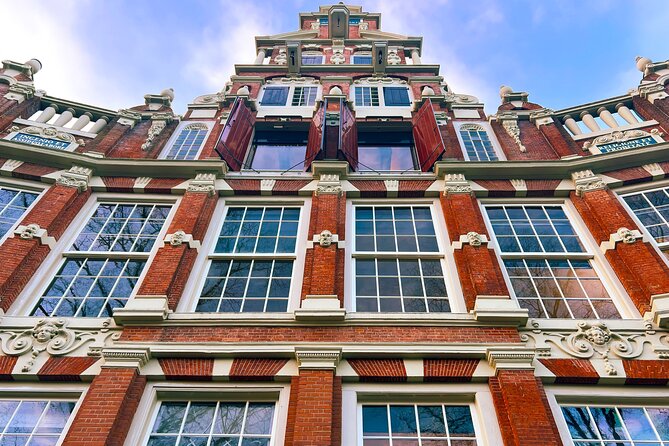
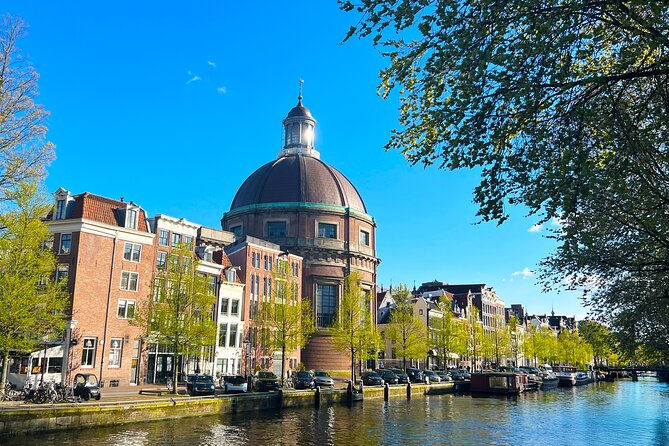
The Ronde Lutherse Kerk provides a change of shape. Its dome reflects the importance of domed structures during the Renaissance period, when such forms were considered a high point of architectural skill.
The stop is brief, so expect a focused explanation rather than a detailed interior visit. The value is comparison. Most of the route emphasizes narrow houses and long canal façades. Here, the eye moves upward to a large rounded form designed for visual impact.
The church also helps show that Amsterdam’s Golden Age architecture was not only residential. Civic buildings, warehouses, and places of worship all expressed the city’s wealth and ambitions in different ways.
Prinsengracht warehouses and practical design
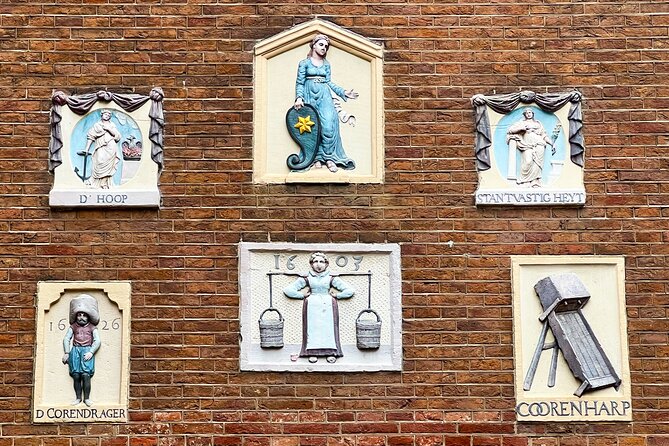
Along Prinsengracht, the tour turns toward function. The warehouses are tied directly to the trade that supported Amsterdam’s growth.
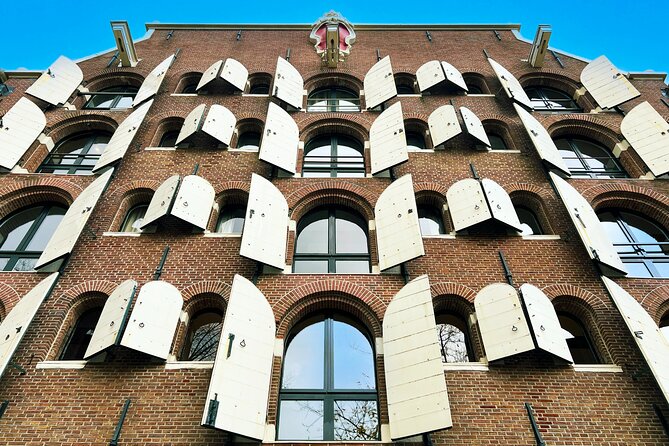
Look for steep gables, tall windows, and wooden hoisting beams near the roofs. Those beams were practical tools. Merchants used them to raise cargo from ships and move goods into upper storage areas. The narrow buildings made efficient use of expensive canal-front plots, while the height provided room for storage.
The façades can look simple compared with House Bartolotti. That simplicity is part of the lesson. Not every wealthy building needed heavy ornament. A warehouse could show power through size, scale, and location, while its main purpose remained storage and trade.
This stop is especially useful if you have wondered why so many canal houses have hooks or beams high above street level. After Anna explains the system, the canal belt becomes easier to read. You see a working port and commercial district, not only a photogenic row of houses.
Jordaan, workshops, and gevelstenen
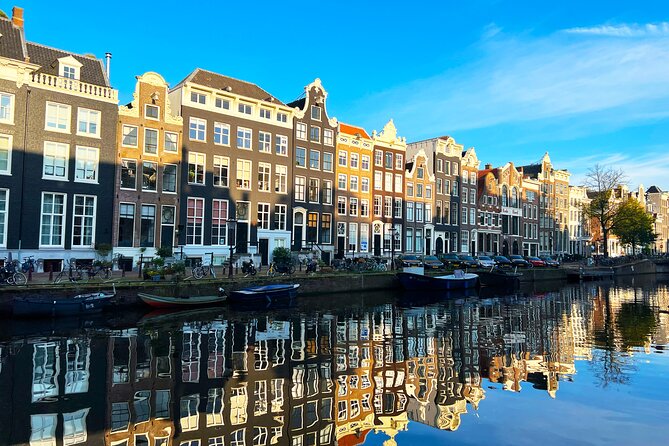
The 20-minute Jordaan section is the longest stop on the route, and it gives the tour its most distinctive subject: gevelstenen, or carved façade stones.
The Jordaan developed as a lower and middle-class neighborhood for craftsmen and laborers. Its narrow canals and closely packed houses supported both home life and work. Small shops and workshops often occupied ground floors, so the neighborhood had a different social feel from the grander merchant addresses.
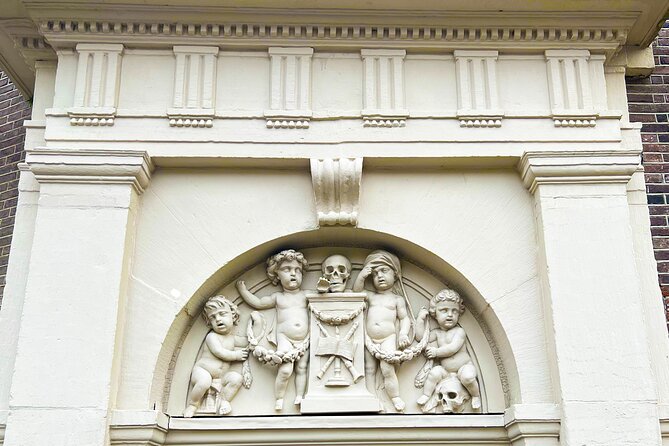
Gevelstenen helped identify buildings at a time when modern street numbering was not the only way to find a place. A carved plaque might show a trade, a profession, a symbol, or an important fact about the people who lived there. Some are simple. Others have detailed carvings that turn a plain wall into a small piece of public storytelling.
I consider this the tour’s most rewarding section for anyone who enjoys details. You can walk through Amsterdam’s streets after the tour and keep looking for these signs. They give you a way to spot the working lives behind the façades, rather than focusing only on large monuments.
Ask Anna about the social differences between Jordaan homes and the grand canal houses. The available feedback specifically points to her explanations of architecture, history, and social policy as accessible and easy to follow. That wider context is important. A building’s style tells only part of the story. Its location and original occupants tell you who had money, who worked nearby, and how the city was organized.
Ending at Westerkerk near the Anne Frank House
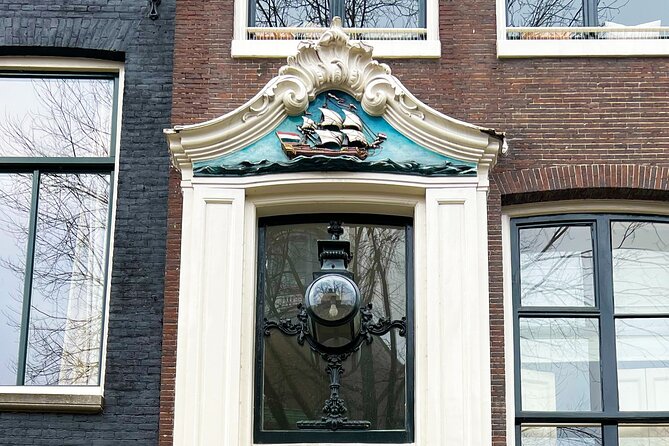
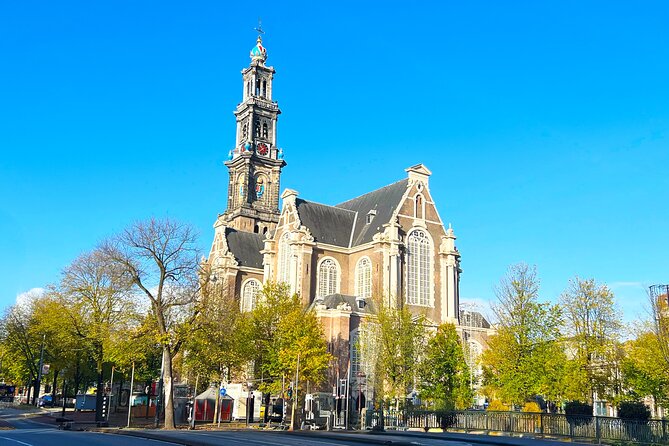
The final stop is Westerkerk, on Prinsengracht near the Anne Frank House. The church was built as a Calvinist place of worship for Amsterdam’s growing population.
Its design is large and airy, with a simpler character than the more ornate Catholic churches you might see elsewhere in Europe. That restraint reflects Calvinist worship, where decoration was generally less important than the service and the congregation.
The tower rises 85 meters, or about 280 feet, above the Jordaan. Its imperial crown links the building to Amsterdam’s civic identity, while the clock chimes have marked time for centuries. Anne Frank wrote about those chimes in her diary, giving the sound a particular place in the modern memory of the neighborhood.
Westerkerk is also associated with Rembrandt, who was buried there. The tour does not function as a full church visit, and the itinerary allows about five minutes at this final stop. Still, it is a fitting end because the building brings together religion, art, city status, and local memory.
The tour ends at Westerkerk, next to the Anne Frank House area. That makes the timing useful if you have a separate booking nearby, though you should leave enough time between activities rather than assuming the walk will finish exactly on schedule.
What the private format changes
A private tour is most useful when you want conversation rather than a fixed lecture. You can ask Anna to explain a building again, compare two façades, or suggest additional sights after the walk. The feedback repeatedly highlights her patience with questions and willingness to pause for photographs.
The tour is offered in English. It is also a group activity in the sense that your own party participates together, but no outside group joins you. That gives you more control over the rhythm than a standard large walking tour.
The route covers a lot in 90 minutes. You move from civic architecture to wealthy homes, bridges, churches, warehouses, working neighborhoods, and a major landmark. I like that range, but you should not expect a slow, technical examination of every stop. Think of it as a well-focused introduction that teaches you how to see the city.
You will be walking and standing for the full period. The experience is not recommended if you have trouble walking or standing for 1.5 hours, use a walker, or need mobility equipment. Mobility aids are not available. Service animals are allowed, and the route is near public transportation.
Is $73.59 per person a fair price?
At $73.59 per person, this is a premium choice for a 90-minute city walk. You are paying for a private guide, a central route, and a subject that goes beyond the usual list of famous sights.
The price makes the most sense for a couple, family, or small group with a strong interest in buildings and urban history. If your group is large enough to share the cost, the personal format becomes a better deal. If you prefer to wander alone and read a guidebook, you can see many of these streets without paying for a tour, but you will miss the explanations linking design, trade, engineering, and social class.
The tour is commonly booked well ahead, with an average booking lead time of 43 days. That suggests you should not leave it until the last moment if your Amsterdam dates are fixed.
Who will get the most from this walk?
Book it if you want to understand why Amsterdam looks the way it does, not simply photograph the canals. It suits first-time visitors who want a quick orientation, architecture fans, amateur photographers, and repeat visitors who have already seen the major sights but want more meaning behind them.
It also works well early in a city stay. Afterward, you can recognize hoisting beams, gevelstenen, leaning façades, and differences between merchant homes and working neighborhoods. Anna’s local connection and strong English make the walk especially useful if you want to ask many questions.
Skip it if your priority is entering museums, touring palace rooms, or spending a relaxed afternoon with long café breaks. The route is short and active, and much of the experience comes from exterior observation. You also need to be comfortable walking and standing for the entire 90 minutes.
Should you book the Golden Age architecture walk?
I would book this tour if Amsterdam’s canal houses have caught your eye and you want someone to explain what you are seeing. The best parts are the engineering behind the Royal Palace, the practical warehouse design on Prinsengracht, and the small gevelstenen in Jordaan.
The private format and Anna’s patient, question-friendly style add real value. Just keep your expectations realistic: this is a brisk exterior walking tour, not an interior museum visit or a full architectural course. For a small group that values personal attention and wants a sharper understanding of central Amsterdam, it is a strong choice.
FAQ
Where does the tour start?
The meeting point is the Royal Palace Amsterdam at Nieuwezijds Voorburgwal 147, 1012 RJ Amsterdam.
Where does the tour end?
The tour ends at Westerkerk, Prinsengracht 279, near the Anne Frank House.
How long does the tour last?
The walk lasts approximately 1 hour and 30 minutes.
Is the tour private?
Yes. Only your own group participates in the activity.
What language is offered?
The tour is offered in English.
Is a guide included?
Yes. A private local guide is included. The guide identified in the tour information is Anna.
Are entrance tickets included?
The listed stops are discussed from the outside, and admission tickets are not charged for those stops. Entry to other attractions is not included.
Is the tour suitable for people with limited mobility?
It is not recommended for people who use a walker or have trouble walking and standing for 1.5 hours. Mobility aids are not available.
Can I cancel for a refund?
You can cancel at least 24 hours before the local start time for a full refund. Cancellations or changes made less than 24 hours before the start are not accepted for a refund.
Just added around Amsterdam
- Amsterdam: Giethoorn Tour with Canal Cruise and Windmills★ 5.0 · 3 reviews
- Full-day excursion to Edam, Volendam, and Marken★ 3.7 · 3 reviews
- Amsterdam: Chocolate Fondue in the Dark★ 5.0 · 3 reviews
- Amsterdam Private Walking Tour of Famous Painters★ 5.0 · 3 reviews
- Amsterdam Family Friendly Historical Walking Tour★ 5.0 · 3 reviews
- Amsterdam Old-West Vegan Food Tour with Local Guide★ 4.7 · 3 reviews
- From Amsterdam: visit Zaanse Schans, Muiderslot and more!★ 5.0 · 3 reviews
- Amsterdam Walking Tour with Dutch Pancake Lunch★ 5.0 · 3 reviews
Amsterdam Tours, compared.


Amsterdam Classic Saloon Boat Cruise with Drinks and Cheese
Read our review →
Amsterdam Luxury Canal Cruise + Unlimited Drinks & Bites option
Read our review →


Classic Boat Cruise with Optional Cheese & Wine
Read our review →
Evening Cruise with Optional Wine and Snacks
Read our review →
75 Minute City Canal Cruise with Audio Guide
Read our review →Browse the lists this tour appears in