
Reviewed · ROTTERDAM TOURS
Rotterdam: Private Tour with Local Guide + Cube House visit
Rotterdam’s most memorable sight may be the one you enter: a Cube House apartment tilted at an angle that makes ordinary furniture and floor space seem like a design puzzle. This two-hour private walk connects that oddball home with the Markthal, the Old Harbour, a medieval church, and the city’s prewar center.
I like two things here. First, the route gives you a quick, clear look at Rotterdam’s mix of old and new, from the 14th-century Laurenskerk to Piet Blom’s 1980s architecture. Second, the private format lets your guide adjust the pace for your group. The main consideration is time: two hours is enough for an introduction, not a full exploration of Rotterdam.
Key points at a glance
- Enter a real Cube House apartment: The Kijk-Kubus Museum-house visit is included, not an extra-cost add-on.
- See Rotterdam’s sharpest contrasts: Move from the medieval Laurenskerk to the futuristic Markthal and angular Cube Houses.
- Start in the Blaak district: This is tied to Rotterdam’s origins at a dam in the river Rotte.
- Hear stories beyond architecture: The route covers wartime damage, political and social change, Erasmus, and German bullet holes.
- Enjoy a private English tour: Only your group takes part, with space for questions and a more flexible walking pace.
- Pay one group price: The $294.55 rate covers up to 15 people, which can be good value for a larger party but less so for two people.
Why Blaak is the right place to begin
The tour starts at Blaak, a transport hub and one of Rotterdam’s most visually striking areas. It is also a useful place to understand the city before you begin looking at its buildings.
Rotterdam’s origin story is tied to a dam in the river Rotte. That early connection gives the Blaak area more weight than a simple modern shopping district. Today, the area has a market twice a week, and its public spaces gather food, housing, transport, and unusual architecture in one compact setting.
I like this start because you do not spend the first part of the walk searching for a grand old town that Rotterdam largely lost. The city center was heavily damaged during the Second World War, so Rotterdam rebuilt itself in a bold, modern way. Your guide can explain that change while you are surrounded by the results.
The opening stop is brief, about 15 minutes. That is enough for orientation and a few questions, but you should not expect a long archaeological discussion or a full market visit. If a market is operating during your tour, you may get extra atmosphere. The schedule does not promise time for shopping or eating.
A few more Rotterdam trips worth a look
- Rotterdam: Harbor Sightseeing Cruise
★ 4.3 · 7,599 reviews - Rotterdam: 1-Hour Sightseeing Splash Tour
★ 4.5 · 3,299 reviews - Rotterdam: Rotterdam Zoo Blijdorp Entry Ticket
★ 4.6 · 2,754 reviews
Looking up inside the Markthal
The Markthal is one of Rotterdam’s signature buildings, and the tour takes you inside. Its curved structure contains apartments along the two sides, while the central interior holds food stalls and places offering food from around the world.
The best detail is above you. The ceiling carries one of the largest pieces of art on the planet, so remember to look up rather than focusing only on the stalls at eye level. Your guide can help you read the building as both a market and a piece of city design.
This 15-minute visit is short but well judged for a walking introduction. You can see the main interior and understand why the building became a city symbol without losing half the tour to browsing. If food is a major reason for your visit, plan to return later. The tour does not include food, and the brief stop is not designed as a tasting experience.
The Markthal also works as a useful counterpoint to the nearby Laurenskerk. One is new, curved, and filled with color. The other is centuries old and carries the marks of war. That contrast is the central pleasure of this route.
City Hall and the prewar Rotterdam that survived
From Blaak, you walk toward Rotterdam City Hall on the Coolsingel. The boulevard is sometimes compared with the Champs-Élysées, a grand description that signals its importance in the city’s civic life.
City Hall is one of the few prewar buildings still present in central Rotterdam. That fact gives the stop real meaning. You are not simply looking at a formal civic building. You are seeing part of the older city that survived the destruction around it.
The planned time here is about 15 minutes. Your guide can place the building within Rotterdam’s wider political and architectural story, then help you see how the surviving structure relates to the newer city around it.
Do not expect an interior tour of City Hall. The experience focuses on the exterior and the walk through the city. That is a sensible choice for a two-hour route, but it matters if you hoped to visit inside.
Laurenskerk, Erasmus, and the scars of war
The Grote of Sint-Laurenskerk brings you back to the 14th century. It is close to the Markthal, yet it belongs to a very different Rotterdam.
The church tower miraculously survived the bombing of the city. Today, the building is used mostly as an event location, but its historical role remains clear. Your guide will cover the church’s past and the story of Erasmus, the famous figure said here to have been born.
This is one of the strongest stops for understanding how much Rotterdam changed. The church is not presented as an isolated old monument. It becomes evidence of what was lost, what survived, and how the city chose to rebuild.
The stop lasts about 15 minutes, and admission is listed as free. The schedule does not include a dedicated interior visit, so you should treat the church as a historical and architectural stop rather than a full church tour. If you want more time inside, ask your guide if the timing allows, but do not count on it.
I especially like the way this point breaks up the modern architecture. Without it, the route could feel like a parade of bold postwar buildings. Laurenskerk gives the city a human timeline.
Same country, a completely different kind of day:
- Rotterdam: Euromast Lookout Tower Ticket
★ 4.4 · 2,549 reviews - Rotterdam: Pancake Cruise
★ 4.4 · 1,986 reviews - Rotterdam: Kinderdijk UNESCO World Heritage Entry Ticket
★ 4.6 · 1,477 reviews - Rotterdam: Harbor Cruise with Live Guide
★ 4.0 · 1,270 reviews
Witte Huis and the old port
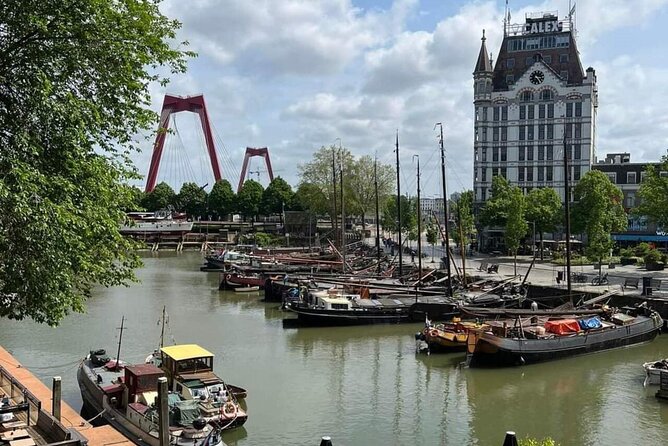
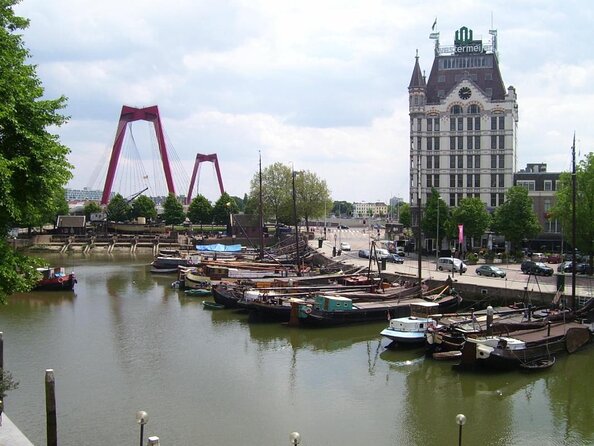
The route continues to Het Witte Huis, or White House, in the Oude Haven district. Dating from 1898, it is described as the oldest skyscraper in Europe. In a city famous for modern towers and experimental architecture, this earlier high-rise helps show that Rotterdam’s ambition did not begin after the war.
Look carefully at the building. You may see remnants of German bullet holes, a small but powerful physical reminder of the city’s wartime experience. Your guide explains their significance, so this is a moment to slow down and inspect the exterior rather than simply photograph it.
The Witte Huis stop takes about 15 minutes. There is no admission fee listed, and the experience is centered on the outside of the building. That keeps the tour moving, though it also means you will not be spending time inside the historic structure.
The nearby Old Harbour gives the route a change of mood. Oude Haven is now a leisure area with terraces and old ships moored along the water. The ships are awaiting restoration, and they add a sense of working waterfront history even though Rotterdam’s main commercial port has moved many kilometers west.
This is a good place to notice the city’s scale. The old harbor is intimate and close to cafes. The modern port is far beyond the central sights. Your guide can help connect those two parts of Rotterdam without taking you away from the compact Blaak route.
Piet Blom’s Cube Houses from the inside
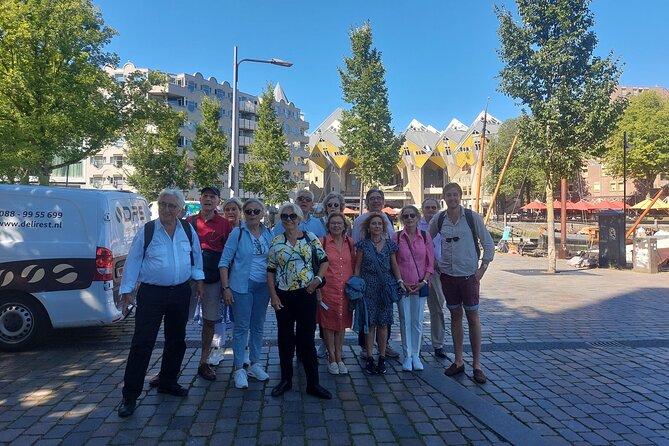
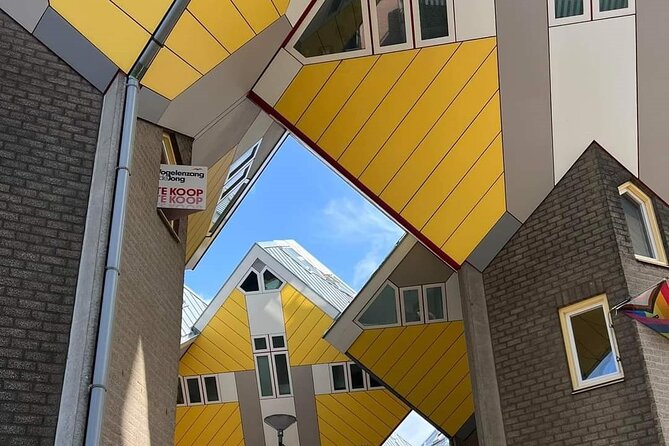
The Cube Houses are the tour’s main hands-on architectural stop. Designed by Piet Blom, they were created in the 1970s and built in the 1980s. Their idea was to create a village within a city, with individual homes grouped into an unusual urban structure.
From outside, the yellow cubes look playful. Entering one is more useful than simply taking a photo. The Kijk-Kubus Museum-house shows how the interior works, and it lets you judge the practical side of Blom’s design for yourself.
The angled walls and floors challenge your normal sense of a room. The visit is not just a quick look at an odd facade. You can see how a home fits inside the tilted form and why the project remains one of Rotterdam’s best-known architectural experiments.
The entry ticket is included in the tour price. That is important because it gives the two-hour walk a clear centerpiece rather than leaving you with a series of exterior views. The Cube House visit lasts about 30 minutes, making it the longest scheduled stop.
There is a practical trade-off. The architecture is memorable, but some people may find the space less comfortable or intuitive than a normal apartment. That is part of the point, and the guide’s explanation helps you understand the design rather than judging it only as a novelty.
A private guide changes the pace
This is a private activity, so only your group participates. The listed capacity is up to 15 people, and the tour is offered in English.
That format is useful for families and colleagues. One family group described a relaxed pace that worked well with two teenagers, and that is exactly the kind of benefit you can expect from a private walk. You can ask for clarification, pause for a photo, or spend a little longer on a building that catches your interest.
A private tour does not guarantee an entirely custom route. The stated stops form the backbone of the experience, and two hours puts a natural limit on detours. Still, a guide can make the walk feel less rigid than a large group tour.
Fleur is the guide named in the available feedback. Her approach was described as informative, entertaining, and approachable, with stories about architecture, political conditions, and social movements. Your guide may be someone else, but you should expect the tour to rely on storytelling rather than a list of dates and building names.
That is a real strength. Rotterdam’s architecture makes more sense when you know why the city rebuilt so boldly, how social ideas shaped the Cube Houses, and what the older buildings reveal about the prewar city.
Is $294.55 good value?
The price is $294.55 per group of up to 15 people. That pricing structure matters more than the headline figure.
For a large family, work group, or party of friends, the cost can be reasonable. Divided among 10 people, it is about $29.46 per person. With 15 people, it drops to about $19.64 each. The included Cube House entry, private guide, and taxes are part of that amount.
For one or two people, the calculation is different. A couple would pay close to $147 each, before any optional gratuity. At that price, you should value the private attention and the convenience of having a guide connect the sites. If you mainly want to see the buildings from outside, a self-guided walk will cost much less.
The tour does not include food, drinks, or gratuity. Since the Markthal has food from around the world and the Old Harbour has terraces, you can easily add your own meal before or after the walk, but budget for it separately.
The price is strongest when you have a full group or when you want context that you would not get from simply walking between the sights. It is weaker for a small party that prefers independent exploration.
Timing, walking, and practical planning
The experience lasts about two hours and ends back at Blaak station, the starting point. That makes it easy to fit before another Rotterdam activity or after arriving by public transportation.
The route includes several 15-minute stops, followed by a 30-minute Cube House visit and a walk back to the meeting point. You are walking between sights, so comfortable shoes are sensible, though the tour is designed as a short city introduction rather than a full-day march.
The exact route distance is not provided, so I would not plan a tight connection immediately afterward. Give yourself extra time if you need to catch a train or meet a reservation.
Confirmation arrives at booking. Service animals are allowed, the meeting point is near public transportation, and most people can participate. Since only your group takes part, you can ask the guide about the pace at the beginning.
Free cancellation is available up to 24 hours before the local start time. Cancellations or changes made less than 24 hours ahead are not accepted for a refund.
Who will get the most from this walk?
This tour fits first-time visitors who want Rotterdam explained quickly. You see the city’s core contrasts without spending hours on a bus or trying to connect the sights on your own.
Families should find the Cube House visit and unusual modern buildings more engaging than a standard civic walking tour. The private format is also helpful if children or teenagers need a slower pace.
Architecture fans get a good sample of Rotterdam’s changing design: the Markthal, City Hall, Laurenskerk, Witte Huis, and Piet Blom’s Cube Houses. The tour also adds social and political context, which keeps the buildings from feeling like disconnected photo stops.
It suits colleagues and larger groups especially well because the group rate becomes more attractive as the party grows. Solo visitors and couples should compare the price with their interest in having a personal guide.
This may not be right for you if you want extensive museum time, a food tour, or a deep look at Rotterdam’s port. The route stays around Blaak, the city center, and the Old Harbour. That focus is its advantage, but it also means you will not see the wider port district.
Should you book the Rotterdam private tour?
Book it if you want a short, private introduction to Rotterdam with a clear route and one included interior visit. The Cube House, Markthal, Laurenskerk, and Witte Huis create a strong two-hour sequence, and the guide’s stories add meaning to the city’s sharp mix of old and new.
I would especially recommend it for a group of four or more, for families with teenagers, and for anyone who prefers to ask questions rather than follow a large crowd. If you are a couple watching every euro, the price deserves more thought.
Choose this tour for context, architecture, and convenience. Skip it if your main goal is a long food stop, extensive museum time, or a broad tour of Rotterdam’s port. For a first look at the Blaak area, though, it gives you the right amount of history, design, and local orientation without taking your whole day.
FAQ
Where does the tour start?
The tour starts at Blaak, 3011 Rotterdam, Netherlands.
Where does the tour end?
The activity ends back at the starting point near Blaak station.
How long does the tour last?
The tour lasts approximately two hours.
Is the tour private?
Yes. Only your group participates, with a maximum group size of 15 people.
Is the Cube House entry included?
Yes. Entry to the Kijk-Kubus Museum-house is included in the tour price.
Is the tour offered in English?
Yes. English is the listed tour language.
What is included in the price?
The price includes the private guide, the Cube House entry ticket, and all fees and taxes. Gratuities are optional and not included.
Just added around Rotterdam
- Discover Rotterdam: Classic Highlights Bike Tour by a Local★ 5.0 · 3 reviews
- Rotterdam: Capture the most Photogenic Spots with a Local★ 5.0 · 3 reviews
- Private tour: Markthal, Cube houses and Rooftop Het Witte Huis★ 4.5 · 3 reviews
- Private Transfer from Rotterdam Port to Amsterdam Airport (AMS)★ 5.0 · 3 reviews
- Rotterdam: 2.5-Hour Leckers Boat Cruise and Buffet★ 3.2 · 3 reviews
- Discover Rotterdam’s most Photogenic Spots with a Local★ 5.0 · 3 reviews
- Rotterdam: Wilhelminapier, High-rise & floating architecture★ 4.0 · 3 reviews
- Private Transfer from Rotterdam City to Amsterdam Schiphol Airport★ 5.0 · 4 reviews
Rotterdam Tours, compared.


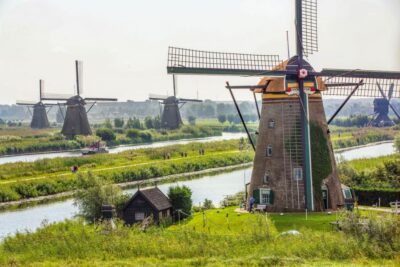
Kinderdijk UNESCO World Heritage Entry Ticket
Read our review →
Browse the lists this tour appears in