
Reviewed · ROTTERDAM TOURS
Rotterdam Must Do Tour: Highlights, History, WW2 and Architecture
Rotterdam’s most striking feature is its fresh start. Much of the city center was destroyed in 1940, and this tour shows how Rotterdam rebuilt itself with daring buildings, broad streets, and a willingness to try designs that would look wild elsewhere. You move from Rotterdam Centraal to the Cube Houses and Markthal while a local guide connects the concrete, steel, and glass to the city’s wartime past.
I like the small maximum group of 15, which should make it easier to hear your guide and ask questions. I also like the mix of famous sights and less obvious stops, especially the wooden Luchtsingel bridge and the reconstructed Delft Gate. The main drawback is pace: two hours is enough for an overview, but not enough for long visits inside every major building.
Key points at a glance
- WWII reconstruction is the main thread: See how the bombing reshaped Rotterdam’s center and led to landmark projects such as the Lijnbaan and Groot Handelsgebouw.
- The route covers major architectural symbols: The Cube Houses, Markthal, Rotterdam Centraal, and Luchtsingel each show a different side of the modern city.
- The guide makes the difference: Susan, Edwin, Michel, Ed, John, Tony, and Stephan are among the guides praised for clear stories, local pride, and friendly conversation.
- You get more than a postcard route: Shopping streets, a medieval church, a rebuilt city gate, and the Old Harbour add context to the famous buildings.
- The price is modest: At $29.41 per person, the tour offers a useful first look without charging separate admission for the walk itself.
- Plan for a brisk outing: Food and drinks are not included, and the tour ends back at the meeting point near Rotterdam Centraal.
Rotterdam’s bold rebuilding story
Rotterdam is not a city of old streets at every turn. Its center was heavily damaged during the Second World War, and the rebuilding that followed gave the city a modern identity. This walk helps you read that city rather than simply photograph it.
The guide talks about the harbor, the wartime destruction, and the choices made during reconstruction. That background matters. The Lijnbaan, for example, was opened in 1953 as a pedestrian shopping street after the former shopping district had been destroyed. Groot Handelsgebouw, also completed in 1953, became one of the first major buildings raised in the rebuilt center.
I find this approach more useful than a tour that only lists architects and construction dates. You begin to understand why Rotterdam feels so different from Amsterdam, Delft, or Utrecht. The city’s unusual appearance is not random. It comes from loss, planning, commerce, and a taste for experiments.
The experience is rated 4.8 out of 5, with 95 percent of participants recommending it. The strongest feedback centers on guides who explain the city in a warm, personal way. Susan is praised for making the walk feel like an outing with a well-informed friend, while Edwin is singled out for explaining reconstruction and architecture clearly. Michel, Ed, John, and Stephan also receive strong praise for their easy manner and lively information.
More history tours in Rotterdam:
- Rotterdam: Kinderdijk UNESCO World Heritage Entry Ticket
★ 4.6 · 1,477 reviews - Rotterdam: Harbor Cruise on a Historic Ship
★ 4.2 · 812 reviews - MUST DO: Rotterdam highlights & history with a local guide
★ 4.5 · 57 reviews
Starting at Rotterdam Centraal
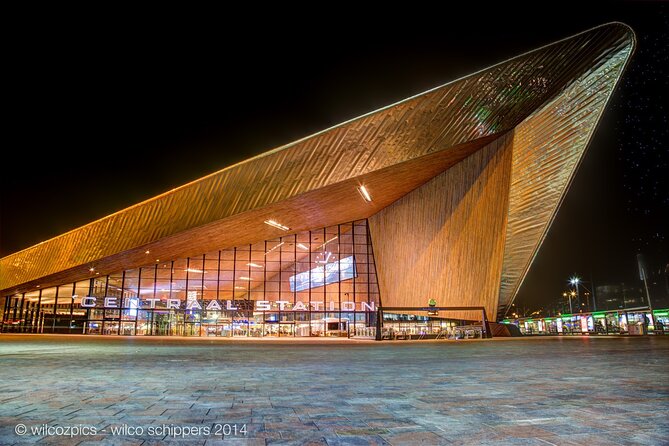
The meeting point is Stationsplein 10, outside Rotterdam Centraal Station. This is a sensible place to begin, since the station itself introduces you to the city’s modern design before the walking route gets properly underway.
Allow time to find the meeting point and look for your guide. The station portion can take around 30 minutes, and the guide uses it to introduce the architecture of Rotterdam. That gives the tour an immediate focus: you start with a building that reflects the city’s present rather than an old monument from its past.
Rotterdam Centraal is also practical for people arriving by train or public transport. The tour is near public transportation, and the route is designed as a walking experience. The provided information does not promise a fully step-free route, so if you have specific mobility needs, it is sensible to confirm the details before booking.
The group limit of 15 is helpful here. A large crowd can make an architectural explanation difficult, especially around a busy station. A smaller group gives you a better chance to stay close to the guide and hear the story without constant repositioning.
Groot Handelsgebouw and the first postwar landmarks
From the station, the tour moves toward Groot Handelsgebouw. Completed in 1953, it is one of the first major buildings constructed after the Rotterdam bombing. It is an important stop because it represents the practical side of rebuilding.
Not every building on this walk is meant to be admired like a sculpture. Groot Handelsgebouw tells you about offices, trade, and the need to get the city working again. The guide can place the building in the wider postwar plan, helping you see reconstruction as a daily task as well as an architectural project.
This is also where the tour’s WWII focus becomes concrete. Instead of treating the war as a short historical note, the walk links it to streets, shopping areas, and building choices you can see around you.
West-Kruiskade and the Lijnbaan
The Kruiskade and West-Kruiskade are central shopping streets, and they add ordinary city life to a tour that could otherwise become a parade of landmark buildings. You see where people shop and move through the center, not just where they stop for photographs.
The Lijnbaan is the more historically important shopping stop. It opened in 1953 as Rotterdam’s main pedestrian shopping street, replacing a district destroyed during the bombing. Its design reflects an early postwar idea that shopping streets should give pedestrians room away from traffic.
I like this part of the route because it shows how planning affects everyday life. The story is not only about famous architects. It is about where people buy things, how they walk through the city, and how a damaged center was reorganized.
These stops are brief, about 10 minutes each. You should expect an explanation and a look around, not time for shopping. If you want to browse the stores or buy gifts, return later. One guide, Susan, is especially praised for pointing out good places to find gifts for grandchildren, but the tour itself is not a dedicated shopping trip.
A few more Rotterdam trips worth a look
- Rotterdam: Harbor Sightseeing Cruise
★ 4.3 · 7,599 reviews - Rotterdam: 1-Hour Sightseeing Splash Tour
★ 4.5 · 3,299 reviews - Rotterdam: Rotterdam Zoo Blijdorp Entry Ticket
★ 4.6 · 2,754 reviews - Rotterdam: Euromast Lookout Tower Ticket
★ 4.4 · 2,549 reviews
The Luchtsingel bridge and Rotterdam’s experimental side
The Luchtsingel is one of the most unusual stops. This wooden pedestrian bridge runs for 390 meters and links Rotterdam North with the city center. It was built to bring life back to an area that had suffered from vacancy and neglect.
The bridge gives the tour a useful change of scale. You are no longer looking only at large buildings from street level. You are considering how a simple pedestrian connection can help join parts of a city and encourage activity around them.
The Luchtsingel also fits Rotterdam’s habit of trying something different. It is practical, eye-catching, and tied to the repair of an underused part of town. The stop is short, so your guide will not provide a full urban planning lecture, but the bridge makes the point quickly.
If architecture is your main reason for booking, this is one of the stops that makes the tour worthwhile. It is less famous than the Cube Houses, yet it says a great deal about Rotterdam’s current approach to public space.
The Nieuwe Delftse Poort, rebuilt in modern form
The original Delftsche Poort was a city gate, with the last version built in 1764. About 50 years later, a steel reconstruction designed by artist Cor Kraat was placed near the original site on Pompenburg.
This stop helps correct a common misunderstanding about Rotterdam. The city is not simply an old place that lost its buildings and replaced them with modern ones. It also preserves memories through reconstructions, references, and new interpretations.
The gate is a compact stop, listed at about 10 minutes. You will not spend a long time inside a museum or historic structure. Instead, the guide explains what the gate was, what happened to it, and why the modern reconstruction matters.
For me, this is the kind of detail that improves a city walk. You gain a small piece of Rotterdam’s older identity before moving into the medieval church and the modern market hall.
Sint-Laurenskerk, the medieval survivor
The Grote of Sint-Laurenskerk, also called the Laurenskerk, is a Protestant church and the only surviving remnant of medieval Rotterdam. Its presence gives the tour a strong contrast with the buildings around it.
After seeing bold postwar designs, you can understand how unusual this church is within the center. It connects present-day Rotterdam with the city that existed before the bombing. The guide’s explanation of its survival and place in the rebuilt city is one of the walk’s most useful historical moments.
You can also enter the church for free. The tour schedule is tight, so the inside visit may need to be brief, and the available information does not promise a dedicated interior tour. Still, free entry gives you the option to look inside if timing allows.
I would not skip the church simply because the Cube Houses and Markthal look more dramatic in photographs. The contrast is the point. Rotterdam’s character becomes clearer when you see its one medieval survivor beside its most daring modern projects.
Markthal and the Cube Houses
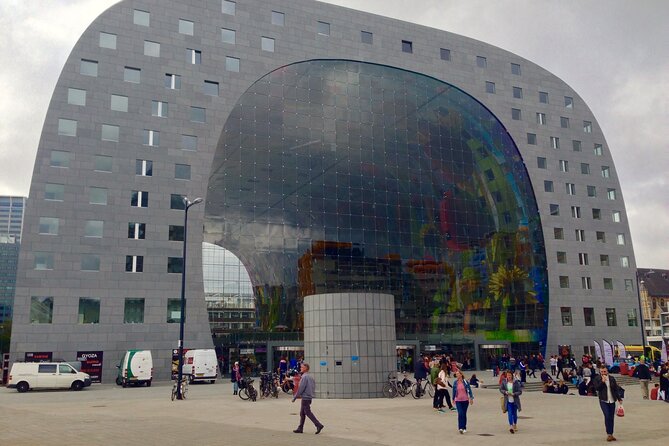
The Markthal is one of Rotterdam’s major architectural attractions. Designed by MVRDV, it has a grey natural-stone exterior and a large arch shaped like a horseshoe. Inside, you find restaurants and a huge artwork showing enlarged fruits, vegetables, seeds, fish, flowers, and insects.
The building works best when you look at both its exterior form and its interior artwork. The outside makes a strong urban statement, while the inside gives the market hall a more playful feel. You can expect time to look around, but food and drinks are not included in the tour price.
The Markthal stop is listed at about 30 minutes, making it one of the longer pauses. That is useful because the building deserves more than a quick glance from the pavement. Still, if you are eager to eat there, you may need to return after the tour or manage your time carefully.
Some participants felt that the artistic details around Markthal could receive more explanation. That is a fair consideration. The building itself is easy to admire, but a strong guide should point out why its shape, materials, and interior images matter. Guides such as Edwin and Michel are praised for explaining architecture clearly, while one less positive experience suggests that the quality of interpretation can vary.
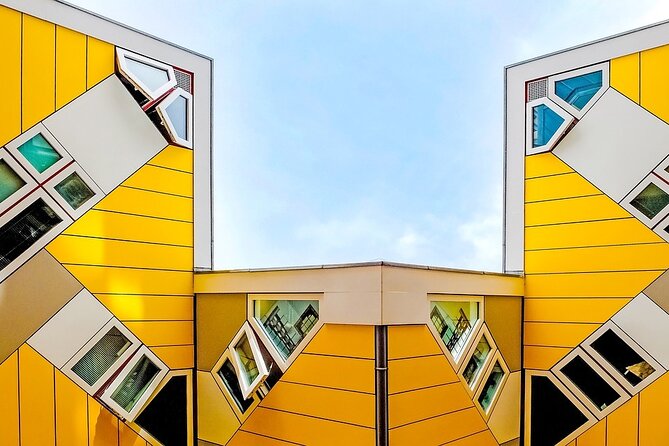
The Cube Houses are nearby in the Oude Haven area. Their tilted forms are among Rotterdam’s best-known sights, and they show the city’s willingness to make housing part of the architectural conversation. The supplied schedule groups the Cube Houses with the Old Harbour rather than giving them a separate stop, so expect an exterior visit and an explanation rather than a long interior tour.
Oude Haven and the city’s older waterfront
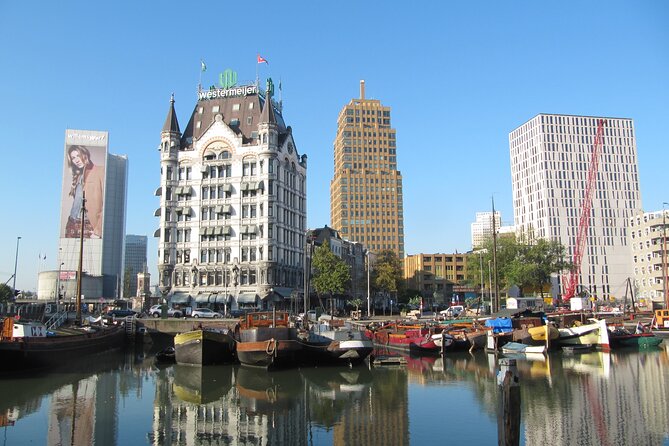
Oude Haven, or Old Harbour, is a historic area in the city center on the north side of the Maas. It is also where you find the Cube Houses, making it a natural final section for the walk.
This area brings several layers together: the old harbor, modern housing, and the rebuilt city center. You can see why Rotterdam is best understood through contrasts. A harbor district can carry historic associations while nearby buildings push into new forms.
The stop is listed at about 20 minutes. That is enough for orientation and photographs, but not a full exploration of every street or waterfront corner. If you enjoy taking pictures, keep an eye on the clock. The tour ends back at the meeting point, and the walk is designed to give you a broad view rather than leave you in one district for the afternoon.
What $29.41 buys you
At $29.41 per person, this is a reasonable price for a two-hour guided introduction to central Rotterdam. You are paying for a local guide, route planning, historical context, and access to a small group capped at 15. The tour itself does not charge admission to the outdoor stops, and food and drinks are separate.
The value is strongest if you are new to Rotterdam and want a clear framework for exploring on your own. In two hours, you cover the station, postwar landmarks, shopping streets, Luchtsingel, a rebuilt gate, Laurenskerk, Markthal, Oude Haven, and the Cube Houses. That is a lot of ground.
The trade-off is depth. You will not have time for a full church visit, extended shopping, a meal inside Markthal, or a detailed architectural study of each building. If you already know central Rotterdam well, the tour may feel familiar unless your guide adds fresh local stories.
Different tour times are available, which helps you fit the walk around a train journey, cruise schedule, or other plans. One particularly useful service detail comes from a delayed ship arrival: Tony helped arrange transport so a late participant could meet guide Susan, and Susan adjusted the route when the participant needed to leave early. That kind of flexibility is valuable, but you should not assume every shortened tour can cover everything. A late start led to a faster pace and fewer stops.
Who will enjoy this walk most
I would recommend this tour to first-time visitors who want Rotterdam explained rather than simply photographed. It suits people interested in WWII, postwar planning, modern architecture, city life, and the connection between buildings and daily routines.
It is also a good choice for cruise passengers or anyone with only part of a day. The start near Rotterdam Centraal makes the meeting point easy to connect with public transport, and the compact route gives you a useful first orientation.
Families can benefit from the variety. The Cube Houses, wooden bridge, market hall artwork, and unusual station design give younger visitors visual points to enjoy, while the guide’s stories add meaning for adults. Service animals are allowed, and most people can participate.
I would be more cautious if you need a slow pace or want extended indoor visits. The route has many stops, and the two-hour schedule means explanations and walking take priority over lingering. If you want a specialized architecture tour, a dedicated WWII tour, or a food-focused visit to Markthal, this general city walk may not go far enough in one subject.
The experience requires a minimum number of participants. If it cannot run for that reason, you are offered another date or experience, or a full refund. You can cancel for a full refund up to 24 hours before the start time, but late cancellations and late changes are not refunded or accepted.
Should you book it?
Book this tour if you want a compact, affordable introduction to Rotterdam’s unusual center. Its best feature is the way the route links WWII destruction to the Lijnbaan, Groot Handelsgebouw, the surviving Laurenskerk, and the city’s striking modern buildings.
The guide is important. Strong guides such as Susan, Edwin, Michel, Ed, John, and Stephan have been praised for clear explanations, humor, local pride, and friendly conversation. Because one experience found the Markthal discussion too thin, I would ask questions whenever a building catches your eye.
Skip it if you want a slow day of shopping, eating, or entering every attraction. For most first visits, though, the $29.41 price and small group make this a sensible way to get your bearings before exploring Rotterdam on your own.
FAQ
How long does the Rotterdam Must Do Tour last?
The tour lasts approximately two hours.
Where does the tour start?
The meeting point is Stationsplein 10, 3013 AJ Rotterdam, at Rotterdam Centraal Station.
Where does the tour end?
The activity ends back at the meeting point.
What landmarks are included?
The route includes Rotterdam Centraal Station, Groot Handelsgebouw, West-Kruiskade, Lijnbaan, Luchtsingel, Nieuwe Delftse Poort, Sint-Laurenskerk, Markthal, Oude Haven, and the Cube Houses.
Is the tour offered in English?
Yes. The tour is offered in English.
What is included in the price?
A local guide is included. Food and drinks are not included.
How large is the group?
The tour has a maximum of 15 participants.
Can I cancel the tour for a refund?
Yes. You can cancel up to 24 hours before the start time for a full refund. Cancellations or changes made less than 24 hours before the start time are not refunded or accepted.
Just added around Rotterdam
- Discover Rotterdam: Classic Highlights Bike Tour by a Local★ 5.0 · 3 reviews
- Rotterdam: Capture the most Photogenic Spots with a Local★ 5.0 · 3 reviews
- Private tour: Markthal, Cube houses and Rooftop Het Witte Huis★ 4.5 · 3 reviews
- Private Transfer from Rotterdam Port to Amsterdam Airport (AMS)★ 5.0 · 3 reviews
- Rotterdam: 2.5-Hour Leckers Boat Cruise and Buffet★ 3.2 · 3 reviews
- Discover Rotterdam’s most Photogenic Spots with a Local★ 5.0 · 3 reviews
- Rotterdam: Wilhelminapier, High-rise & floating architecture★ 4.0 · 3 reviews
- Private Transfer from Rotterdam City to Amsterdam Schiphol Airport★ 5.0 · 4 reviews
Rotterdam Tours, compared.

Kinderdijk UNESCO World Heritage Entry Ticket
Read our review →
Browse the lists this tour appears in