
Reviewed · ROTTERDAM TOURS
Rotterdam: Architecture Highlights Tour including the Depot
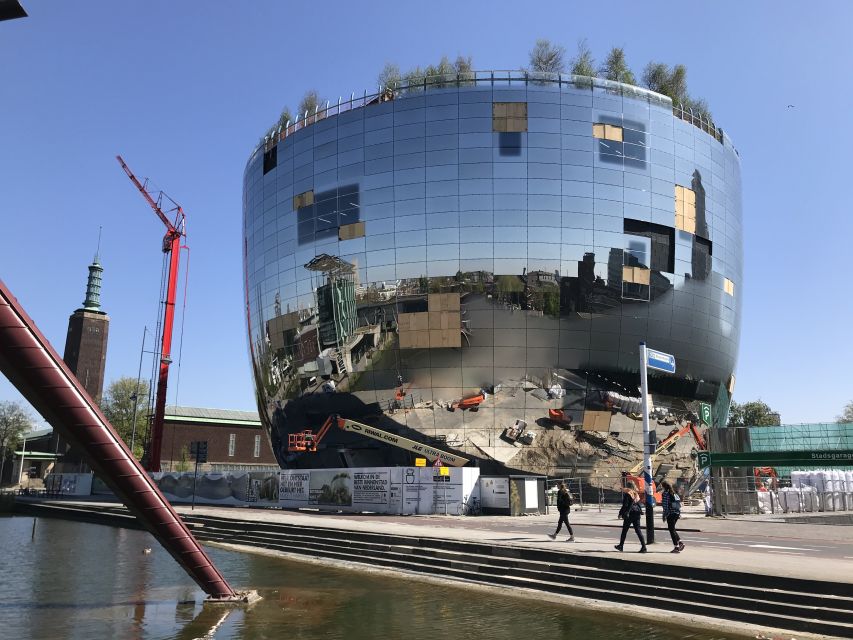
Rotterdam’s best architecture tour ends at its newest showstopper, Depot Boijmans van Beuningen, where curved mirrored panels turn a working art storehouse into a giant urban sculpture. Along the way, you see Markthal, Central Station, postwar buildings, modern offices, and several rooftops that reveal how the city fits together.
I like the private format, since a group of up to six can ask detailed questions about design, engineering, and Rotterdam’s rebuilding after wartime destruction. I also like the mix of famous sights and less obvious stops, including Timmerhuis, Sonneveld House, and the former post office.
The main drawback is the pace. In 2.5 hours, you cover a lot of ground, so this is best for people who enjoy walking and want a broad architectural introduction rather than long indoor visits. Check the rooftop arrangement carefully, too: weekday and weekend tours offer different access.
Key points at a glance
- Depot’s double-curved facade: Learn how reflective panels and aviation engineering help create the building’s unusual form and huge moving doors.
- Two different rooftop experiences: Weekday tours include access connected with Timmerhuis and the city center, while weekend tours begin with views from Het Witte Huis.
- A private group of up to six: The $494 group price becomes much better value when shared by four to six people.
- Markthal from the inside: See how housing, a food hall, and a large public artwork share one bold structure.
- Rotterdam’s full architectural story: The route links historic survivors, postwar rebuilding, experimental housing, and new cultural buildings.
- Three architectural postcards: You receive postcards by Rotterdam photographer Ossip van Duivenbode, plus a 50 percent discount for the Cube Houses.
Why this Rotterdam architecture walk is worth your time
Rotterdam is a city where the skyline changes from one block to the next. Historic buildings sit beside daring new structures, and the sharp contrast is part of the point. This tour gives you a guide to that visual conversation instead of leaving you to admire each building without context.
The route is led by a local guide in Dutch, English, or German. Frank Schipper has guided some of these tours, and his approach, based on guest feedback, combines architectural detail with a friendly, easygoing manner. The strongest praise has focused on clear explanations of building history, design, construction methods, and the structural problems involved in making tall buildings work.
That detail matters here. Rotterdam’s architecture is not only about unusual shapes. You learn why a building looks the way it does, how it is supported, what it replaced, and how the city keeps testing new ideas.
This is a private tour, so you are not squeezed into a large crowd. With six people or fewer, you can ask about a building that catches your eye or spend a little more time on a subject that interests your group. The guide can speak to architecture students, design professionals, curious first-time visitors, or anyone who wants a sharper introduction to Rotterdam.
A few more Rotterdam trips worth a look
- Rotterdam: Harbor Sightseeing Cruise
★ 4.3 · 7,599 reviews - Rotterdam: 1-Hour Sightseeing Splash Tour
★ 4.5 · 3,299 reviews - Rotterdam: Rotterdam Zoo Blijdorp Entry Ticket
★ 4.6 · 2,754 reviews
Starting outside Het Witte Huis
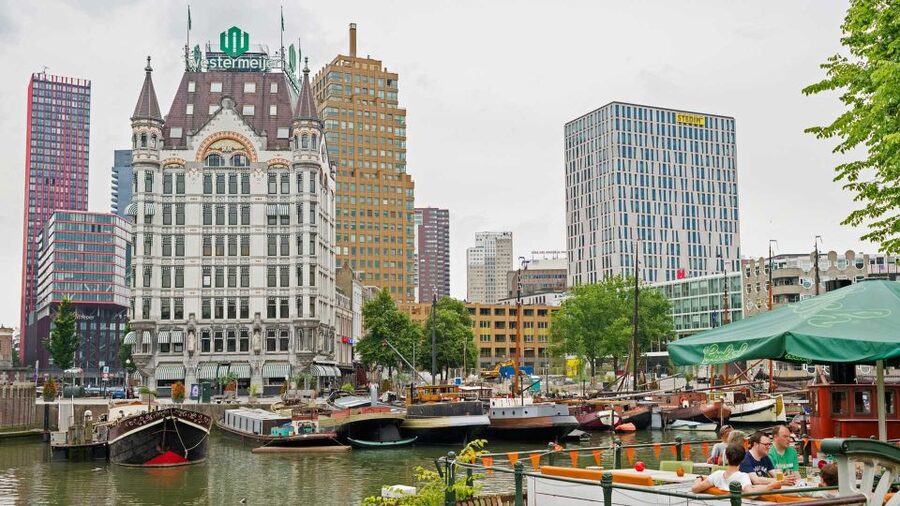
The meeting point is outside the entrance of Het Witte Huis, an easy place to connect with the city’s architectural past. The building is presented as Europe’s oldest skyscraper, and its location near the river gives it a useful starting position for understanding Rotterdam’s central district.
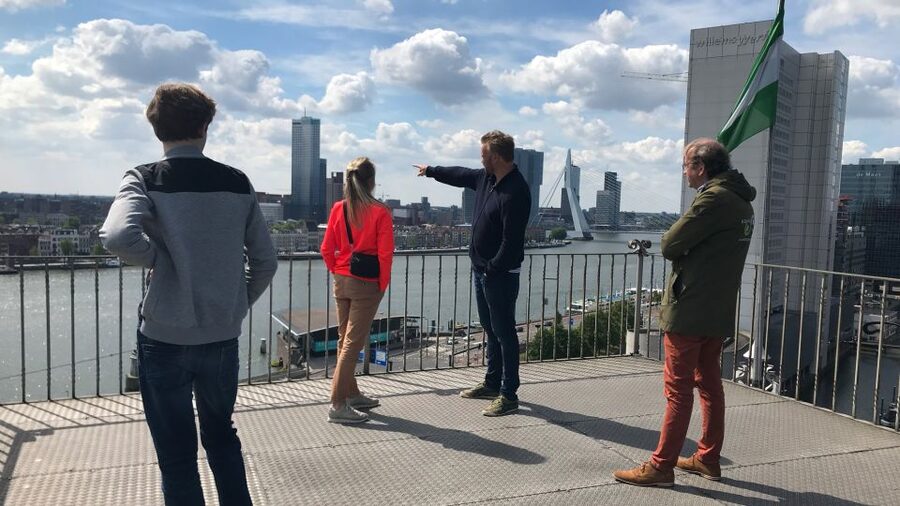
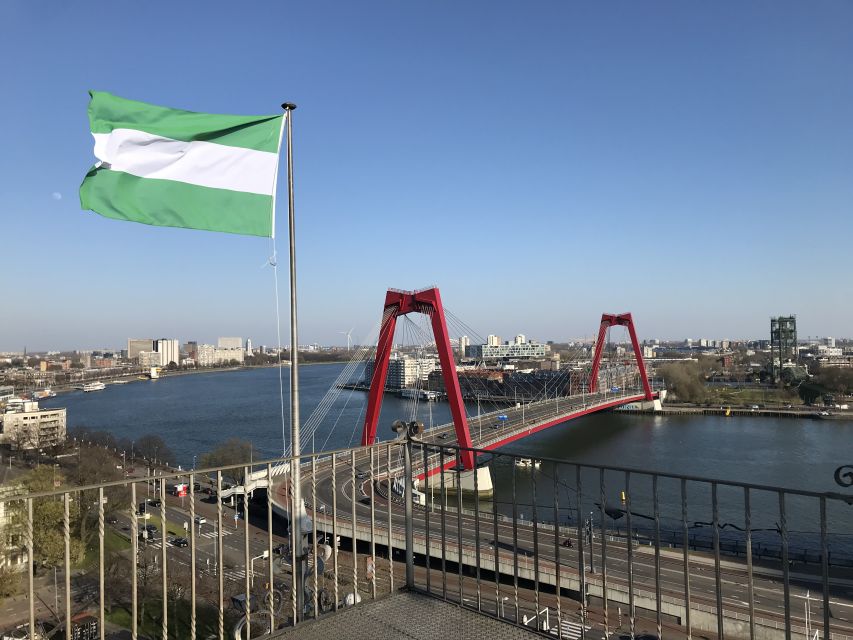
On weekend tours, you begin on the roof of Het Witte Huis. From there, you can look across to Markthal, the Cube Houses, Erasmus Bridge, Willems Bridge, and De Rotterdam. This is an excellent opening because the view shows several eras at once, from early high-rise ambition to large-scale contemporary construction.
The rooftop is a major part of the weekend version, but you should not assume the same experience on weekdays. Weekday tours include rooftop access connected with Timmerhuis and a terrace near Grotekerkplein, while weekend tours use Het Witte Huis. If the rooftop is a priority, confirm the day-specific arrangement before booking.
Markthal and the Cube Houses
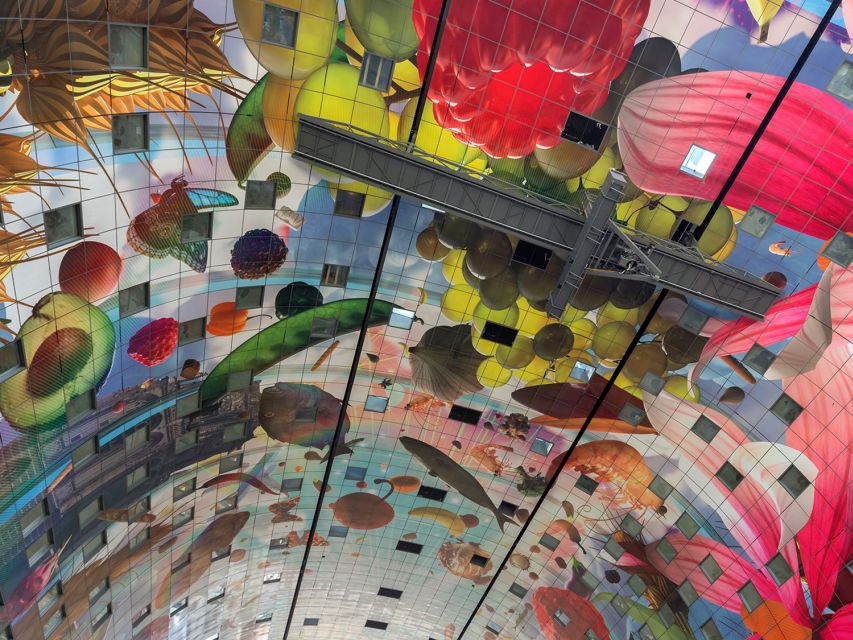
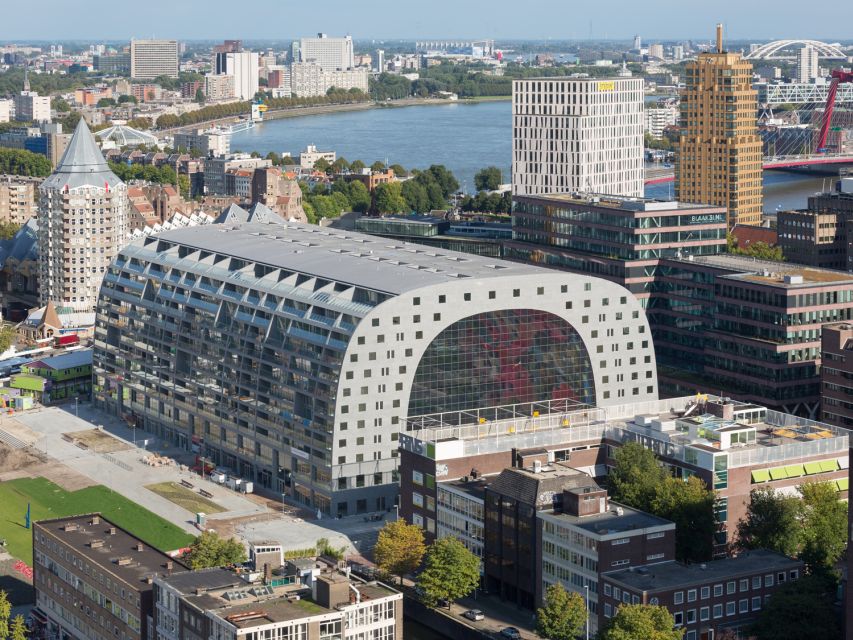
From Het Witte Huis, the route moves through one of Rotterdam’s most recognizable public spaces. Markthal is not simply a market building. Its large arch combines apartments with a food hall, creating a design concept in which people live above a public place filled with food and color.
Walking inside is important. From the street, you see the sweeping outer form. Inside, the relationship between housing, shops, food stalls, and the huge artwork overhead becomes clearer. Your guide explains how MVRDV handled the mixed-use plan and why the building became such a strong symbol of Rotterdam’s modern identity.
The food hall also gives the tour a welcome change of mood. This is not a museum visit with a quiet series of displays. You are in a working public building where the design has to handle daily use, commerce, housing, and large numbers of people.
You also receive a 50 percent discount on admission to the Cube Houses. The tour does not promise a full Cube House visit, so treat the discount as a useful extra if you want to return and explore one from inside. The houses are particularly interesting when seen from the nearby rooftop because their tilted forms make more sense as part of the larger urban plan.
Grotekerkplein and the weekday rooftop
The route continues toward Grotekerkplein, a refurbished city park with a public stage for music and dance. This stop helps explain how Rotterdam is not only adding striking buildings, but also reshaping the open areas between them.
On weekdays, the tour includes entrance to a rooftop terrace near Grotekerkplein, described in the itinerary as part of the Timmerhuis rooftop experience. The view gives you another angle on the city center and Markthal. Rooftop access can be a rare privilege in a city where many high viewpoints are controlled by offices or private buildings.
The weekday arrangement may suit you if you want a closer look at the central business district from above. The weekend Het Witte Huis roof offers a more historic setting and a broad view toward the river and major bridges. Neither option is automatically better. Pick the day based on which perspective sounds more useful to you.
Same country, a completely different kind of day:
- Rotterdam: Euromast Lookout Tower Ticket
★ 4.4 · 2,549 reviews - Rotterdam: Pancake Cruise
★ 4.4 · 1,986 reviews - Rotterdam: Kinderdijk UNESCO World Heritage Entry Ticket
★ 4.6 · 1,477 reviews - Rotterdam: Harbor Cruise with Live Guide
★ 4.0 · 1,270 reviews
Timmerhuis and Rotterdam’s postwar layers
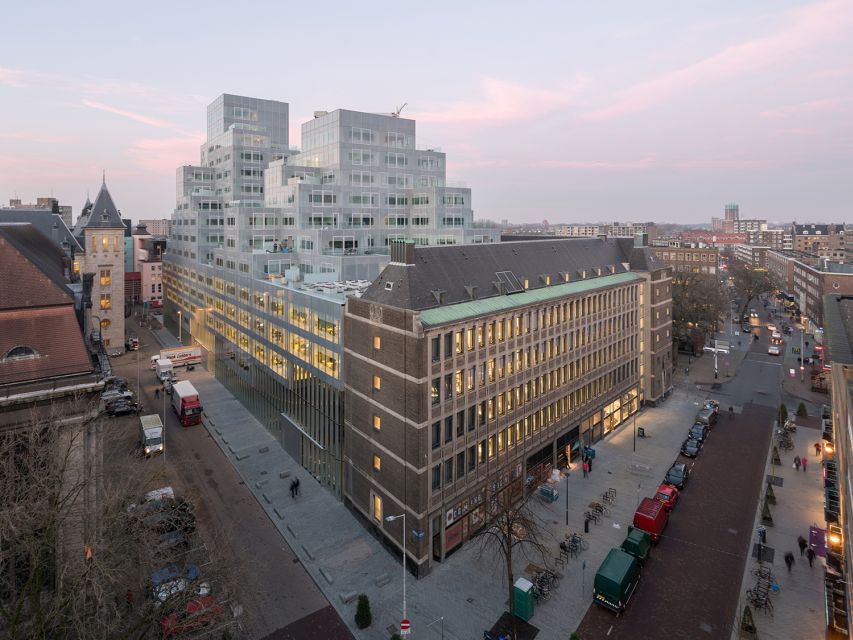
After the central market area, the guide points out Dudok’s Dudok before bringing you to Timmerhuis. This building is one of the clearest examples of Rotterdam’s habit of joining old and new rather than simply clearing a site.
OMA merged a municipal office block from the 1950s with a pixel-like steel and glass structure. The result is a building that looks different from every angle. Its design shows how a city can keep part of an earlier building while making room for new offices and new public use.
This is where an expert guide adds real value. You can see the glass and steel form, but the more useful question is how the older block and the new structure share one site. The tour is strongest when it explains those decisions rather than merely naming the architect.
You then pass historic and postwar monuments, including the post office and the de Bijenkorf warehouse. These stops help fill in the period between old Rotterdam and the city’s newest architecture. Rotterdam’s center was heavily damaged during the Second World War, and the mix of surviving buildings and later replacements is central to the city’s character.
Schouwburgplein, Kruiskadeplein, and Central Station
The route continues past Forum to Schouwburgplein, one of the city’s key public squares. From there, you reach Kruiskadeplein and see the Groothandelsgebouw, Rotterdam Central Station, and de Delftse Poort.
Central Station is one of the tour’s major visual stops. Its striking shape and large scale reflect Rotterdam’s role as a modern transport hub, but the surrounding buildings show that this part of town did not develop all at once. The tour links the station to earlier structures and to the broader push for urban renewal.
Groothandelsgebouw adds another layer. It is one of the important postwar buildings on the route, and seeing it alongside the new station makes the city’s repeated rebuilding easy to grasp. You are not studying isolated architectural objects. You are watching Rotterdam update itself over several generations.
The walking pace here may feel brisk. There are many names and buildings in a short stretch, and you may want to note down a few favorites so you can return later. This is a survey of the city, not a slow photographic walk at every stop.
Calypso, Pauluskerk, and de Unie
The route then takes in Calypso, Pauluskerk, and de Unie. Together, these buildings show the city’s willingness to use strong color, unusual shapes, and bold planning in ordinary urban settings.
Calypso is one of the more modern residential projects on the route, while Pauluskerk brings a different social and architectural presence. De Unie adds another distinctive stop to the sequence. The value here comes from seeing several contrasting buildings close together, with the guide explaining how each fits into Rotterdam’s changing center.
This section is useful if you want more than the usual postcard sights. Markthal and Central Station are easy to find on your own, but buildings such as these can pass unnoticed unless someone points them out and explains why they matter.
Museumpark and Sonneveld House
Near Museumpark, the tour turns toward Sonneveld House and Het Nieuwe Instituut. This area shifts the focus from large urban projects to design, domestic architecture, and cultural institutions.
Sonneveld House gives you a chance to consider how modern design worked at a smaller scale. Het Nieuwe Instituut broadens the picture again, connecting architecture with design and creative practice. The tour does not promise extended interior visits at every stop, so you should see this portion as an introduction to buildings you may want to explore separately.
Museumpark is also a natural lead-in to the final stop. The route moves from early modern design and cultural buildings toward one of Rotterdam’s most talked-about recent structures.
Depot Boijmans van Beuningen and its mirrored shell
Depot Boijmans van Beuningen is the finale, and it earns the attention. Its round, mirrored exterior reflects the surrounding city, sky, and park, making the building seem to change as you walk around it.
The guide explains the building’s double-curved facade and the concept behind its reflective panels. This is not a simple glass box. The curved surface creates demanding engineering problems, and the tour covers how aviation engineering techniques were needed to operate the enormous entrance doors.
The most useful fact about Depot is its purpose. It is the world’s first public art depot, designed to make an art collection’s storage operation part of the public experience. You should not assume that this walking tour includes a full interior visit to the depot itself. The detailed focus is on the exterior design, construction, and working concept.
That distinction matters when you compare this tour with an art museum ticket. If you want paintings and gallery time, you need a separate plan. If you want to understand how a new cultural building is engineered and why it looks so unusual, the Depot stop is a fitting finish.
What the $494 private-group price really means
The listed cost is $494 for a group of up to six. That works out to about $82 per person for six people, about $124 each for four, or $247 each for two.
For a couple, this is a costly walking tour. You are paying for a private guide, not a low-cost group introduction. For a family or group of friends with five or six people, the calculation is much better, especially if you value being able to ask questions and move at your own group’s pace.
The package also includes rooftop entrance, three postcards by Rotterdam architectural photographer Ossip van Duivenbode, and the 50 percent Cube Houses discount. The postcards are a pleasant souvenir, but they do not change the basic price calculation. The value comes mainly from the private guide and the access to rooftops that are not normally open to everyone.
I would book it for a group that wants architecture to be the main subject of the day. I would think twice if you only want a quick list of famous buildings or if you plan to spend most of your time inside museums.
Who will enjoy this tour most
This experience suits you if you want a city orientation built around buildings rather than food, shopping, or traditional sightseeing. It is especially useful at the start of a Rotterdam stay because it gives you a map of the center and several places to revisit.
Architecture students and design professionals may get the most from the structural explanations. One German architecture office found the tour especially inspiring, and that makes sense given the focus on construction, statics, and design choices.
You should also enjoy it if you like asking questions. Frank Schipper received especially strong praise for answering questions clearly and explaining both architectural history and the mechanics of high-rise construction.
The tour is listed as wheelchair accessible, but the same information says it is not suitable for people with mobility impairments. That is a real point to clarify before paying, since the route includes substantial walking and rooftop access. Assistance dogs are allowed, but other pets are not.
Practical details that affect your choice
The tour lasts 2.5 hours and is conducted on foot. Starting times vary, so check availability for the date you want. The meeting point is outside Het Witte Huis, even though the rooftop experience changes between weekdays and weekends.
You can choose Dutch, English, or German. Free cancellation is available up to 24 hours before the start time, and you can reserve now and pay later. Those policies are useful if your Rotterdam schedule is still shifting, but the main decision is still the day-specific rooftop access.
The overall rating is 4.6 from 17 reviews, with especially high praise for the guides’ warmth, clear explanations, and ability to answer questions. That matches the design of the tour: the buildings provide the spectacle, but the guide supplies the meaning.
Should you book Rotterdam’s Architecture Highlights Tour?
Book this tour if you are sharing the $494 cost with several people, want a private guide, and care about how Rotterdam’s buildings were planned and built. The route gives you a broad view of the city, from Het Witte Huis and postwar monuments to Timmerhuis, Markthal, Central Station, and Depot.
For two people, the price is harder to justify unless architecture is a top priority. You should also choose your day with care. Weekend tours offer the historic Het Witte Huis rooftop, while weekday tours offer rooftop access near the city center and Timmerhuis.
I would recommend it as a strong first architectural introduction, especially for design-minded visitors and small private groups. Just keep your expectations clear: this is a fast, information-packed walking tour with selected building access, not a series of long interior visits.
FAQ
How long does the Rotterdam architecture tour last?
The tour lasts 2.5 hours.
How much does the private tour cost?
The price is $494 for a private group of up to six people.
What languages are available?
The live guide can conduct the tour in Dutch, English, or German.
Where does the tour meet?
You meet the guide outside the entrance of Het Witte Huis.
Which rooftop can I visit?
Weekday tours include rooftop entrance connected with Timmerhuis and a terrace near Grotekerkplein. Weekend tours visit the roof of Het Witte Huis.
Is the tour private?
Yes. It is offered as a private group experience for up to six people.
Is the tour wheelchair accessible?
The activity information lists it as wheelchair accessible, but it also says it is not suitable for people with mobility impairments. Contact the provider before booking if you need to confirm whether the walking route and rooftop access meet your needs.
Just added around Rotterdam
- Discover Rotterdam: Classic Highlights Bike Tour by a Local★ 5.0 · 3 reviews
- Rotterdam: Capture the most Photogenic Spots with a Local★ 5.0 · 3 reviews
- Private tour: Markthal, Cube houses and Rooftop Het Witte Huis★ 4.5 · 3 reviews
- Private Transfer from Rotterdam Port to Amsterdam Airport (AMS)★ 5.0 · 3 reviews
- Rotterdam: 2.5-Hour Leckers Boat Cruise and Buffet★ 3.2 · 3 reviews
- Discover Rotterdam’s most Photogenic Spots with a Local★ 5.0 · 3 reviews
- Rotterdam: Wilhelminapier, High-rise & floating architecture★ 4.0 · 3 reviews
- Private Transfer from Rotterdam City to Amsterdam Schiphol Airport★ 5.0 · 4 reviews
Rotterdam Tours, compared.


Kinderdijk UNESCO World Heritage Entry Ticket
Read our review →
Browse the lists this tour appears in