
Reviewed · AMSTERDAM TOURS
Guided Walking Street Food Tour of De Pijp & Beyond
Amsterdam’s best food stories often come from a market stall or a narrow neighborhood shop, not a grand restaurant. This four-to-five-hour walk through De Pijp takes you from Albert Cuyp Market into the small businesses that serve local residents, with tastes ranging from herring and stroopwafels to Indonesian and Surinamese specialties.
I like the small group of no more than eight, which gives the guide room to explain what you are eating and adjust the pace. I also like the mix of old and new: family-run businesses, market vendors, local toko shops, and newer spots such as Japanese sandwich counters. The main drawback is the price, $155.68 per person, which is a serious spend for a walking tour, even with food and drinks included.
Key points at a glance
- Seven or more tastings: Expect Dutch favorites such as herring, kroket, fries, poffertjes, stroopwafels, and broodje pom, along with Indonesian, Surinamese, and Japanese foods.
- Albert Cuyp Market first: The tour begins among Amsterdam’s best-known street stalls, with about 45 minutes around the market.
- De Pijp beyond the postcard view: Roughly three hours are spent in local shops and eateries on the neighborhood’s narrower streets.
- A useful local lens: Your guide explains everyday life in Amsterdam and places food in its social and historical setting.
- Personal guiding: Sharmain is praised for reading the group well and keeping the conversation lively, while Sara brings clear food and history commentary.
- Easy small-group format: The tour starts at 11 a.m., is offered in English, and ends in a different location from the meeting point.
Why this food walk works
De Pijp is a good place to talk about Amsterdam through food because its eating culture is not limited to one national menu. Dutch staples sit beside Indonesian and Surinamese dishes, reflecting the city’s long connections with other parts of the world. Newer food businesses add another layer without wiping out the older neighborhood character.
That mix is the real point of the experience. You are not simply collecting snacks. You are seeing how a local district eats on an ordinary day, with the guide connecting each bite to the people and businesses behind it.
The tour begins at 11 a.m. at Albert Cuypstraat 75. From there, you spend about 45 minutes in and around Albert Cuyp Market before moving into De Pijp for about three hours. The full outing lasts approximately four to five hours, so you should treat it as a late breakfast and lunch rolled into one.
I like the length because it leaves room for conversation. A shorter market crawl can feel rushed, with one bite swallowed before the next stop. Here, the walking time between places helps you get your bearings and gives your stomach a break.
The trade-off is that four to five hours is a large block of your Amsterdam day. If you want to visit several museums, take a canal cruise, or cover the historic center on the same afternoon, this may feel too long. It works best when you give the experience its own half-day.
More Food Tours in Amsterdam
- 10 Tastes of Amsterdam: Food Tour by UNESCO Canals and Jordaan
★ 5.0 · 3,020 reviews - Amsterdam Food and Cultural Tour with Tastings
★ 5.0 · 2,442 reviews - Amsterdam Jordaan Food & Drinks Tour with Eating Europe
★ 5.0 · 2,425 reviews
Starting at Albert Cuyp Market
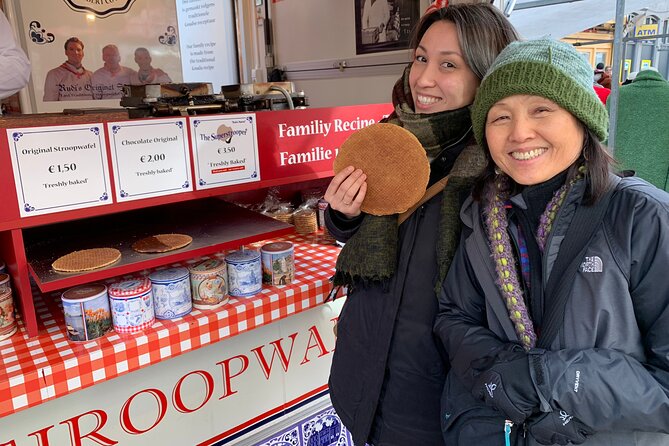
Albert Cuyp Market is the natural opening act. It is the Netherlands’ most popular street market, and the tour uses the market as more than a photo stop. You visit small family businesses, market vendors, and newer food entrepreneurs who sell to people living nearby.
The food list gives you a good idea of the range. Herring offers a classic Dutch taste. A kroket brings a crisp, savory snack, while stroopwafels supply the sweet side. Broodje pom introduces a Surinamese dish, and the menu may also include other Indonesian, Japanese, and international items.
I like that the emphasis is on places the guides have returned to for years. That matters in a market full of choices. Instead of wandering past dozens of stalls and guessing what to order, you get a local filter.
Do not expect every stop to be a sit-down meal. This is street food, so the pleasure comes from small portions, quick tastes, and the contrast between one item and the next. If you prefer a long meal with a fixed table, this format may not suit you.
Market conditions can also affect the feel of this part of the walk. Albert Cuyp is a working market, not a quiet museum. You will be on your feet and moving through public spaces, with food stands and shops close together.
Walking deeper into De Pijp
After the market, the tour spends about three hours in De Pijp. This is where the experience becomes less about one famous market and more about how a neighborhood functions.
The guide takes you along small, narrow streets to local businesses. Stops can include toko shops, which are small grocery stores and eateries tied to Indonesian, Surinamese, and wider Asian food culture. You may also visit Dutch street food places and newer international eateries.
The food range remains broad. Dutch options can include herring, fries, kroket, poffertjes, and stroopwafels. Indonesian and Surinamese dishes bring different spices, textures, and ingredients. Japanese sandos show how the district continues to absorb newer food ideas.
This is a strong choice if you want help making sense of Amsterdam’s food culture. A menu item alone tells you only what is on the plate. A guide can explain why a dish belongs in the neighborhood and how different food traditions have become part of daily Amsterdam life.
The walk also gives you a practical introduction to De Pijp. You learn the area by moving through it, rather than viewing it from a sightseeing bus or passing through on the way to a museum. That can help you return later for your own meal or a second look at the market.
Still, remember that the schedule is built around food. You may pass interesting streets and businesses without stopping for a long look. The tour offers a first feel for De Pijp, not a full architectural or cultural tour of every corner.
What you may eat and drink
You should expect at least seven local street foods and a few drinks. The exact selection is not presented as a fixed menu, so do not book this expecting a guaranteed sequence of identical dishes.
The listed examples cover several useful categories:
- Dutch classics: herring, kroket, fries, poffertjes, stroopwafels, and other pastries.
- Surinamese food: broodje pom is specifically named, offering a taste beyond the standard Amsterdam snack list.
- Indonesian and Asian foods: local toko shops may provide savory foods and products connected to Indonesian and wider Asian cooking.
- Newer international food: Japanese sandos are included among the modern possibilities.
- Drinks: A few drinks are part of the experience, though the specific beverages are not stated.
I appreciate this kind of menu because it avoids reducing Dutch food to cheese, pancakes, and sweets. You get familiar items, but also a clearer sense of Amsterdam as a city shaped by many food traditions.
The uncertain element is choice. Since the stops can include different types of businesses, the precise tastings may vary. If you have a strict diet, allergy, or strong food restriction, ask before booking. The available information does not promise a vegetarian, vegan, halal, gluten-free, or allergy-specific menu.
You should also arrive ready for several small portions rather than one large lunch. Seven or more tastings can add up, but the format is designed for variety. The few drinks add to the social side of the walk, though you should not assume a full drinking experience.
More Walking Tours in Amsterdam
- Anne Frank’s Story – Guided Walking Tour through Amsterdam
★ 5.0 · 11,619 reviews - Amsterdam: Life of Anne Frank and World War II Walking Tour
★ 4.8 · 10,467 reviews - Absolutely Amsterdam – the Essential Introductory Walking Tour
★ 5.0 · 3,629 reviews - Amsterdam: Anne Frank Guided Small Group Walking Tour
★ 4.8 · 2,722 reviews
The guide can make or break the pace
A food walk needs more than a list of places. The guide has to keep the group moving, explain unfamiliar foods, and notice when people need a pause. The feedback associated with this tour gives useful clues about the guiding style.
Sharmain is praised for reading the group well and keeping the banter going. That suggests a relaxed tour where the conversation can respond to the people in front of the guide rather than follow a stiff script.
Sara is praised for making food and history work together. That combination is especially useful here. You can taste an item, hear where it fits in Amsterdam’s story, and then understand why it matters instead of treating it as just another snack.
I would value both qualities. Food tours can become either dry lectures or nonstop chatter. The best balance gives you enough facts to understand the dishes while leaving room for ordinary conversation.
The small group helps. With a maximum of eight people, you are less likely to be lost at the back of a crowded party. You can ask questions, hear the answers, and get a better look at food being served. It also means the social mood depends on the group, so the guide’s ability to read the room matters.
Is $155.68 a fair price?
At $155.68 per person, this is not a budget way to grab lunch. You are paying for a guided half-day, at least seven tastings, a few drinks, local knowledge, and access to small businesses you might not find on your own.
The value depends on how you use it. If you would otherwise spend the morning sampling food independently, the included tastings offset some of the cost. You also save the time and uncertainty of choosing among market stalls and neighborhood shops.
I see the best value for a first visit to Amsterdam, especially if you want a friendly introduction to De Pijp and prefer food to formal sightseeing. The guide gives the meal structure, and the neighborhood context makes the money go beyond what you would pay for snacks alone.
The value is weaker if you already know De Pijp well or are comfortable finding food on your own. You could spend far less by visiting Albert Cuyp Market independently and ordering a few items. You would not get the same explanations, route, or group experience, but the lower cost may matter more to you.
The 96 percent recommendation rate and 4.9 rating from 57 reviews point to strong satisfaction, with particular praise for the guides’ social skills and food explanations. Those numbers do not remove the price concern, but they support the idea that the tour’s strength is the complete experience, not simply the food bill.
Practical details before you book
The tour is offered in English and uses a mobile ticket. Confirmation is sent within 48 hours of booking, subject to availability. Since the activity is often booked about 34 days ahead, you may want to reserve early if your Amsterdam dates are fixed.
The meeting point is Albert Cuypstraat 75, 1072 CN Amsterdam, at 11 a.m. The end point is different from the start, so plan your afternoon with that in mind. The exact ending location is not supplied here, so check the booking details before scheduling a museum or timed activity afterward.
The tour is near public transportation, and most people can participate. Service animals are allowed. Since this is a long walking and eating experience, wear comfortable shoes and avoid planning anything immediately afterward that requires you to be across the city at a precise time.
Free cancellation is available up to 24 hours before the start time for a full refund. Changes or cancellations made less than 24 hours before departure are not accepted, and the tour requires a minimum number of people. If that minimum is not reached, you are offered another date or experience, or a full refund.
Who will enjoy this Amsterdam walk?
I would choose this tour for someone who wants food to explain a city. It suits first-time Amsterdam visitors, curious eaters, couples, friends, and solo bookers who like a small social group.
It is also a good match if you want to see beyond the historic center. De Pijp gives you a different sense of Amsterdam, with local shops and mixed food traditions rather than only canals and major monuments.
Families may appreciate the small tastes and informal format, though the four-to-five-hour length should fit everyone in the group. People who need a fully accessible route, a specific diet, or a guaranteed list of dishes should confirm those details before paying, since they are not promised in the available information.
I would skip it if you want a quiet sit-down lunch, a short activity, or a tour devoted mainly to architecture. I would also think twice if $155.68 feels too high for a meal-centered outing and you are happy to explore markets without a guide.
Should you book this De Pijp food tour?
Book it if you want a half-day introduction to Amsterdam through small businesses, local snacks, and neighborhood life. The combination of Albert Cuyp Market, toko shops, Dutch classics, Surinamese and Indonesian foods, and newer Japanese sandos gives you more range than a standard city food crawl.
The strongest reasons to go are the small group, the guide-led context, and the chance to taste foods you might not choose on your own. Sharmain’s easy banter and Sara’s food-and-history approach also suggest that the human side of the experience is a major part of its appeal.
Skip it if you are watching your budget, need a guaranteed dietary menu, or would rather spend four hours sightseeing at your own speed. At this price, the tour earns its keep only if you value the guidance and the local connections as much as the food.
FAQ
Where does the tour start?
It starts at Albert Cuypstraat 75, 1072 CN Amsterdam, at 11 a.m.
Where does the tour end?
The activity ends in a different location from the meeting point. Check the booking details for the exact ending location.
How long does the experience last?
It lasts approximately four to five hours. About 45 minutes are spent at Albert Cuyp Market, followed by about three hours in De Pijp.
How many foods are included?
You will try at least seven local street foods, along with a few drinks. The specific selection may vary.
Is the tour offered in English?
Yes. The experience is offered in English and uses a mobile ticket.
Can I cancel for a full refund?
Yes, if you cancel at least 24 hours before the experience start time. Cancellations or changes made less than 24 hours before departure are not accepted for a refund.
More Food in Amsterdam
- Amsterdam: River Cruise With All-You-Can-Eat Dutch Pancakes
★ 4.4 · 1,504 reviews - Amsterdam: Food and Culture Walking Tour with Tastings
★ 4.9 · 838 reviews - Eating Amsterdam: Food Tour & Canals Cruise
★ 5.0 · 496 reviews - Amsterdam High-End Dutch Food & History Tour – Up to 8 guests
★ 5.0 · 482 reviews
Just added around Amsterdam
- Amsterdam: Giethoorn Tour with Canal Cruise and Windmills★ 5.0 · 3 reviews
- Full-day excursion to Edam, Volendam, and Marken★ 3.7 · 3 reviews
- Amsterdam: Chocolate Fondue in the Dark★ 5.0 · 3 reviews
- Amsterdam Old-West Vegan Food Tour with Local Guide★ 4.7 · 3 reviews
- Amsterdam Family Friendly Historical Walking Tour★ 5.0 · 3 reviews
- Amsterdam Private Walking Tour of Famous Painters★ 5.0 · 3 reviews
- From Amsterdam: visit Zaanse Schans, Muiderslot and more!★ 5.0 · 3 reviews
- Amsterdam Walking Tour with Dutch Pancake Lunch★ 5.0 · 3 reviews
Amsterdam Tours, compared.


Amsterdam Classic Saloon Boat Cruise with Drinks and Cheese
Read our review →
Amsterdam Luxury Canal Cruise + Unlimited Drinks & Bites option
Read our review →


Classic Boat Cruise with Optional Cheese & Wine
Read our review →
Evening Cruise with Optional Wine and Snacks
Read our review →
75 Minute City Canal Cruise with Audio Guide
Read our review →Browse the lists this tour appears in