
Reviewed · AMSTERDAM TOURS
Amsterdam Highlights and History Walking Tour (MUST DO)
Amsterdam’s story is written into its streets, canals, churches, courtyards, and market squares. This two-hour walk gives you a useful first look, moving from Dam Square through the canal ring, Begijnhof, the Old Church, the Royal Palace, and Nieuwmarkt. It is the kind of tour that helps you understand what you are seeing instead of simply ticking off sights.
I like the small maximum group of 15, since it gives you a better chance to hear the guide and ask questions. I also like the moderate pace and strong focus on history, with guides such as Andrea, Aaron, Aarre, David, Gio, and James praised for making their stories lively and easy to follow. The main caution is simple: you must walk and remain on your feet for about two hours while watching for bicycles.
Key points to know before booking

- Six central Amsterdam landmarks: The route links Dam Square, the canal ring, Begijnhof, the Old Church, the Royal Palace, and Nieuwmarkt.
- A useful first-day orientation: You finish back at the meeting point near Damrak, with a clearer sense of the city center.
- History told through real places: Dutch politics, religion, urban planning, trade, and royal life all appear along the walk.
- Maximum of 15 people: This is smaller than a typical large city tour and should make questions easier.
- English-speaking local guide: Guides named in the feedback include Andrea, Aarre, Aaron, David, Gio, and James.
- Good value at $26.91: For two hours of guided sightseeing in central Amsterdam, the price is reasonable, especially if you are short on time.
Starting at Damrak and Dam Square
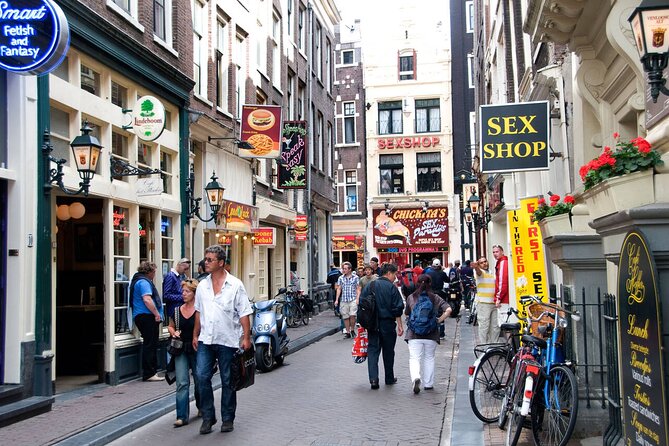
The tour begins at Damrak 1-5, close to Dam Square and Amsterdam’s central station area. That location is practical for a first visit because it puts you near the city’s main historic core and is easy to reach by public transportation.
Dam Square is not just a wide open space for photos. It has been a center of political and cultural life for centuries, and it gives your guide a natural place to explain how Amsterdam developed as a city. From here, you can begin to connect the buildings around you with the city’s changing role in Dutch public life.
The opening stop also helps you get your bearings. Amsterdam’s center can feel confusing at first, with canals, narrow streets, tram tracks, busy footpaths, and bicycle lanes all competing for your attention. A guided walk gives you a map in your head before you set off on your own.
The meeting point and ending point are the same, which is useful if you want to continue sightseeing afterward. You can return to a familiar spot rather than trying to find your way back from an unfamiliar neighborhood.
More History Tours in Amsterdam
- Amsterdam Food and Cultural Tour with Tastings
★ 5.0 · 2,442 reviews - Amsterdam: Haunted History and Ghost Walking Tour
★ 4.5 · 488 reviews - Amsterdam High-End Dutch Food & History Tour – Up to 8 guests
★ 5.0 · 482 reviews
Following Amsterdam’s canal ring
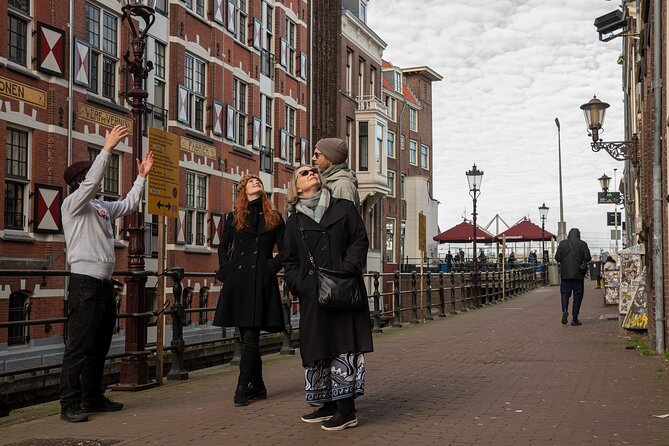
Amsterdam’s canal ring is the visual heart of the city. Its waterways are also part of a large urban planning project that made Amsterdam easier to build, manage, and expand. The canal district is a UNESCO World Heritage Site, and seeing it on foot lets you notice details that can pass quickly from a boat window.
A guide can explain why the canals matter beyond their postcard appeal. They reflect Amsterdam’s engineering skills, commercial growth, and careful city planning. As you walk, you might find yourself looking more closely at the relationship between water, streets, bridges, and historic buildings.
This part of the route is especially helpful if you plan to take a canal cruise later. The walking tour gives you context first, so a boat ride can become a second view of places you already recognize. You will also be better prepared to choose which canal areas deserve more of your own time.
The main drawback is the street environment. Amsterdam’s center is active, and bicycles can appear quickly and quietly. Keep your attention on the guide and stay aware when crossing paths or stepping near bike lanes.
Entering the 14th-century Begijnhof
Begijnhof offers a sharp change from the public energy of Dam Square and the canal streets. This historic courtyard dates to the 14th century and was once home to Beguines, religious women who lived in a semi-monastic community.
The courtyard is one of the oldest and best-preserved parts of Amsterdam. Its importance is not only its age. It shows how different forms of religious and community life existed within the city, and it gives you a quieter setting in which to consider Amsterdam’s past.
This is the kind of stop that benefits from a guide. Without context, you might see a peaceful courtyard and a collection of old buildings. With an explanation of the Beguines and the site’s purpose, the place becomes easier to understand.
You should also expect this stop to feel different from the larger public squares. The experience is based on looking and listening rather than rushing from one photo point to another. Keep your voice low and follow any local rules while inside the courtyard.
Seeing the Old Church in Amsterdam’s oldest quarter
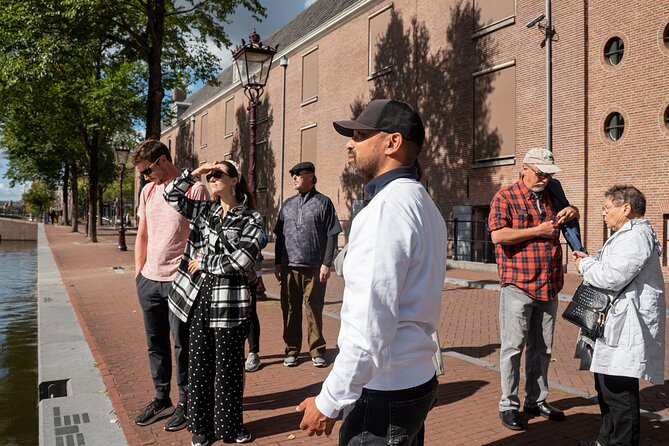
The Old Church, or Oude Kerk, dates to the 13th century and is Amsterdam’s oldest surviving building. It began as a Catholic church, later served Protestant congregations, and now functions as a cultural center.
That change in use gives the stop several layers. Your guide can connect the building with shifts in religion and public life, rather than treating it as an isolated monument. The church also helps you see how Amsterdam’s oldest structures have continued to change with the city around them.
The Old Church is located in a part of central Amsterdam where modern city life and old architecture sit close together. That contrast is one reason a walking tour works well here. You move through the city at street level, seeing how historic sites fit into the working city rather than viewing them only as museum pieces.
The tour information does not state that admission inside the church is included, so you should treat this as an exterior and historical stop unless your guide tells you otherwise. The walking tour includes a tour of Amsterdam and a local guide, but food, drinks, and any separate admissions are not included.
More Walking Tours in Amsterdam
- Anne Frank’s Story – Guided Walking Tour through Amsterdam
★ 5.0 · 11,619 reviews - Amsterdam: Life of Anne Frank and World War II Walking Tour
★ 4.8 · 10,467 reviews - Absolutely Amsterdam – the Essential Introductory Walking Tour
★ 5.0 · 3,629 reviews - Amsterdam: Anne Frank Guided Small Group Walking Tour
★ 4.8 · 2,722 reviews
Understanding the Royal Palace and Dutch classicism
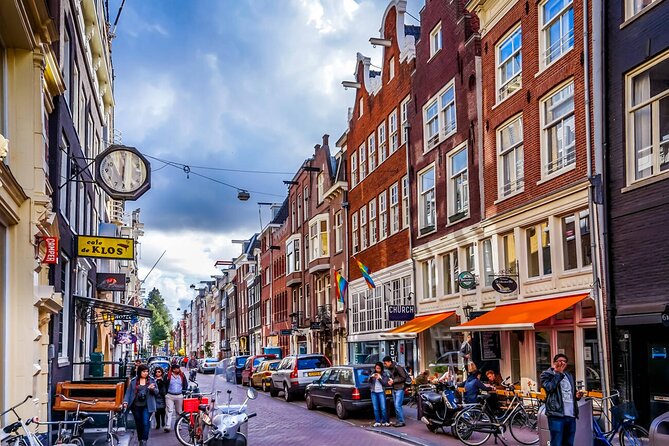
The Royal Palace began as a 17th-century town hall, a reminder that Amsterdam once placed civic government at the center of this grand building. It later became one of three palaces used by the Dutch royal family.
The building is an impressive example of Dutch classicism, and its original purpose makes it more interesting than a simple royal residence. Your guide can help you read it as both a symbol of civic power and a royal building.
The palace is open to the public for tours, but that separate visit is not listed as part of this two-hour walking experience. If the interior interests you, plan it as an additional activity and check its opening details independently before you go.
For a short city tour, this stop adds useful context. You are not only looking at a grand façade. You are seeing how Amsterdam’s wealth and political importance were expressed through architecture during the 17th century.
Finishing at Nieuwmarkt
Nieuwmarkt brings the walk into another kind of public space. It was once part of Amsterdam’s 17th-century city walls and is now a square with a daily market, cafes, restaurants, and historic buildings.
This is a good final stop because it connects the past with present-day city life. The square remains a place where people gather, eat, shop, and pass through, while its older buildings point back to Amsterdam’s defensive and commercial past.
Nieuwmarkt also gives you practical choices after the tour. You can pause for food or continue exploring nearby streets. One guide, James, is specifically praised for offering restaurant recommendations, so it may be worth asking your guide for suggestions if you plan to eat nearby.
The walk ends back at the original meeting point rather than at Nieuwmarkt. That may mean a final walk back with the group, depending on the exact route and timing. The supplied details do not give a detailed minute-by-minute schedule, so you should allow a little flexibility around the two-hour estimate.
What the guide adds to the experience
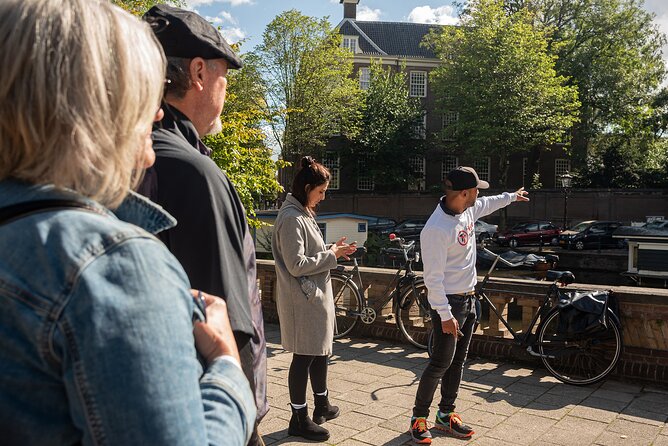
The strongest part of this tour is the guide’s role. The route includes famous places, but you can see many of them on your own. The value comes from having someone explain why each location matters and connect the stops into one story.
Several guides receive especially warm praise for their delivery. Andrea is described as clear, well informed, and comfortable to follow. Aarre is singled out for making the significance of buildings and areas fascinating. Aaron is praised for his extensive knowledge and friendly personality, while David is noted for answering questions and taking an active interest in the group.
Gio appears repeatedly in the feedback, with particular emphasis on his enthusiasm and passion for the city. James is praised for combining historical details with monuments in an easy, engaging way and for recommending good restaurants.
Guide assignments can change, so you should not assume that a particular person will lead your departure. Still, the range of positive comments suggests that the experience depends on a team of guides who know how to make history accessible.
The style is interactive rather than purely lecture-based. You should expect stories, explanations, and chances to ask questions while walking. If you prefer a completely self-directed visit, the fixed pace may feel less flexible. If you want help noticing details and understanding the city, the structure is useful.
Is two hours enough for Amsterdam?
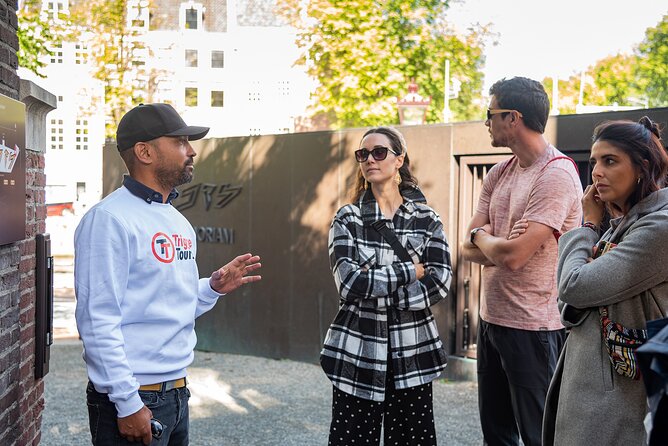
Two hours is enough for an introduction, not a full study of Amsterdam. You will see a strong set of central landmarks, but you will not explore every neighborhood or spend extended time inside each building.
That limited length is part of the value. If you have only a short stay, this tour can help you use your remaining time wisely. One participant with limited time in Amsterdam found that the walk helped make the most of the visit, and that is exactly where this experience fits best.
I would schedule it early in your stay if possible. The route covers enough of the center to help you decide what deserves a longer visit later. You might return to the Royal Palace, spend more time around the canal ring, visit the Old Church, or explore Nieuwmarkt after you know where each area sits.
The pace is described as moderate, but you still need to walk for roughly two hours and remain alert around bicycles. Wear comfortable shoes and dress for the weather. One missed booking was linked to very bad weather, and the cancellation terms do not provide a refund for cancellations made less than 24 hours before the start time.
Price, group size, and practical value
At $26.91 per person, this is a fair price for a two-hour guided walk in central Amsterdam. You are paying for a local guide, route planning, historical context, and the chance to ask questions in a small group. Food, drinks, and separate attraction admissions are not included.
The maximum group size is 15 people. That is small enough to feel more personal than a large street tour, though the experience will naturally be more intimate if your departure has only a few people. One group of 11 used the walk as a team activity, so it can also suit a family group, work group, or friends traveling together.
Group discounts are available, which may improve the value for larger parties. The tour is offered in English and includes a mobile ticket, making it a simple choice if you want a guided orientation without committing to a longer excursion.
The tour requires a minimum number of participants. If that minimum is not reached and the activity is canceled, you are offered another date or experience, or a full refund. Otherwise, you can cancel for a full refund up to 24 hours before the start time. Changes or cancellations inside that 24-hour window are not accepted for a refund.
Who should book this walk?
This tour suits first-time visitors who want a clear introduction to central Amsterdam. It also fits history fans who enjoy learning how religion, city planning, politics, architecture, and daily life overlap.
I would recommend it for anyone who likes to ask questions. The guides are praised for their humor, energy, and ability to explain complex subjects in an approachable way. The smaller group makes that interaction more realistic than it would be on a large coach tour.
It also works well for a short city break. You get major sights in a compact two-hour route and finish near the same place where you started. The walk is less suitable if you have difficulty walking or standing for two hours, or if you want a slow visit inside every building.
Most people can participate, and service animals are allowed. The tour is near public transportation, but the provided information does not describe wheelchair access in detail, so you should confirm that directly if you need specific mobility arrangements.
Should you book the Amsterdam Highlights and History Walking Tour?
I would book this tour if you want a practical first look at Amsterdam and care about the story behind the buildings. The route is well chosen, the price is reasonable, and the guide is the main attraction. Andrea, Aarre, Aaron, David, Gio, and James are all associated with strong comments about clear explanations, humor, and enthusiasm.
You should skip it only if two hours of walking is a poor fit, if you prefer exploring without a set route, or if your schedule is so tight that bad weather or a missed meeting point could cause trouble. For most first-time visitors, especially those with limited time, this is a sensible way to get oriented before exploring Amsterdam on your own.
FAQ
How long does the Amsterdam Highlights and History Walking Tour last?
The tour lasts approximately two hours.
Where does the tour begin?
It begins at Damrak 1-5, 1012 TM Amsterdam, Netherlands.
Where does the tour end?
The activity ends back at the meeting point.
What language is the tour offered in?
The tour is offered in English.
How many people can join the tour?
The tour has a maximum of 15 participants.
What is included in the price?
The price includes a local guide and a tour of Amsterdam. Food and drinks are not included.
Just added around Amsterdam
- Amsterdam: Giethoorn Tour with Canal Cruise and Windmills★ 5.0 · 3 reviews
- Full-day excursion to Edam, Volendam, and Marken★ 3.7 · 3 reviews
- Amsterdam: Chocolate Fondue in the Dark★ 5.0 · 3 reviews
- Amsterdam Private Walking Tour of Famous Painters★ 5.0 · 3 reviews
- Amsterdam Family Friendly Historical Walking Tour★ 5.0 · 3 reviews
- Amsterdam Old-West Vegan Food Tour with Local Guide★ 4.7 · 3 reviews
- From Amsterdam: visit Zaanse Schans, Muiderslot and more!★ 5.0 · 3 reviews
- Amsterdam: Beer Tasting with Paired Bites at Eighty-Four★ 5.0 · 3 reviews
Amsterdam Tours, compared.


Amsterdam Classic Saloon Boat Cruise with Drinks and Cheese
Read our review →
Amsterdam Luxury Canal Cruise + Unlimited Drinks & Bites option
Read our review →


Classic Boat Cruise with Optional Cheese & Wine
Read our review →
Evening Cruise with Optional Wine and Snacks
Read our review →
75 Minute City Canal Cruise with Audio Guide
Read our review →Browse the lists this tour appears in