
Reviewed · AMSTERDAM TOURS
Amsterdam Central Walking Tour
Amsterdam’s story comes into focus on foot, one canal bridge and crooked house at a time. This two-hour walk moves from the city’s oldest quarter through the Red Light District, Jordaan, Anne Frank House, Negen Straatjes, and Spui, ending at Dam Square. The best part is the range of subjects, from wooden foundations and herring trade to squatting, gay rights, religion, and student protest.
I like the small groups of up to 12, which give you a better chance to hear the guide and ask questions. I also like the local focus. Guides such as Willem and Sid have brought together old city stories with present-day politics and culture. The main drawback is the pace: two hours is enough for an excellent orientation, but not enough time to linger at every sight.
Key points to know before you book
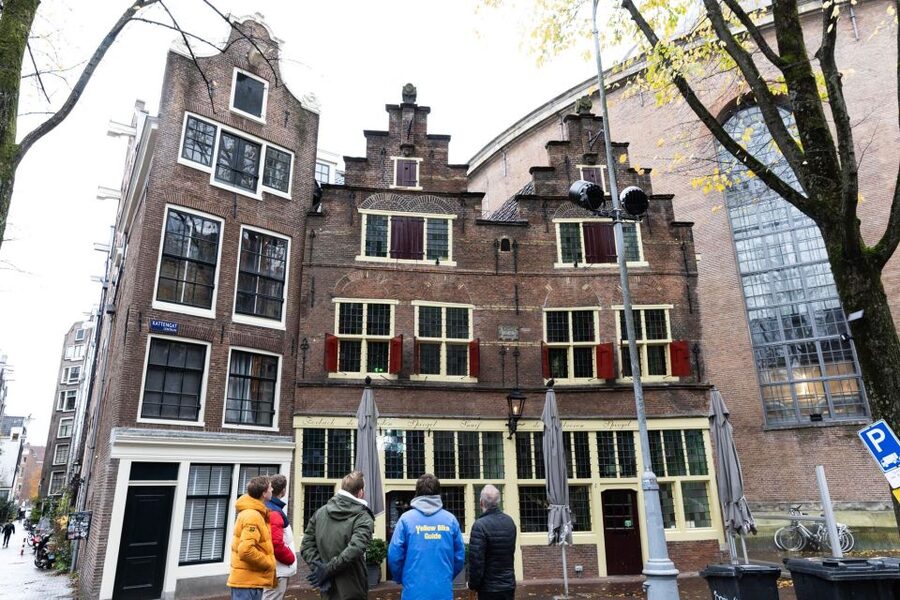
- A compact route with a wide subject range: You cover canals, trade, architecture, war history, civil resistance, shopping, and modern Amsterdam in two hours.
- Small groups matter: The tour is capped at 12 people and can sometimes become a much smaller outing.
- The café stop is not included: You pause at a traditional Dutch brown café, but you pay for your own drink.
- Winter requires proper clothing: The walk runs rain or shine, so bring warm layers, a hat, gloves, scarf, and comfortable shoes.
- Local guides shape the experience: Willem and Sid have both led tours praised for clear English, strong storytelling, and useful city advice.
- Mobility deserves careful thought: The tour is described as wheelchair accessible, yet it is also marked unsuitable for people with mobility impairments. Ask Yellow Bike to clarify the route before booking.
Starting at Nieuwezijds Kolk in Amsterdam’s oldest quarter
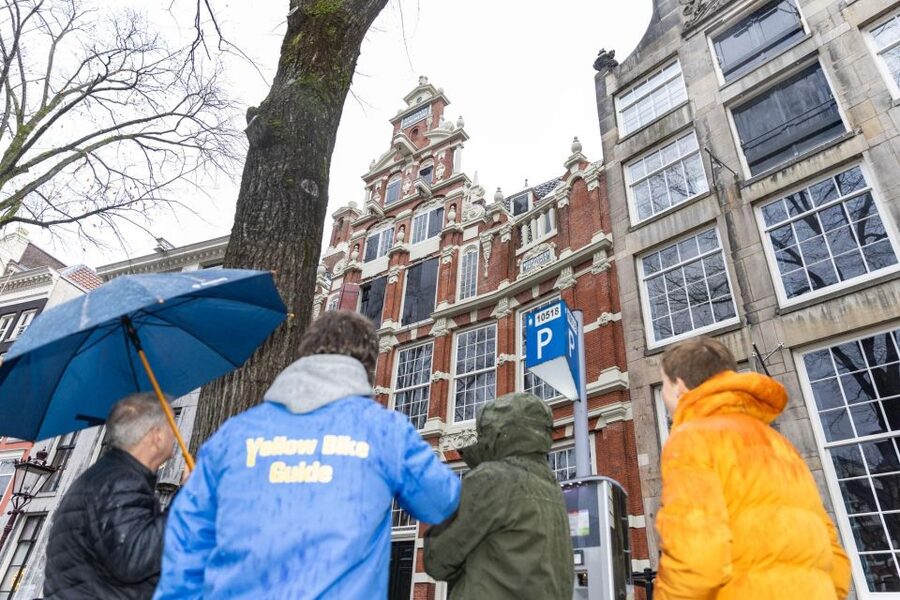
You meet at Yellow Bike, Nieuwezijds Kolk 29. Look for the Yellow Bike sign and check in at the counter. This is a practical starting point near the old center, and the same place serves as the return point, so you do not need to work out a new meeting location after the walk.
The tour begins in the oldest part of Amsterdam, where the city’s early growth is tied closely to water, trade, and defense. You are not simply walking between famous buildings. You are learning why the streets and canals formed where they did, and how Amsterdam dealt with the sea pressing against its edges.
That foundation helps make sense of the city’s odd angles. Amsterdam’s famous crooked houses are not just charming photo subjects. You learn why many buildings lean and how much of the city rests on wooden poles driven into the soft ground. The tilted façades become part of a practical engineering story, not just an architectural curiosity.
More Walking Tours in Amsterdam
- Anne Frank’s Story – Guided Walking Tour through Amsterdam
★ 5.0 · 11,619 reviews - Amsterdam: Life of Anne Frank and World War II Walking Tour
★ 4.8 · 10,467 reviews - Absolutely Amsterdam – the Essential Introductory Walking Tour
★ 5.0 · 3,629 reviews
The Red Light District with clear ground rules
The route includes the Westerlijke Wallen, commonly known as the Red Light District. The guide treats this part of the city as a working neighborhood with its own rules and social context, rather than as a stage set for gawking.
You are asked not to take photos, and you should not linger. That matters. A respectful walk lets you understand how Amsterdam handles a highly visible adult industry without turning local workers into attractions. This portion may feel more restrained than some visitors expect, but that is a good thing.
The route also touches the Nieuwe Haarlemmersluis, where you learn how Amsterdam has dealt with seawater entering the canal system. The subject connects the city’s daily life to a larger challenge: Amsterdam exists because generations of people managed water with gates, walls, pumps, and careful planning.
Herring, breweries, and the business of old Amsterdam
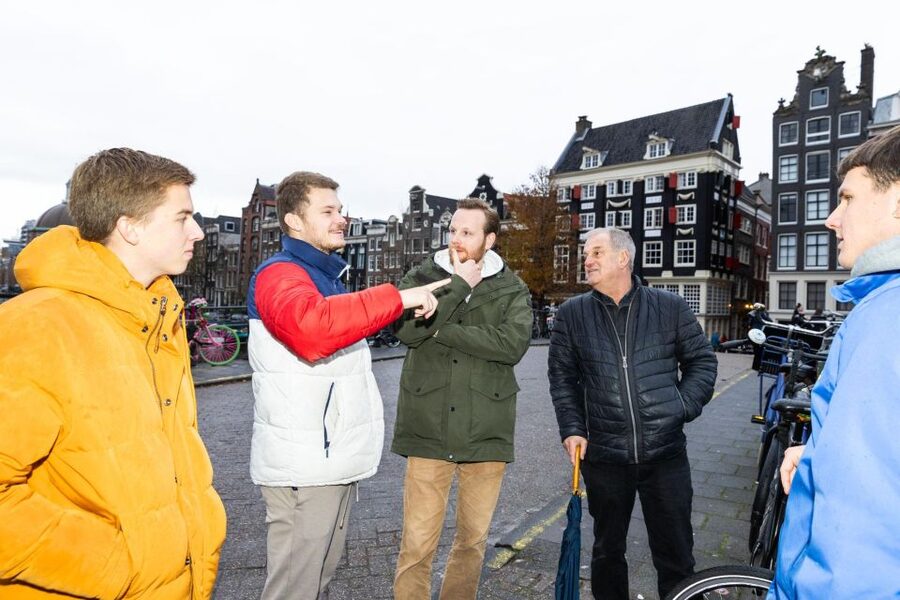
Amsterdam’s past was built on commerce, and the walk gives you several concrete examples. The herring trade receives its own stop, helping you see how food, shipping, preservation, and overseas trade shaped the city.
At Brouwersgracht, the subject changes to grain. Grain supplied Amsterdam’s breweries, and the canal carried goods to the businesses that turned them into beer. You also hear how this brewing culture helped give Amsterdam the nickname Booze Capital. It is a lively detail, but the larger point is serious: canals were working routes, not just scenic waterways.
The Koepelkerk adds another layer. This copper-clad Lutheran church has a story tied to a massive fire and the city’s ability to recover from disaster. The building is worth seeing for its unusual exterior, but the guide’s explanation gives it more weight than a quick photograph would.
Bridges, prisons, and Amsterdam’s grandest houses
At Jan Roodenpoortstoren, the guide points out what lies beneath the bridge, including historic prison cells. It is the kind of detail you can easily miss when crossing a canal on your own. Amsterdam’s bridges were not merely convenient ways to get from one street to the next. Some carried political, legal, and defensive functions too.
The Torensluis brings the city’s defenses into view. It is described as Amsterdam’s oldest bridge and was once part of the defensive wall. You get a strong sense of how compact the old city was, with water and fortifications controlling movement.
The Bartolotti House offers a sharp contrast. Here you see one of Amsterdam’s finest mansions and hear about the people and wealth behind it. Moving from prison cells to an elegant merchant house shows the gap between Amsterdam’s working population and its richest residents. That contrast is one of the strengths of this tour: it does not present the city as only picturesque or only prosperous.
Same country, a completely different kind of day:
- Amsterdam: Van Gogh Museum Ticket
★ 4.7 · 52,054 reviews - Amsterdam Classic Saloon Boat Cruise with Drinks and Cheese
★ 5.0 · 31,825 reviews - Amsterdam Luxury Canal Cruise + Unlimited Drinks & Bites option
★ 5.0 · 30,518 reviews - Amsterdam: Heineken Experience Ticket
★ 4.6 · 30,055 reviews
The Gay Monument and Anne Frank House
The Gay Monument provides an opportunity to learn about the struggles and victories of the Dutch LGBTQ+ community. The site marks the world’s first gay marriage, according to the tour information, and gives the walk a clear connection to modern rights and public memory.
You then reach the Anne Frank House area. The tour does not include entry to the museum, so this is an exterior and historical stop rather than a museum visit. Still, the location carries enormous weight. The guide places Anne Frank’s story and diary within the events of World War II, giving you time to reflect on the people who lived through that period.
If you hope to visit the Anne Frank House inside, arrange a separate ticket in advance. This walking tour should not be treated as a substitute for the museum. Its value here is the setting and the historical explanation, not admission.
Westertoren and the traditional brown café stop
The Westertoren is Amsterdam’s tallest church tower, and it is one of the route’s clearest visual markers. Your guide explains its place in the city’s past while you take in the tower from street level. The stop works well because it combines a major landmark with the surrounding streets of the former working-class Jordaan.
The Jordaan was once associated with working people, and the walk uses the district to show how Amsterdam’s social character changed over time. You get more than a list of buildings. You begin to see how neighborhoods carry traces of class, religion, labor, and later redevelopment.
The café break takes place at a traditional Dutch brown café. This is a useful pause, especially in winter, when two hours outdoors can feel longer than expected. Drinks are not included, so bring a payment method and consider the stop a chance to warm up rather than a provided refreshment.
The schedule appears to allow roughly two hours, though one cold afternoon tour finished after about one hour and 45 minutes. That small variation is not unusual for a walking outing, but it is worth remembering if you have a tightly timed reservation afterward.
Negen Straatjes and the changing Jordaan
The Negen Straatjes, or Nine Streets, once housed artisans and now contain boutiques and cafés. The area gives you a close look at Amsterdam’s shift from production and trade toward shopping, dining, and style.
I find this part most useful when you pay attention to the layers rather than only the storefronts. The narrow streets and canals still show the old city pattern, while the businesses reflect a newer Amsterdam. Your guide can help connect those two periods, which is more useful than simply being told that the area is fashionable.
This is also a place where the group may need to keep moving. The streets are narrow, and a group of 12 can take up space quickly. If you want time to browse shops or take photographs, plan to return later on your own.
Spuistraat, Spui, and Amsterdam’s protest culture
The walk presents Amsterdam’s squatting history along Spuistraat. This gives you a less polished view of the city and introduces the battles over vacant buildings, housing, ownership, and public space.
At Spui, you learn about the Provos, a movement connected with civil resistance, student protests, and cultural change. The Provo statue helps anchor the story in a physical place. This is one of the tour’s most distinctive subjects because it moves beyond standard sightseeing and shows Amsterdam as a city shaped by argument and public action.
The guide may also discuss politics and religion here. That wider conversation was a highlight of the tour led by Willem, who was praised for combining older events with current local insight and speaking excellent English. You should choose this walk if you enjoy asking questions and making connections between buildings and public life.
Kalverstraat and the finish at Dam Square
Kalverstraat is the Netherlands’ best-known shopping street, with upscale stores and heavy foot traffic. It is not the most atmospheric stretch of the route, but it shows another side of central Amsterdam: the city as a major retail center.
The walk ends at Dam Square, one of Amsterdam’s main public spaces. From there, you walk back to Yellow Bike at Nieuwezijds Kolk. Ending at a familiar place makes the route easy to manage, especially if you need to collect luggage or continue to another central attraction.
Do not expect a quiet finish. Kalverstraat and Dam Square can feel crowded, and the final section is more about orientation than intimate canal scenery. Still, the ending puts you in a useful location for the rest of your day.
What the guides add to the walk
The guide is the main reason to choose this experience over walking the same streets with a map. Yellow Bike is one of Amsterdam’s original tour companies and is run by locals. The tour is offered in Dutch or English, with a live guide rather than an audio recording.
Willem received particularly strong praise for being engaging, entertaining, and able to discuss history, politics, and religion in clear English. Another guide, Sid, led a tour that became a private outing when no other participants joined. That possibility cannot be guaranteed, but a small booking may create a more personal experience.
The feedback is not perfectly uniform. One three-star assessment described the tour as having little information and feeling disorganized. That is a useful warning. Guide-led walks can vary with the person leading them, the weather, group energy, and the exact route taken. The overall score is 4.9 from 11 reviews, with most ratings at five stars, but you should still book this for the chance to learn from a local guide, not for a fixed museum-style presentation.
Is $26 a fair price for two hours?
At $26 per person, the tour is reasonably priced for a two-hour guided walk in central Amsterdam. You are paying for a local guide, a compact route through many important areas, and the chance to ask questions in a small group. Free luggage storage adds practical value if you are carrying bags before check-in or after check-out.
The price is less attractive if you want entry to major sights. The Anne Frank House is seen from the outside, and no museum, church, or other admission is included. You also pay for your drink at the brown café.
I would view this as an orientation tour. It can save you time by showing how the old center fits together, then leave you with a better plan for independent visits. If you already know central Amsterdam well, the strongest reason to book is the social and political material, especially the Provo and squatting stories.
Who should book this Amsterdam walk?
This tour suits a first visit, a short stay, or anyone who wants the city explained by a local rather than reduced to a series of photographs. It is also a good choice if you like history that includes ordinary work, protest, religion, housing, and civil rights.
The two-hour length works well on a first morning or afternoon. You can use the walk to decide which areas deserve a second look. The small group limit is useful for solo visitors and couples who want a more personal exchange with the guide.
It is less suitable if you dislike outdoor tours in poor weather, need long stops at each landmark, or have mobility concerns. The walk goes ahead rain or shine. Wear comfortable shoes and bring warm clothing, a hat, gloves, and scarf in winter.
The information describes the activity as wheelchair accessible but also says it is not suitable for people with mobility impairments. Those statements do not provide enough detail about paving, steps, canal bridges, or the pace. If access is important for you, contact Yellow Bike before paying and ask for a route-specific answer.
Should you book it?
Book this walk if you want a compact introduction to Amsterdam that goes beyond canals and pretty façades. The strongest features are the small groups, local guides such as Willem and Sid, the unusual subjects at Spuistraat and Spui, and the mix of old commerce with modern social issues.
Skip it if you need museum admission, guaranteed private guiding, or a sheltered activity. For most first-time visitors, $26 is a fair way to get oriented, especially early in a stay. Bring warm clothes, accept that weather may be wet, and treat the café stop as a welcome pause rather than part of the price.
FAQ
Where does the Amsterdam Central Walking Tour start?
It starts at Yellow Bike, Nieuwezijds Kolk 29. Look for Yellow Bike and check in at the counter.
Where does the tour finish?
The walking route ends at Dam Square, and the group then walks back to Yellow Bike at Nieuwezijds Kolk 29.
How long does the walking tour last?
The stated duration is two hours. One tour finished after about one hour and 45 minutes, so allow a little flexibility afterward.
What languages are available?
The tour is offered in Dutch and English with a live guide.
How large is the group?
Groups are limited to a maximum of 12 participants and are often smaller.
Is a café drink included?
No. The tour includes a stop at a traditional Dutch café, but beverages are not included in the $26 price.
Does the tour enter the Anne Frank House?
No entry is included. You see the Anne Frank House as part of the walking route and learn about its World War II history.
Does the tour run in bad weather?
Yes. The walk takes place rain or shine, so bring warm clothing and suitable shoes.
What should I bring?
Bring comfortable shoes, warm clothing, a hat, gloves, and a scarf. These items are especially useful for a winter walk.
Can I cancel the booking?
You can cancel up to 24 hours in advance for a full refund. You can also reserve now and pay later, keeping your plans flexible.
Is the tour wheelchair accessible?
The activity information describes it as wheelchair accessible but also says it is not suitable for people with mobility impairments. Contact Yellow Bike before booking to confirm whether the route fits your needs.
Just added around Amsterdam
- Amsterdam: Giethoorn Tour with Canal Cruise and Windmills★ 5.0 · 3 reviews
- Full-day excursion to Edam, Volendam, and Marken★ 3.7 · 3 reviews
- Amsterdam: Chocolate Fondue in the Dark★ 5.0 · 3 reviews
- Amsterdam Family Friendly Historical Walking Tour★ 5.0 · 3 reviews
- Amsterdam Private Walking Tour of Famous Painters★ 5.0 · 3 reviews
- Amsterdam Old-West Vegan Food Tour with Local Guide★ 4.7 · 3 reviews
- From Amsterdam: visit Zaanse Schans, Muiderslot and more!★ 5.0 · 3 reviews
- Amsterdam: Beer Tasting with Paired Bites at Eighty-Four★ 5.0 · 3 reviews
Amsterdam Tours, compared.


Amsterdam Classic Saloon Boat Cruise with Drinks and Cheese
Read our review →
Amsterdam Luxury Canal Cruise + Unlimited Drinks & Bites option
Read our review →


Classic Boat Cruise with Optional Cheese & Wine
Read our review →
Evening Cruise with Optional Wine and Snacks
Read our review →
75 Minute City Canal Cruise with Audio Guide
Read our review →Browse the lists this tour appears in