
Reviewed · AMSTERDAM TOURS
Red Light District tour in Amsterdam
Amsterdam’s Red Light District tour is really a guided walk around the area, not a stroll through the working window district. Since 2020, city rules have barred guided groups from entering the core area, so the tour uses nearby streets and viewpoints to explain De Wallen, prostitution, coffee shops, and Amsterdam’s long experiment with tolerance.
I like the small group size, capped at 15, and the relaxed pace through places such as Dam Square, Warmoesstraat, Zeedijk, and Nieuwmarkt. I also like the human side of the subject: the tour discusses the legal status of prostitution and the problems sex workers face today, rather than treating the district as a sideshow.
The main thing to know is simple: you will not walk among the red-lit windows with the guide. Some people find the outside route a useful, respectful introduction. Others may feel they are getting a street lecture rather than the experience they expected.
Key things to know before you book
- The tour stays outside the core Red Light District: City regulations have prohibited guided tours inside the district since 2020.
- You receive a map at the end: It helps you visit the area independently after the guided portion.
- The route covers more than sex and drugs: Expect Amsterdam’s religious past, coffee shop culture, Chinatown, tolerance, and urban change.
- Guides shape the experience: Carlos, Manouk, David, Nadav, and Valeria are among the guides associated with this tour, though your guide is assigned rather than selected.
- The walk lasts about 90 minutes: It is mostly an easy city walk, but there are several stretches of standing while the guide talks.
- The price is $31.44 per person: That is fair if you want context and a chance to ask questions, but less attractive if you mainly want to see the windows themselves.
What this Amsterdam walk actually covers
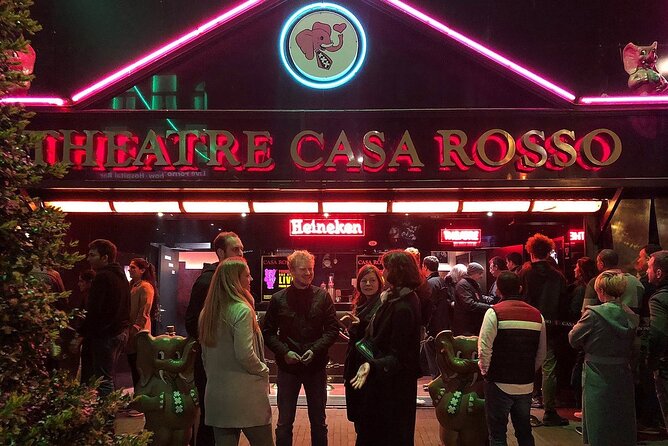
The tour begins at Bistro Berlage on Beursplein, close to Dam Square and easy to reach by public transport. Finding the precise meeting point can take a little effort, so I would allow extra time rather than arriving at the last minute.
From there, the group walks through the central area while the guide explains how Amsterdam developed its reputation for a liberal attitude toward sex. The discussion is not limited to sensational details. You hear how prostitution became connected with this part of town, why sex workers settled near a sacred site, and how the area changed over time.
That setting matters. The Red Light District is not an isolated entertainment zone created for modern visitors. It is part of the old city, with churches, canals, historic streets, homes, restaurants, and ordinary daily life packed close together. The contrast between religious buildings and commercial sex is one of the tour’s central themes.
The pace is designed to be manageable. You move between stops, then pause for explanations and questions. One guide may finish close to the full 90 minutes, while another may complete it in about an hour if the group asks fewer questions. That variation is worth keeping in mind if you are planning a tight evening schedule.
More Red Light District walks:
- Amsterdam: Red Light Secrets Museum Entry Ticket
★ 4.2 · 5,722 reviews - Amsterdam: Red Light District Tour in German/English/Italian
★ 4.9 · 5,623 reviews - Amsterdam Red Light District & Coffee Shop Tour
★ 4.6 · 4,134 reviews
De Wallen and the story behind the district
The first main stop is De Wallen, Amsterdam’s best-known Red Light District. The guide explains the district’s history and the reasons prostitution became established in this location.
The most useful part is the attempt to explain the area as a working neighborhood shaped by trade, religion, law, and social custom. You learn why Amsterdam came to be associated with tolerance and how that reputation relates to sex and drugs.
This is also where expectations matter most. You will be near the district and may catch views toward its streets, but the group does not enter the central window area. The guide cannot take you through it, point out individual sex workers, or lead you into the district as a sightseeing procession.
That restriction can feel disappointing if you booked this mainly for access. Still, it creates a more respectful format. You receive context without turning working people into a backdrop for group photos. The map supplied at the end lets you decide if you want to explore on your own, quietly and within local rules.
Dam Square and the roots of coffee shop culture
At Dam Square, the focus shifts to the origins of the coffee shop concept and the idea of tolerance in Amsterdam. The square is one of the city’s most important public spaces, so it gives the guide a useful place to connect local policy with the broader story of Amsterdam.
You will hear about a time when the square represented freedom and tolerance. The tour also explains how coffee shops became part of the city’s cultural identity and discusses their legal status.
Do not expect a long stop inside a coffee shop. This is an outdoor walking tour, and the emphasis is explanation rather than consumption. That makes it useful for first-time visitors who want to understand the difference between Amsterdam’s reputation and the rules that govern the city today.
I like this part because it places coffee shops in a social and political context. Without that background, it is easy to treat them as a novelty. The guide instead connects them to Amsterdam’s approach to regulation and public behavior.
Warmoesstraat and the Old Church
Warmoesstraat is one of Amsterdam’s oldest streets and now functions as an entertainment center. The group pauses here to connect the old street pattern with the modern district.
You also get a glimpse of the Old Church, one of the most striking reminders that this area has religious roots as well as commercial ones. The tour uses that contrast well: sacred buildings, nightlife, prostitution, and tourism all share a small section of the historic center.
This stop is short, listed at about 10 minutes, but the idea is important. The Red Light District is not just a row of windows. Its identity comes from layers of city life placed side by side.
The drawback is that much of the experience depends on the guide’s storytelling. A strong guide can make a short street corner interesting by explaining how the pieces fit together. A less engaging presentation may feel like facts you could have found with a quick search. Guide quality is therefore a bigger part of the value than the number of sights covered.
A few more Amsterdam trips worth a look
- Amsterdam: Van Gogh Museum Ticket
★ 4.7 · 52,054 reviews - Amsterdam Classic Saloon Boat Cruise with Drinks and Cheese
★ 5.0 · 31,825 reviews - Amsterdam Luxury Canal Cruise + Unlimited Drinks & Bites option
★ 5.0 · 30,518 reviews - Amsterdam: Heineken Experience Ticket
★ 4.6 · 30,055 reviews
Zeedijk and Amsterdam’s Chinatown
The route continues to Zeedijk, an area associated with Amsterdam’s Chinatown. The guide explains how the street was once regarded as one of the city’s most dangerous places during the 1970s, then describes its decline and later transformation into a favorite spot for local residents.
This is a welcome change of subject. It shows how city districts can shift from fear and neglect toward everyday use and renewed appeal. It also gives you a wider view of Amsterdam’s center, beyond the sex industry.
Some people may not expect Chinatown to be included, but it is part of the stated route and is officially treated as part of the Red Light District area for this tour. If you want a narrow, sex-focused walk, this section may feel like a detour. If you want to understand the neighborhood as a whole, it adds useful context.
The walk through Zeedijk also helps break up the more serious discussion. You are not standing in one place for the entire tour, though several stops involve listening on the street.
Nieuwmarkt and the human cost of legalization
At Nieuwmarkt, the guide discusses the legalization of prostitution and the challenges sex workers face today. This is the point where the tour moves beyond Amsterdam’s famous image and asks harder questions about how legal systems work in real life.
Legalization does not remove every problem. The guide addresses the pressures and difficulties that remain for people working in the industry, giving the subject a more human and less tourist-focused frame.
I consider this one of the most valuable stops because it keeps the tour from becoming a string of amusing facts. You are encouraged to think about safety, rights, public policy, and the people who live and work in the district.
The subject matter is adult and direct. One person found some topics too inappropriate, even for this setting. That is a fair warning. You should book only if you are comfortable discussing prostitution and drug policy openly, with a group that may ask frank questions.
Kloveniersburgwal and coffee shop rules
The brief stop at Kloveniersburgwal returns to coffee shops and their place in Amsterdam’s culture. The guide explains what makes these establishments well known and outlines their legal status.
Because this stop is only about five minutes, it is more of a compact explanation than a full lesson. The details you take away will depend on the questions asked and the guide’s ability to explain a complicated topic clearly.
This is where guides with a local connection can make a difference. Manouk, for example, has been described as living in the district and bringing personal familiarity with the area. Other named guides include Carlos, David, Nadav, and Valeria. You should not assume you will receive a particular guide, but the range of styles means the tone can vary from humorous and lively to more factual.
Paulusbroederssluis and the self-guided finish
The final stop is Paulusbroederssluis, where you receive a map with information about the Red Light District. The guided portion ends back at the meeting point, but the map gives you a way to continue on your own.
This arrangement is central to the experience. The guide provides the background and boundaries, then you choose if you want to visit the district independently. You can use the information to get your bearings, decide what interests you, and avoid wandering without understanding the setting.
The map does not turn the guided tour into an inside visit. It is simply a practical handoff from the guide to your own exploration. You should still behave discreetly, avoid photographing sex workers, and remember that this is also a residential and working neighborhood.
A small gift is included as well. Past groups have received playful gummy sweets shaped like body parts. It is a cheeky finish, and not everyone will find it tasteful, but it fits the adult theme and is meant as a light moment after a serious discussion.
Guide style, group size, and walking pace
The maximum group size is 15 people, which is a useful limit for narrow central streets and question time. Smaller groups can feel much more personal, especially when the topic is sensitive or you want to ask about local customs.
The strongest guides make the tour feel open and safe. Manouk has been praised for combining humor, empathy, local experience, and patience. David has been described as personable and comfortable answering questions about Amsterdam’s customs and even unexpected subjects such as canal engineering. Carlos is often presented as funny and well informed, though one person found his pace quick and his delivery too fast.
That range gives you a realistic picture. The tour is not a fixed audio program. It depends on who leads it, how many questions the group asks, and how quickly the group walks.
Amsterdam is largely flat, so the route is not demanding for most people with moderate physical fitness. You should still wear comfortable shoes and prepare to stand outside. Rain and snow can affect the experience, though guides may adjust the pace when conditions are poor.
Is $31.44 a fair price?
At $31.44 per person, this is reasonably priced for a 90-minute small-group walking tour in central Amsterdam. You are paying for a guide, focused subject matter, question time, the map, and a small gift.
The value is strongest if you want a clear introduction before exploring the district alone. A guide can help you understand why the area developed as it did, what coffee shops mean in the city, and why the legal framework is more complicated than the usual tourist shorthand.
The value is weaker if your main goal is to walk inside the core Red Light District with a guide. That is not possible under the current rules, and no tour operator can provide that part legally. If you only want a quick look at the windows, you may prefer to walk the area independently and spend the $31.44 elsewhere.
The tour is also less appealing if you already know Amsterdam’s sex and drug policies well. Some explanations may overlap with a general city walk. Its advantage is focus, not exclusive access.
Who should book this experience?
I would suggest it to first-time visitors who want a respectful introduction to De Wallen and do not want to wander into the area without context. It suits curious adults, couples, and small groups who enjoy asking questions and hearing the social background behind famous city customs.
It also works for people who are unsure how to approach the district. The guide can explain what the area is, how it functions, and what to expect if you return independently.
I would be more cautious if you want a fast-moving sightseeing walk with lots of entrances and attractions. The tour includes several standing stops, and one person found it more like a lecture than a walk. It may also disappoint anyone who assumes the guide will lead the group through the working window streets.
Free cancellation is available when you cancel at least 24 hours before the start time. The activity is offered in English, uses a mobile ticket, allows service animals, and operates near public transport.
My practical verdict
Book this tour if you want background, balance, and a map for independent exploring. It gives you a useful framework for understanding Amsterdam’s most misunderstood neighborhood and treats prostitution and coffee shops as real social subjects rather than cheap punchlines.
Skip it if you expect direct access to the central Red Light District or a tour built around seeing sex workers. The city rules make that impossible, and the outside route should be clear before you pay.
For the right person, $31.44 is a sensible way to get oriented, ask uncomfortable questions, and see the district with more respect. Just arrive early for the meeting point, wear shoes suited to city streets, and think of the experience as a guided introduction followed by optional self-guided exploration.
FAQ
Does the tour enter Amsterdam’s Red Light District?
No. Guided tours have been prohibited inside the Red Light District since 2020, so this experience follows the outskirts and provides views and explanations from nearby streets.
How long does the walking tour last?
The advertised duration is about 1.5 hours. It can sometimes finish closer to one hour if the group has fewer questions or moves quickly.
What language is the tour offered in?
The tour is offered in English.
Where does the tour start?
The meeting point is Bistro Berlage, Beursplein 1, 1012 JW Amsterdam, Netherlands.
Where does the tour end?
The activity ends back at the meeting point.
Is the tour physically difficult?
You need a moderate level of physical fitness. Amsterdam is largely flat, but the experience includes walking between stops and standing while the guide speaks.
What is included in the booking?
The booking includes a 1.5-hour walking tour, a map with information for the final self-guided stretch, and a small gift. A mobile ticket is provided, and service animals are allowed.
Just added around Amsterdam
- Amsterdam: Giethoorn Tour with Canal Cruise and Windmills★ 5.0 · 3 reviews
- Full-day excursion to Edam, Volendam, and Marken★ 3.7 · 3 reviews
- Amsterdam: Chocolate Fondue in the Dark★ 5.0 · 3 reviews
- Amsterdam Family Friendly Historical Walking Tour★ 5.0 · 3 reviews
- Amsterdam Private Walking Tour of Famous Painters★ 5.0 · 3 reviews
- Amsterdam Old-West Vegan Food Tour with Local Guide★ 4.7 · 3 reviews
- From Amsterdam: visit Zaanse Schans, Muiderslot and more!★ 5.0 · 3 reviews
- Amsterdam: Beer Tasting with Paired Bites at Eighty-Four★ 5.0 · 3 reviews
Amsterdam Tours, compared.


Amsterdam Classic Saloon Boat Cruise with Drinks and Cheese
Read our review →
Amsterdam Luxury Canal Cruise + Unlimited Drinks & Bites option
Read our review →


Classic Boat Cruise with Optional Cheese & Wine
Read our review →
Evening Cruise with Optional Wine and Snacks
Read our review →
75 Minute City Canal Cruise with Audio Guide
Read our review →Browse the lists this tour appears in