
Reviewed · AMSTERDAM TOURS
Amsterdam in World War Two Cycle Tour
Amsterdam’s World War Two story is written into ordinary streets, apartment blocks, school buildings, and quiet squares. This small-group bike tour takes you through Amsterdam South, where the past is easier to see when you stop beside the actual houses and compare them with wartime photographs.
I like the maximum of six people, which gives Rudy, and sometimes Peter, room to answer questions and tell personal stories from neighborhoods where Rudy grew up. I also like the use of old photographs at present-day locations. The main drawback is that you need to be comfortable cycling for roughly three hours, and the tour focuses on Amsterdam South rather than the city center.
Key points to know before you book
- See the former Frank family home at Merwedeplein, along with the bookstore where Otto Frank bought Anne’s diary.
- Use wartime photographs at the exact sites, including resistance locations and former Nazi offices.
- Cycle through quieter Amsterdam South, covering more ground than you could on foot.
- Visit places tied to the 1943 roundup, the Dutch resistance, Nazi administration, and the final days of the occupation.
- Ride with no more than six people, making it easier to follow the guide and ask questions.
- Bring your own bike, meet at Tesselschadestraat at 11:00 a.m., and plan for about 2 hours 30 minutes to 3 hours 10 minutes.
Why Amsterdam South tells the war story so well
This is not a tour of grand memorial halls or famous city-center monuments. You ride through residential Amsterdam, past streets that still look much as they did during the occupation. That gives the experience its force. A normal apartment entrance can become the place where a family once lived, hid, resisted, or disappeared.
The route begins at Tesselschadestraat 1, near Leidseplein, at 11:00 a.m. The first historical stop is Victorieplein, then called Daniël Willinkplein. From there, the tour moves through the southern districts before returning toward Leidseplein through Vondelpark.
Cycling matters here. The route covers a broad area, including Merwedeplein, Museumplein, Beethovenstraat, Olympiaplein, and the streets around the Amsterdam Lyceum. You would spend much longer walking between these points, and a bus would make it harder to pause at smaller sites. A bicycle lets you stop at a street corner, look at a photograph, and continue without losing the thread.
You should also expect an outdoor history lesson rather than a polished museum presentation. The value comes from the guide’s explanations, the location-by-location route, and the visual material. Rudy is described as a lifelong local and history professor, and he brings a personal connection to the neighborhoods. Peter may also guide the tour.
More Bike Tours in Amsterdam
- Amsterdam: Guided Bike Tour City Centre in EN/DE/FR/ES
★ 4.7 · 4,187 reviews - Countryside Bike Tour from Amsterdam: Cheese, Clogs & a Windmill
★ 5.0 · 1,485 reviews - Amsterdam: Hidden Gems & Highlights Guided Bike Tour
★ 4.8 · 1,404 reviews
Victorieplein and the June 1943 raid
Victorieplein is a sobering opening. On June 20, 1943, a major raid took place in Amsterdam. Jewish residents were arrested in large numbers at the foot of the Skyscraper, then known as Daniël Willinkplein.
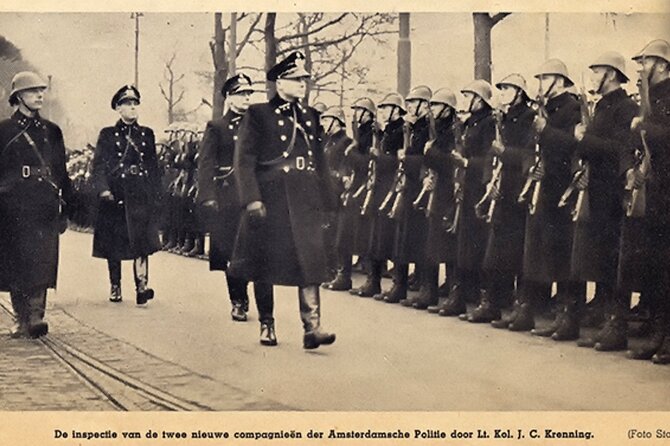
Dutch police units, including the Amsterdam Police Battalion, and police volunteers linked to the Dutch National Socialist Movement helped the German authorities. Those arrested were taken to places including Olympiaplein for registration before being transported to Westerbork concentration camp in the east of the Netherlands.
This stop gives you an early sense of the tour’s method. The focus is not only on German orders, but also on Dutch participation and the machinery needed to carry them out. That distinction matters. The occupation was imposed by Nazi Germany, but local institutions and collaborators also played a role.
The location today is an ordinary city square. That contrast can be difficult, but it is exactly why the stop works. You are asked to picture a mass arrest in a place now used for daily life.
Merwedeplein, Anne Frank’s family, and the diary
At Merwedeplein 37-II, on the third floor by American counting, the Frank family lived before going into hiding. In the summer of 1942, Otto Frank moved his family and several acquaintances into the Secret Annex on Prinsengracht, where his company was based.
A statue of Anne Frank now marks the square. The stop also connects the family story with a nearby bookstore, Jimmink, on Waalstraat. The shop is still active, and Otto Frank bought Anne’s diary there for his daughter. The first edition of Het Achterhuis was later published by Contact in 1947.
This is one of the most important stops for many people, but the guide does not treat Anne Frank as the whole story of wartime Amsterdam. Instead, her former home becomes one part of a wider account involving deportation, resistance, collaboration, and survival.
You will want to allow yourself a quiet moment here. Merwedeplein is not the Secret Annex, and this visit does not replace the Anne Frank House. It gives you another part of the family’s story, the life they had before hiding and the neighborhood where Otto Frank bought the book that became Anne’s diary.
The Tilex Bar and Lex van Weren’s survival
Across from Merwedeplein, at Waalstraat 48, Café Blek occupies the site of the former Tilex Bar, named for Tilly and Lex van Weren. Lex survived Auschwitz because he was required to play his trumpet at executions.
It is a grim and startling detail, and it shows how survival could depend on a person’s skill being useful to the people running the camp. This stop is brief in physical terms, but it adds a personal story to the larger account of persecution.
The tour often works best when you listen for these smaller stories. They prevent the war from becoming a list of dates and military movements. You hear about individuals, families, artists, police officers, resistance workers, and collaborators, all connected to streets you can still visit.
Same country, a completely different kind of day:
- Amsterdam: Van Gogh Museum Ticket
★ 4.7 · 52,054 reviews - Amsterdam Classic Saloon Boat Cruise with Drinks and Cheese
★ 5.0 · 31,825 reviews - Amsterdam Luxury Canal Cruise + Unlimited Drinks & Bites option
★ 5.0 · 30,518 reviews - Amsterdam: Heineken Experience Ticket
★ 4.6 · 30,055 reviews
Police barracks at Cornelis Troostplein
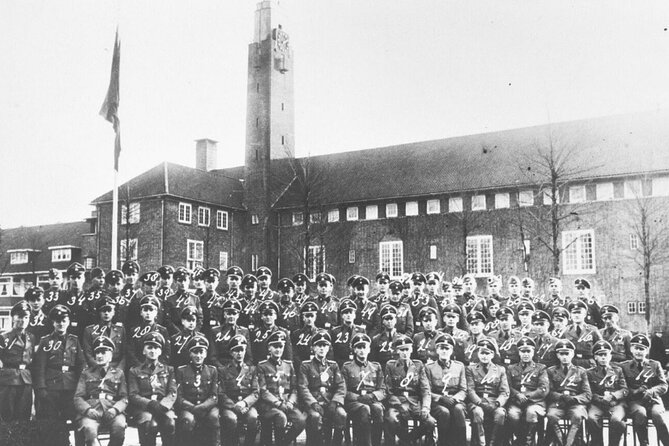
Cornelis Troostplein 23 once housed the Amsterdam police battalion barracks. Before the war, the complex was known as the Peace Parish, a Catholic site with two convents and a school.
In spring 1942, Sicherheitsdienst and Gestapo chief Hanns Albin Rauter inspected the police battalion and met Heinrich Himmler at Museumplein. The stop points to the way German security forces worked with Dutch police structures during the occupation.
Again, the setting is not a preserved wartime compound. You see a modern neighborhood and need the guide’s photographs and explanation to understand what occupied the site. This is one reason the quality of the guide matters so much. Rudy’s local knowledge helps connect the present street plan with the events that took place there.
Coffee at Roelof Hartplein
At Roelof Hartplein, Café Wildschut provides a short break of about ten minutes for coffee and a restroom visit. The admission cost is listed as free, but you should not assume that refreshments are included in the tour price.
This pause is practical. Three hours on a bicycle, especially while listening closely, is easier with a moment to sit and reset. It also breaks up the heavier material before the route continues into resistance history.
The nearby Roelof Hartstraat has its own important story. A photo shop beside the library building was used by the Dutch resistance to develop photographs, including images by Charles Breijer. Those photographs documented the first roundup of Jews in Amsterdam by the SD, Gestapo, and German order police.
You will also see a small monument remembering Jewish people taken from the neighborhood. It is easy to miss such a marker when walking or cycling alone. With the guide, it becomes part of the route rather than an anonymous object passed on the way to somewhere else.
Beethovenstraat and the cost of retaliation
At the corner of Beethovenstraat and Apollolaan, the guide discusses an execution in late October 1944. In front of approximately number 6, Dutch resistance killed Herbert Oelschlägel, an SS officer and SD or Gestapo agent.
The German response was brutal. Two houses were burned, and 29 resistance fighters were executed. The fact that many house numbers remain the same as during the war helps you place the event with unusual precision.
This is an important point for keeping the story balanced. The resistance fought an oppressive regime, but its actions could bring immediate danger to nearby families and buildings. You are not given a simple tale of heroes and villains. You are shown choices made under pressure, and the severe punishment imposed by the occupiers.
Euterpestraat and Gerrit van der Veen
The street now known as Gerrit van der Veenstraat was called Euterpestraat during the occupation. Gerrit van der Veen led an important Dutch resistance group and is remembered in the street name.
Names on street signs can carry history, but only if you know why they are there. This stop gives you that context. You see how Amsterdam later chose to remember resistance figures in the city’s own geography.
The tour’s photographs are especially useful in places like this. A present-day street can look calm and unchanged, while a wartime image reveals uniforms, barricades, damaged buildings, or an entirely different use of the same address.
Nazi offices and the resistance attack
At the corner of Memlingstraat and Rubensstraat, two organizations involved in Nazi repression operated from offices. One was the Amsterdam headquarters of the SD, under Willy Lages. The other was the Hausraterfassungsstelle, which catalogued and stole the possessions of deported Jewish people.
The property office was linked to the Central Jewish Emigration Office, and its leader was a Dutch collaborator named Henneicke. This part of the tour shows that persecution involved more than arrest and deportation. Homes were emptied, belongings recorded, and property taken.
In November 1944, the Dutch resistance asked the Royal Air Force to attack these headquarters. A secret radio message requested the strike because destroying SD and Gestapo files was a main goal. Group Captain Denys Gillam, leader of 149 Typhoon Wing, carried out the attack.
Nearby, at the corner of Rubensstraat and Gerrit van der Veenstraat, a resistance safehouse is marked by a Stolperstein, or stumbling stone. In June 1944, a female informant working for the SD and Gestapo betrayed the address.
This section may be the most rewarding for people interested in resistance work. You see how intelligence, secret addresses, photography, radio messages, and air attacks were connected. You also see the danger within the resistance itself, where one betrayal could expose an entire network.
Olympiaplein and the machinery of deportation
At Olympiaplein and Parnassusweg, Jewish people arrested during the June 1943 raid were registered at a sports complex. The SD and Gestapo carried out the registration with help from Jewish camp police sent from Westerbork.
The use of a sports site for this purpose is unsettling. It shows how ordinary public places could be turned into holding and processing areas. A square used for recreation became part of a system that sent people toward deportation.
This stop also returns you to the opening story at Victorieplein. The route is not a collection of unrelated addresses. It traces how arrests, registration, police work, deportation, and local administration fitted together.
The Amsterdam Lyceum and Queen Emma’s statue
At Valeriusplein, the Amsterdam Lyceum building served as Luftwaffe headquarters late in the occupation. The stop is another reminder that schools, houses, offices, and civic buildings could be taken over for military use.
The route then reaches the statue of Queen Emma on the corner of Emmalaan and Prins Hendriklaan. In summer 1940, people placed flowers at the statue as an act of defiance against the German occupiers.
Nearby, the guide recalls Charles Breijer, one of the resistance photographers. He photographed a guard at the Kriegsmarine headquarters in 1944. His work connects the quiet act of placing flowers with the more dangerous work of secretly recording German occupation.
These stops shift the mood. Earlier points focus on arrests, theft, and murder. Here, you see symbolic resistance and covert documentation. Not every act of opposition involved weapons. Sometimes a public gesture or a hidden camera carried its own risk.
The final shootings of May 7, 1945
The tour’s last historical point concerns the German surrender on May 7, 1945. The surrender did not make every street safe at once. Frustrated German troops and resistance fighters faced one another, and dangerous confrontations followed.
A monument here remembers victims of one of the shootings on the final day. It is a fitting end because it complicates the usual image of liberation as an instant moment of celebration. The occupation ended, but fear and violence did not disappear on a precise timetable.
From here, the guide takes you through Vondelpark toward Leidseplein, near the starting point. The listed duration is approximately 2 hours 30 minutes to 3 hours 10 minutes, so leave room in your schedule for the longer estimate.
What the $66.09 price gets you
At $66.09 per person, this tour is not the cheapest way to see Amsterdam. You are paying for a small group, a carefully planned route, a guide with local ties, and historical photographs that make the stops easier to understand.
The group limit of six is a real part of the value. On a large city tour, you may struggle to hear at a street corner or hesitate to ask a detailed question. Here, the format is better suited to discussion and personal stories.
You should also compare the price with what you want from a WWII tour. If you prefer a large museum with artifacts, captions, and indoor exhibits, this may not be your first choice. If you want to connect history with actual addresses and cover a wider area by bicycle, the price is more reasonable.
The tour is offered in English and includes a mobile ticket. Free cancellation is available up to 24 hours before the start time. The tour is listed as suitable for most people, but you should be ready to cycle and listen outdoors for several hours.
Who should book this bike tour
I would choose this tour if you have already seen Amsterdam’s central sights and want a more focused look at the occupation. It is also a strong choice if you prefer local neighborhoods to crowded landmark routes.
The tour suits:
- Adults and older teenagers interested in World War Two, Anne Frank, or the Dutch resistance.
- Cyclists who want to cover Amsterdam South efficiently.
- Visitors who learn best from photographs and real locations.
- People who prefer a small group and plenty of opportunity for questions.
- Anyone curious about Dutch collaboration as well as resistance.
I would think twice if you are uncomfortable cycling, want a fully indoor activity, or have only a short time in Amsterdam and need to stay near the central canal belt. The tour does not include the Anne Frank House, and it is not designed as a general introduction to Amsterdam’s main sights.
Should you book the Amsterdam WWII Cycle Tour?
Book it if you want the occupation explained street by street, with wartime photographs held up beside the places they show. Rudy’s connection to Amsterdam South adds something difficult to reproduce on a standard sightseeing route, especially when he links public events with family and neighborhood stories.
The strongest reasons to go are the six-person limit, the exact-location photographs, and the route’s coverage of places most visitors would not find on their own. Bring your bike, meet at Tesselschadestraat at 11:00 a.m., and reserve enough time for a thoughtful, sometimes painful history lesson on two wheels.
FAQ
Where does the Amsterdam WWII Cycle Tour start?
The meeting point is Tesselschadestraat 1, 1054 ET Amsterdam. The tour starts at 11:00 a.m.
Where does the tour end?
The activity ends back at the meeting point. The final ride goes through Vondelpark toward Leidseplein.
How long does the bike tour last?
The tour takes approximately 2 hours 30 minutes to 3 hours 10 minutes.
How many people can join the tour?
The tour has a maximum of six participants.
Is the tour offered in English?
Yes. The tour is offered in English, and a mobile ticket is available.
Can I cancel for a full refund?
Yes. You can cancel up to 24 hours before the experience start time for a full refund. Cancellations or changes made less than 24 hours in advance are not accepted or refunded.
Just added around Amsterdam
- Amsterdam: Giethoorn Tour with Canal Cruise and Windmills★ 5.0 · 3 reviews
- Full-day excursion to Edam, Volendam, and Marken★ 3.7 · 3 reviews
- Amsterdam: Chocolate Fondue in the Dark★ 5.0 · 3 reviews
- Amsterdam Old-West Vegan Food Tour with Local Guide★ 4.7 · 3 reviews
- Amsterdam Private Walking Tour of Famous Painters★ 5.0 · 3 reviews
- Amsterdam Family Friendly Historical Walking Tour★ 5.0 · 3 reviews
- From Amsterdam: visit Zaanse Schans, Muiderslot and more!★ 5.0 · 3 reviews
- Amsterdam Walking Tour with Dutch Pancake Lunch★ 5.0 · 3 reviews
Amsterdam Tours, compared.


Amsterdam Classic Saloon Boat Cruise with Drinks and Cheese
Read our review →
Amsterdam Luxury Canal Cruise + Unlimited Drinks & Bites option
Read our review →


Classic Boat Cruise with Optional Cheese & Wine
Read our review →
Evening Cruise with Optional Wine and Snacks
Read our review →
75 Minute City Canal Cruise with Audio Guide
Read our review →Browse the lists this tour appears in