
Reviewed · AMSTERDAM TOURS
Amsterdam: Private Pedicab Historical Sightseeing Tour
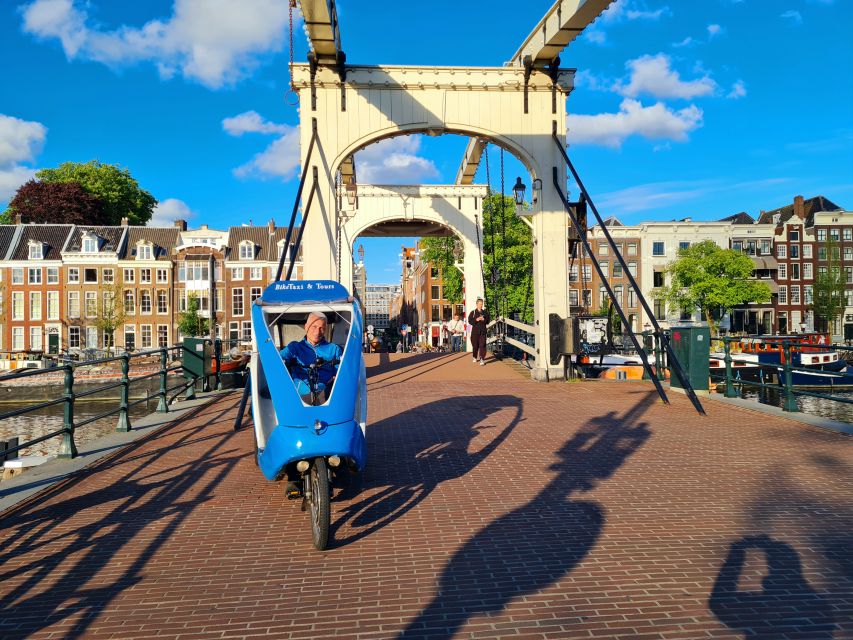
Amsterdam’s old centre is best understood at street level, and this private pedicab tour gives you a comfortable way to cover a lot of ground. You’ll move from Dam Square through the canal ring, Jewish Quarter, Chinatown and Museumplein without spending two hours on foot or squeezing into a large group.
I like the personal guiding from Amsterdam local Bram de Haan, especially his use of maps and old photographs to explain how the city grew. I also like the easy access: the pedicab can use streets that cars cannot, and hotel pickup makes this a simple first outing after arrival.
The main drawback is the price, $230 for up to two people, which is a serious spend for a two-hour tour. You’ll also need to consider the 200-kilogram combined passenger limit and bring warm clothing, since you are outside for the whole ride.
Key points to know before booking

- Dam Square sets the story: Begin at the birthplace of Amsterdam, with the Royal Palace, Nieuwe Kerk and National Monument in view.
- One ride covers several districts: See the old centre, canal ring, Jewish Quarter, Chinatown and Museumplein without a long day of walking.
- Bram adds visual context: Maps, photographs and local knowledge help explain how Amsterdam changed over time.
- The Skinny Bridge brings the best river view: Pause above the Amstel for photographs and a wide view of Amsterdam’s main waterway.
- Good for limited mobility: The pedicab reduces walking, though you still need to get in and out at stops.
- It is a private tour for two: You can arrange a preferred end point in advance, and the guide speaks English, Dutch or German.
A gentle start at Dam Square
The tour begins at Dam Square, the central stage of Amsterdam’s old centre. This is where the city’s story begins, and it remains one of the easiest places to understand the relationship between commerce, government and religion in the Dutch capital.
From the pedicab, you’ll see the Royal Palace, the Nieuwe Kerk and the National Monument. The square itself can feel busy, but the advantage of a private ride is that Bram can explain what you are looking at without forcing you to keep pace with a walking group.
This is a useful opening stop for first-time visitors. You get the basic city story before moving into smaller streets and older neighborhoods. If Amsterdam is your first stop in the Netherlands, this quick orientation can help the rest of your sightseeing make more sense.
More History Tours in Amsterdam
- Amsterdam Food and Cultural Tour with Tastings
★ 5.0 · 2,442 reviews - Amsterdam: Haunted History and Ghost Walking Tour
★ 4.5 · 488 reviews - Amsterdam High-End Dutch Food & History Tour – Up to 8 guests
★ 5.0 · 482 reviews
Zeedijk, Chinatown and the old city edge
The pedicab next heads to Zeedijk. The name refers to a sea dike, a reminder that Amsterdam was once a vulnerable settlement surrounded by water and low ground. Today it is a city street, but its name preserves the practical problem that shaped the city.
Here you can see one of Amsterdam’s oldest surviving cafés, still carrying its original interior. The tour also offers a glimpse of Chinatown nearby. This is not a long food stop, and food and drinks are not included, but the area adds another layer to the city’s identity.
I like this part because it moves beyond the postcard canal view. You are seeing an old defensive edge, a traditional café and a neighborhood shaped by migration, all within a short ride. Keep your camera ready, but listen closely too. The short stops are meant to explain the city rather than provide a long break at each site.
New Market and the medieval city gate

At New Market Square, the focus turns to Amsterdam’s medieval past. The square’s central building is a 15th-century city gate, a sturdy reminder that the city once had a clear boundary and defensive structure.
This stop works well because the setting is easy to read. You can look at the gate and imagine the older city arranged around it, then compare that compact centre with the much larger Amsterdam you see today.
The pedicab also saves energy here. New Market is close to several other sights, but walking between them can involve cobbled streets and crowded routes. You can concentrate on Bram’s explanation rather than watching every step.
Montelbaanstoren and the Oude Waal
A few minutes later, the ride reaches Montelbaanstoren, an old watch and defense tower linked to Amsterdam’s early 16th-century expansion. It is a strong visual marker, and the nearby view gives you a different side of the city.
From here, look toward the Oude Waal, where houseboats sit along the water with 17th-century canal houses behind them. This combination is very Amsterdam: working water, floating homes and merchant-era architecture sharing the same frame.
The view is especially useful for understanding how the canals functioned as more than pretty scenery. They were transport routes, defensive lines and addresses for successful residents. Modern houseboats add a contemporary use of the water without erasing the older buildings behind them.
Same country, a completely different kind of day:
- Amsterdam: Van Gogh Museum Ticket
★ 4.7 · 52,054 reviews - Amsterdam Classic Saloon Boat Cruise with Drinks and Cheese
★ 5.0 · 31,825 reviews - Amsterdam Luxury Canal Cruise + Unlimited Drinks & Bites option
★ 5.0 · 30,518 reviews - Amsterdam: Heineken Experience Ticket
★ 4.6 · 30,055 reviews
The Jewish Quarter and Amsterdam’s wartime memory
The Jewish Quarter is one of the most serious parts of the tour. You’ll see the Big Synagogue, described as the first synagogue Jewish people were permitted to build in Western Europe more than 350 years ago. Across the street is the Portuguese Synagogue.
Nearby, the Holocaust Names Monument records the names of Dutch Jewish victims of the Second World War on 102,000 bricks. The scale of that number is difficult to absorb from a guidebook page. Seeing the names arranged in one place gives the past a human and physical presence.
Opposite the monument are 17th-century canal houses once inhabited by successful Sephardic Jewish immigrants involved in the diamond trade. This makes the stop more than a lesson in tragedy. You also see evidence of Jewish life, enterprise and religious practice before the devastation of the war.
Bram’s historical explanations are especially valuable here. One of the strongest parts of this tour is the way he connects buildings to events, using photographs and maps to show how Amsterdam developed and how the city was affected during the German occupation.
The Hermitage and Amsterdam’s widow house
The next landmark is the Hermitage, housed in a large 17th-century widow house. The building’s former purpose gives you a useful glimpse of social life in Amsterdam’s prosperous period, when charitable institutions and wealthy benefactors shaped the city’s buildings.
You may not have time to visit the museum itself during this tour. That is not a flaw, but it is important to understand the format. This is a sightseeing and orientation ride, not a museum tour. You are seeing the exterior, learning its story and noting places you may want to return to later.
For a first visit, that division of labor works well. The pedicab introduces the city, while you can reserve separate time for the Rijksmuseum, Van Gogh Museum or other interiors.
The Skinny Bridge and the Amstel
The Skinny Bridge is one of Amsterdam’s most recognizable bridges. Its narrow design is picked out by hundreds of light bulbs after dark, although this two-hour tour does not promise an evening departure or nighttime lighting.
The bridge gives you a broad view over the canalized Amstel, Amsterdam’s main and widest canal. This is one of the best points on the route for photographs. The water, bridge and surrounding buildings create the classic Amsterdam scene, but the guide’s explanation helps you see the river as part of the city’s structure rather than just a photo background.
I would pay attention to the timing here. You may want to ask Bram for a moment to take pictures, since the listed route includes stops and the private format allows room for questions. A private guide is most useful when you speak up about what interests you.
Through the 17th-century canal ring
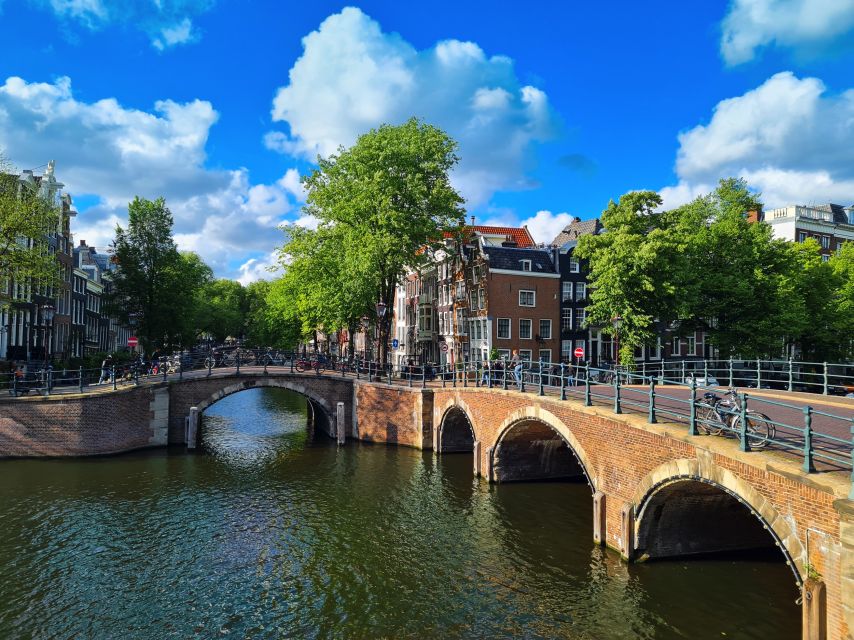
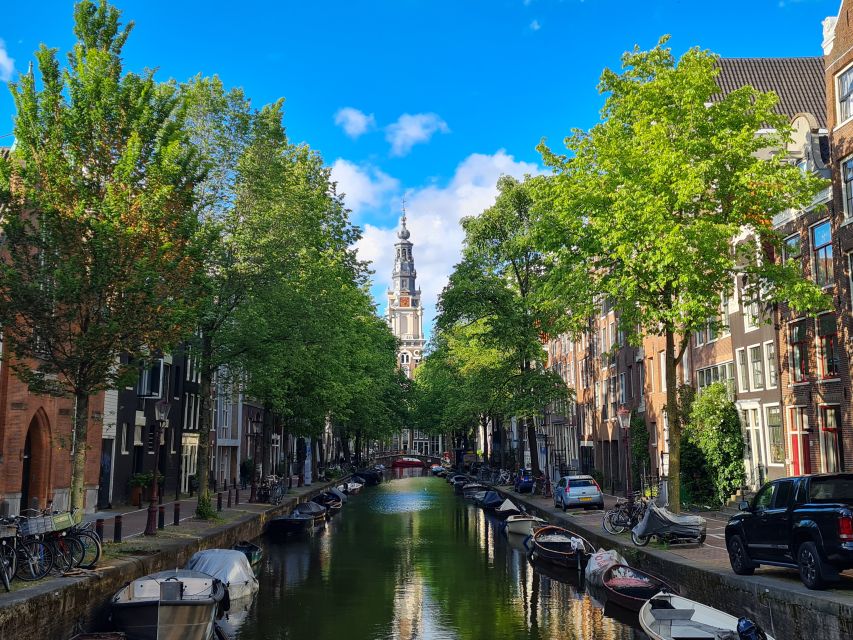
The ride then enters the canal district, the half-circle neighborhood wrapped around the old centre. On a map, the canal ring is easy to spot as a series of curved bands. From the pedicab, you get a broad look at how the system was planned and built.
The canal houses were once home to successful merchants. They are not identical, and their differences can reveal when they were built and how their owners wanted to present themselves. Bram points out common features and changes in style, helping you read the façades instead of simply passing them by.
This is where the pedicab has a practical advantage. It can take you along streets that are inaccessible to cars, giving you a closer view of the canal houses. You remain seated, so you can keep looking upward at the narrow façades, decorative details and varied rooflines without losing the group or falling behind.
The tradeoff is that you are not getting a long walk through the canal ring. If you enjoy stopping at every bridge, courtyard or architectural detail, you may want to return later on foot. Think of this tour as a strong overview that helps you choose where to spend more time.
Museumplein and the Rijksmuseum tunnel
The final major stop is Museumplein, a large 19th-century green square surrounded by some of the Netherlands’ most important museums. The Rijksmuseum and Van Gogh Museum are the big names here.
The pedicab passes through the Rijksmuseum tunnel and stops in the middle of Museumplein. That brief ride through the museum building is one of the route’s more memorable details. It also places you in a useful location for continuing your own sightseeing after the tour.
If you plan to visit either museum, this is a good way to finish because you can arrange to end there instead of returning to your hotel. You need to set that preferred ending point beforehand. If you are still jet-lagged or want a quiet return, hotel drop-off is included.
What the $230 price means
The $230 price covers a private group of up to two people for two hours. For a solo visitor, it is expensive. For two people, it works out to $115 each, and the value depends on how much you care about private guiding, reduced walking and hotel pickup.
You are not paying only for transport. The price includes an in-depth explanation of the sights, a local guide, a private vehicle and the chance to shape the conversation around your interests. Bram has also extended tours to three hours when guests wanted more time, though the advertised experience is two hours and any extension should be confirmed before booking.
I would compare this with the cost of a standard group tour and ask what you need. If your main goal is the cheapest possible overview, this is not the right choice. If two people want a relaxed introduction, have limited walking ability or prefer not to follow a fixed crowd, the higher price can make sense.
Hotel pickup and drop-off add real convenience, particularly on your first day. You need to wait outside in front of the hotel, and the exact ending point can be agreed in advance.
Comfort, weather and mobility
The pedicab is open to the weather, so warm clothing matters even in a season that looks mild on the calendar. A blanket is provided in cold conditions, and it has been useful on cool, rainy days.
You should also expect to sit for the full ride and get in and out for stops. The tour is a strong option for seniors and people with limited walking ability, but it is not completely step-free sightseeing.
The combined passenger weight limit is 200 kilograms. The activity information also says it is not suitable for people over 100 kilograms, or 220 pounds. Because those statements are not perfectly clear for two passengers, ask the provider to confirm the limit for your party before you reserve.
The pedicab can reach streets where cars cannot, but it still shares Amsterdam with bicycles and other traffic. Keep bags compact and follow Bram’s instructions when getting in or out.
Who will get the most from this ride
I would choose this for a first visit, especially if you want to understand Amsterdam before tackling its museums and neighborhoods on your own. The route covers a remarkable spread of the city in two hours, from medieval gates and old dikes to wartime memorials, canals and major museums.
It is also well suited to couples, older visitors and anyone who finds long walking tours tiring. The private setting gives you room to ask questions, request photo pauses and focus on subjects such as architecture, Jewish Amsterdam or the city’s wartime past.
It is less suitable if you want a slow food tour, museum admission or an evening ride focused on illuminated bridges. Food and drinks are not included, and the itinerary is primarily an exterior sightseeing experience.
Bram’s guiding style is a major part of the value. He speaks English, Dutch and German, and he uses visual aids such as old photographs and maps to show how Amsterdam evolved. That makes the tour more than a ride past attractive façades.
Should you book the Amsterdam pedicab tour?
Book it if you want a private, low-walking introduction to Amsterdam and are happy to pay for personal guiding. The route is broad, the historical coverage is unusually strong, and the pedicab gets you into parts of the city that are awkward for cars.
I would especially recommend it for two people arriving in Amsterdam for the first time, or for a couple who wants to see the main districts without spending the day on foot. Ask about the passenger-weight rule before booking, dress warmly and decide whether you want to finish at Museumplein or return to your hotel.
Skip it if budget is your main concern or if you prefer to spend two hours inside museums. For everyone else, this is a practical way to get your bearings, see the city’s major contrasts and start planning the rest of your Amsterdam visit.
FAQ
Where does the Amsterdam pedicab tour begin?
The tour begins at Dam Square, in the heart of Amsterdam’s old centre.
Is hotel pickup included?
Yes. Pickup and drop-off at your hotel are included. You should wait outside in front of the hotel.
How long does the pedicab tour last?
The advertised tour lasts two hours. A preferred ending location can be arranged in advance.
Is the tour private?
Yes. The pedicab is reserved for a private group of up to two people.
Which languages does the guide speak?
The live guide speaks English, Dutch and German.
What sights are included?
The route includes Dam Square, Zeedijk, Chinatown, New Market, Montelbaanstoren, the Jewish Quarter, the Big Synagogue, the Portuguese Synagogue, the Holocaust Names Monument, the Hermitage, the Skinny Bridge, the Amstel, the canal district and Museumplein.
Is a blanket provided in cold weather?
Yes. A blanket is provided in case of cold weather, but you should still bring warm clothing.
Is the tour suitable for people with limited walking ability?
The pedicab can reduce the amount of walking and is suitable for many people with limited walking ability. You still need to get in and out at stops, and the activity has passenger-weight restrictions.
Just added around Amsterdam
- Amsterdam: Giethoorn Tour with Canal Cruise and Windmills★ 5.0 · 3 reviews
- Full-day excursion to Edam, Volendam, and Marken★ 3.7 · 3 reviews
- Amsterdam: Chocolate Fondue in the Dark★ 5.0 · 3 reviews
- Amsterdam Private Walking Tour of Famous Painters★ 5.0 · 3 reviews
- Amsterdam Family Friendly Historical Walking Tour★ 5.0 · 3 reviews
- Amsterdam Old-West Vegan Food Tour with Local Guide★ 4.7 · 3 reviews
- From Amsterdam: visit Zaanse Schans, Muiderslot and more!★ 5.0 · 3 reviews
- Amsterdam: Beer Tasting with Paired Bites at Eighty-Four★ 5.0 · 3 reviews
Amsterdam Tours, compared.


Amsterdam Classic Saloon Boat Cruise with Drinks and Cheese
Read our review →
Amsterdam Luxury Canal Cruise + Unlimited Drinks & Bites option
Read our review →


Classic Boat Cruise with Optional Cheese & Wine
Read our review →
Evening Cruise with Optional Wine and Snacks
Read our review →
75 Minute City Canal Cruise with Audio Guide
Read our review →Browse the lists this tour appears in